

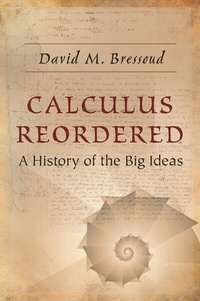
Calculus Reordered
A History of the Big Ideas
1st Edition
Published on 17. June 2019
242 pages
978-0-691-18916-1 (ISBN)
Description

How our understanding of calculus has evolved over more than three centuries, how this has shaped the way it is taught in the classroom, and why calculus pedagogy needs to change
Calculus Reordered takes readers on a remarkable journey through hundreds of years to tell the story of how calculus evolved into the subject we know today. David Bressoud explains why calculus is credited to seventeenth-century figures Isaac Newton and Gottfried Leibniz, and how its current structure is based on developments that arose in the nineteenth century. Bressoud argues that a pedagogy informed by the historical development of calculus represents a sounder way for students to learn this fascinating area of mathematics.
Delving into calculus's birth in the Hellenistic Eastern Mediterranean-particularly in Syracuse, Sicily and Alexandria, Egypt-as well as India and the Islamic Middle East, Bressoud considers how calculus developed in response to essential questions emerging from engineering and astronomy. He looks at how Newton and Leibniz built their work on a flurry of activity that occurred throughout Europe, and how Italian philosophers such as Galileo Galilei played a particularly important role. In describing calculus's evolution, Bressoud reveals problems with the standard ordering of its curriculum: limits, differentiation, integration, and series. He contends that the historical order-integration as accumulation, then differentiation as ratios of change, series as sequences of partial sums, and finally limits as they arise from the algebra of inequalities-makes more sense in the classroom environment.
Exploring the motivations behind calculus's discovery, Calculus Reordered highlights how this essential tool of mathematics came to be.
Calculus Reordered takes readers on a remarkable journey through hundreds of years to tell the story of how calculus evolved into the subject we know today. David Bressoud explains why calculus is credited to seventeenth-century figures Isaac Newton and Gottfried Leibniz, and how its current structure is based on developments that arose in the nineteenth century. Bressoud argues that a pedagogy informed by the historical development of calculus represents a sounder way for students to learn this fascinating area of mathematics.
Delving into calculus's birth in the Hellenistic Eastern Mediterranean-particularly in Syracuse, Sicily and Alexandria, Egypt-as well as India and the Islamic Middle East, Bressoud considers how calculus developed in response to essential questions emerging from engineering and astronomy. He looks at how Newton and Leibniz built their work on a flurry of activity that occurred throughout Europe, and how Italian philosophers such as Galileo Galilei played a particularly important role. In describing calculus's evolution, Bressoud reveals problems with the standard ordering of its curriculum: limits, differentiation, integration, and series. He contends that the historical order-integration as accumulation, then differentiation as ratios of change, series as sequences of partial sums, and finally limits as they arise from the algebra of inequalities-makes more sense in the classroom environment.
Exploring the motivations behind calculus's discovery, Calculus Reordered highlights how this essential tool of mathematics came to be.
More details
Other editions
Additional editions
Book
05/2021
Princeton University Press
€24.00
Shipment within 10-20 days
Book
07/2019
Princeton University Press
€43.33
Shipment within 10-20 days
Person
David M. Bressoud is DeWitt Wallace Professor of Mathematics at Macalester College and Director of the Conference Board of the Mathematical Sciences. His many books include Second Year Calculus and A Radical Approach to Lebesgue's Theory of Integration. He lives in St. Paul, Minnesota.
Content
- Cover
- Contents
- Preface
- Chapter 1. Accumulation
- 1.1. Archimedes and the Volume of the Sphere
- 1.2. The Area of the Circle and the Archimedean Principle
- 1.3. Islamic Contributions
- 1.4. The Binomial Theorem
- 1.5. Western Europe
- 1.6. Cavalieri and the Integral Formula
- 1.7. Fermat's Integral and Torricelli's Impossible Solid
- 1.8. Velocity and Distance
- 1.9. Isaac Beeckman
- 1.10. Galileo Galilei and the Problem of Celestial Motion
- 1.11. Solving the Problem of Celestial Motion
- 1.12. Kepler's Second Law
- 1.13. Newton's Principia
- Chapter 2. Ratios of Change
- 2.1. Interpolation
- 2.2. Napier and the Natural Logarithm
- 2.3. The Emergence of Algebra
- 2.4. Cartesian Geometry
- 2.5. Pierre de Fermat
- 2.6. Wallis's Arithmetic of Infinitesimals
- 2.7. Newton and the Fundamental Theorem
- 2.8. Leibniz and the Bernoullis
- 2.9. Functions and Differential Equations
- 2.10. The Vibrating String
- 2.11. The Power of Potentials
- 2.12. The Mathematics of Electricity and Magnetism
- Chapter 3. Sequences of Partial Sums
- 3.1. Series in the Seventeenth Century
- 3.2. Taylor Series
- 3.3. Euler's Influence
- 3.4. D'Alembert and the Problem of Convergence
- 3.5. Lagrange Remainder Theorem
- 3.6. Fourier's Series
- Chapter 4. The Algebra of Inequalities
- 4.1. Limits and Inequalities
- 4.2. Cauchy and the Language of ? and d
- 4.3. Completeness
- 4.4. Continuity
- 4.5. Uniform Convergence
- 4.6. Integration
- Chapter 5. Analysis
- 5.1. The Riemann Integral
- 5.2. Counterexamples to the Fundamental Theorem of Integral Calculus
- 5.3. Weierstrass and Elliptic Functions
- 5.4. Subsets of the Real Numbers
- 5.5. Twentieth-Century Postscript
- Appendix. Reflections on the Teaching of Calculus
- Teaching Integration as Accumulation
- Teaching Differentiation as Ratios of Change
- Teaching Series as Sequences of Partial Sums
- Teaching Limits as the Algebra of Inequalities
- The Last Word
- Notes
- Bibliography
- Index
- Image Credits
