

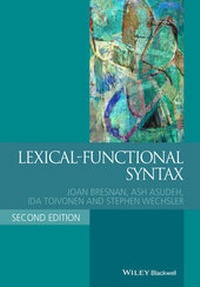
Lexical-Functional Syntax
Description

More details
Other editions
Additional editions
Persons
Content
Preface to the Second Edition xv
Acknowledgments xvii
I Motivation for the LFG Architecture 1
1 Nonconfigurationality 3
Further reading 10
2 Movement Paradoxes 11
2.1 Theoretical assumptions 15
Further reading and discussion 19
3 Lexicality and Argument Structure 21
3.1 Two approaches to passive relation changes 21
3.2 The lexicality of relation changes 23
3.2.1 English passive verb forms 24
3.2.2 Adjectives versus verbs 24
3.2.3 Participle-adjective conversion 25
3.2.4 Passive participles convert to adjectives 25
3.2.5 Differences between adjectival and verbal passives explained 27
3.2.6 Differences between adjectival and verbal passives unexplained 28
3.2.7 Conclusion: passivization is lexical 32
3.3 Passivization with and without movement 32
Further reading and discussion 36
II Formally Modeling the Architecture 39
4 A Formal Model of Syntactic Structure 41
4.1 Design principles 41
4.1.1 Principle I: variability 41
4.1.2 Principle II: universality 42
4.1.3 Principle III: monotonicity 43
4.2 The definition of f-structures 44
4.3 The description of f-structures 46
4.4 The correspondence between c- and f-structures 48
4.5 The solution algorithm 54
Problems 58
4.6 Defining versus constraining equations 59
4.7 Completeness and coherence 62
Problems 63
4.8 Functional uncertainty 63
4.9 Sets of f-structures 70
4.10 Conclusion 71
Further reading 72
5 Monotonicity and Some of Its Consequences 73
5.1 Monotonicity 73
5.2 Relation changes and monotonicity 76
5.3 Information and form 79
5.3.1 The fragmentability of language 79
5.3.2 The nonconfigurationality of language 82
5.3.3 Apparent information flow through external structure 83
5.3.4 Noncompositionality 84
5.4 Conclusion 85
III Inflectional Morphology and Phrase Structure Variation 87
6 A Theory of Structure-Function Mappings 89
6.1 Grammatical functions 94
6.1.1 Basics of grammatical functions 94
6.1.2 Classification of grammatical functions 100
6.2 The organization of c-structure categories 101
6.2.1 Endocentricity and X' structures 101
6.2.2 Endocentric mapping to f-structure 104
Problems 111
6.3 Exocentric categories 112
6.3.1 Lexocentricity and S 112
6.3.2 S and endocentricity 115
6.3.3 Nonprojecting words 116
6.3.4 Summary of the structure-function principles 117
6.4 Toward a typology 118
6.5 Effects of economy of expression 119
Further reading and discussion 124
Appendix: X' theory 125
7 Endocentricity and Heads 129
7.1 Head mobility 129
7.1.1 Verb order in Welsh 130
7.2 Endocentricity and extended heads 135
7.3 Distributed exponence 138
7.3.1 Wambaya c-structure 139
7.3.2 The Wambaya tense system 144
7.4 Conclusion 146
Problems 147
Exercise 147
8 Pronoun Incorporation and Agreement 151
8.1 Chichew^ a 157
8.1.1 Word order 161
8.1.2 Independent pronouns 162
8.1.3 Contrastive focus 164
8.1.4 Interrogatives and relatives 165
8.1.5 Other syntactic and phonological differences 166
8.1.6 Functional ambiguity of subject and topic 167
8.2 Navajo 171
Exercise 1 180
Exercise 2 180
8.3 Plains Cree and inverse agreement 182
Exercise 3 185
Problems 186
8.4 Two types of agreement: index and concord 186
Exercise 4 192
8.5 Conclusion 192
Further reading and discussion 193
9 Topicalization and Scrambling 196
9.1 English topicalization 196
9.2 Russian topicalization 199
9.3 Economy of expression 205
Problems 207
9.4 Topicalization versus scrambling 207
9.5 Detecting empty categories 210
Exercise 223
Further reading and discussion 223
The crossover effect 223
Two types of null pronominals 224
Generalization to operator complexes 225
Other factors 226
IV On Functional Structures: Binding, Predication, and Control 227
10 Basic Binding Theory 229
10.1 Basic concepts 229
10.2 A toy binding theory 231
10.3 Principle C 239
Further reading and discussion 246
10.4 Formalization of the binding constraints 247
11 Types of Bound Anaphors 254
11.1 Dimensions of anaphoric binding 254
11.2 Icelandic: subjective and anti-subjective pronouns 256
11.3 Norwegian: subjective/nuclear pronouns 259
11.4 Logophoricity versus subjectivity 261
Further reading and discussion 273
11.5 The typology of reflexives and the origins of nuclearity 275
Further reading and discussion 283
11.6 Formalization 284
12 Predication Relations 286
12.1 Predicate complements versus adjuncts 286
12.2 F-structures of xcomps 289
Exercise 1 295
Exercise 2 295
12.3 F-structure of PP complements 295
12.4 C-structure of predicate complements 301
12.5 Raising 304
Further reading and discussion 307
13 Anaphoric Control 309
13.1 Gerundive versus participial VPs in English 309
13.2 Structure of gerundive VPs 311
13.3 Anaphoric control versus functional control 319
13.4 Conclusion 323
Problems 323
Further reading and discussion 323
14 From Argument Structure to Functional Structure 324
14.1 What is argument structure? 326
14.2 The theory of a-structures 329
14.3 Mapping a-structures to syntactic functions 333
14.4 Examples and consequences 334
14.4.1 Unaccusatives 334
14.4.2 Resultatives 336
14.4.3 "Fake" reflexives and "nonsubcategorized objects" 336
14.4.4 Word order of internal/external arguments 337
14.4.5 Ditransitives 337
14.4.6 Interactions of passive and raising 340
14.4.7 Morphology that adds or suppresses a-structure roles 341
Problems 344
Further reading and discussion 344
Problem Sets and Solutions 349
Problem Set 1 351
Problem Set 2 354
Problem Set 3 370
Problem Set 4 375
Problem Set 5 391
Problem Set 6 417
Solutions to Selected Problems 436
References for the Problems 461
References 464
Language Index 501
Subject Index 503
1
Nonconfigurationality
One fundamental problem for the design of universal grammar is the great variability in modes of expression of languages. Languages differ radically in the ways in which they form similar ideas into words and phrases. The idea of two small children chasing a dog is expressed in English by means of a phrase structure in which conceptual components of the whole - the concept of the two small children and the concept of the dog being two such components - correspond to single phrases. Phrases are groups of contiguous words that are units for substitutions, remain together as units under stylistic permutations and paraphrases of a sentence, constrain the pronunciation patterns of sentences, and are subject to ordering constraints relative to other words and word groups. The (simplified) phrase structure of an English sentence is illustrated in (1):1
In this structure, the word combinations the two small children and that dog are noun phrases (NPs), in which the words cannot be separated, and there is also a verb phrase (VP). When the phrases are freely broken up, the result is ungrammatical or different in meaning:
The simple correspondence between conceptual units and grammatical phrases seems so natural to the English speaker as to appear a necessary feature of language itself - but it is not. Consider Warlpiri, a language of the people who have inhabited Australia since long before the colonization of that continent by English speakers.2 Example (3) shows the phrase structure of a Warlpiri sentence expressing the same idea as the English sentence (1).3 But in Warlpiri, every permutation of the words in the sentence is possible, with the same meaning, so long as the auxiliary (Aux) tense marker occurs in the second position. In particular, the word orders of all the bad English examples in (2) are good in Warlpiri.
It is not true that Warlpiri lacks phrases altogether: syntactic analysis has shown that some phrases (NPs but not VPs) do optionally occur, and there is evidence for a somewhat more articulated clause structure including a focus position to the left of Aux.4 What appears to the left of Aux may be a single word, as in (3), or a single multi-word NP, which then allows the nonfinal case-marker to be omitted, as in (4):
But crucially, the sole item appearing to the left of Aux cannot be a VP, nor is there any other evidence that VP is ever a phrasal constituent in Warlpiri.5 The subject of a Warlpiri sentence is not identified by its position in the phrase structure, as it is in English, but rather by the appearance of the ergative case marker -rlu. More generally, phrases are not essential to the expression of conceptual units. The coherence of a conceptual unit in Warlpiri is indicated by means of word shapes rather than word groups: noncontiguous words that form a conceptual unit must share the same formal endings - case and number morphology. In (3) the word for 'small' shares the dual and ergative endings -jarra and -rlu with the word for 'child' which it modifies, and these endings differ from those of the words for 'dog' and 'that', which are null. Thus the words kurdu-jarra-rlu ('child-DUAL-ERG') and wita-jarra-rlu ('small-DUAL-ERG') jointly express the concept of 'two small children' and jointly serve as subject of the sentence - regardless of whether those words appear together as a constituent (as in (4)) or not (as in (3)).
This difference between Warlpiri and English exemplifies a broad crosslinguistic generalization observed by many students of linguistic typology: across languages, there often appears to be an inverse relation between the amount of grammatical information expressed by word structure and the amount expressed by phrase structure. Words must appear in a sequence since they cannot be pronounced simultaneously, so the relative order of words is generally available as one means of expressing the grammatical relationships necessary for communication. But some languages lack the rich word structure found in languages such as Warlpiri. Thus languages rich in word structure (morphology) may make more or less use of fixed phrase structure forms (syntax), whereas languages poor in morphology overwhelmingly tend to have more rigid, hierarchical phrase structures. This trade-off between morphology and rigid phrase structure is spectacularly illustrated by some of the radically nonconfigurational languages of Australia, but there is evidence for it also in the other language types we will examine in Part III. We can summarize this generalization with the slogan "Morphology competes with syntax" for the job of expressing the grammatical relations between words.
The idea that words and phrases are alternative means of expressing the same grammatical relations underlies the design of LFG and distinguishes it from other formal syntactic frameworks. In addition, we cannot discount the effect of "configurational bias." Through historical accident, the resources of modern science and technology have been dominated by states whose national languages happen to be highly configurational. As a result, there has been a vast lack of knowledge of typological variation of language within the scientific establishment in computer science, logic, and philosophy - and even among many theoretical linguists of a formal bent.
Although Warlpiri lacks English-style phrase structure, and English lacks Warlpiri-style case and agreement forms of words, there is evidence that they have a common organization at a deeper level than is apparent from their differing modes of expression. Similar conceptual units are expressed by the two languages - objects and their relations and motions, events and their participants, and human emotions, actions, and aims. And at an appropriate level of abstraction, similar grammatical constraints emerge.6 For example, in English, a reflexive pronoun can be an object coreferring with the subject, but cannot be a subject coreferring with the object:
The same is true in Warlpiri:
This constraint holds in Warlpiri whether or not the subject is discontinuous. Indeed, this grammatical constraint on reflexive pronouns is shared by many languages (see Chapters 10 and 11 and references).
Thus, while phrase structure does not universally correspond to conceptual structure, the more abstract grammatical functions it expresses - such as subject and object - are widely shared by different languages. These grammatical functions represent classes of varying forms of expression that are equivalent under the correspondence mappings to argument structure (discussed below).
Here is the first choice point in the design of universal grammar: how to capture the abstraction of grammatical functions, such as subject and object, across the rather different means of expressing them? The overwhelmingly predominant tendency in modern linguistic theory - due to Chomsky - has been to define them as the familiar configurations of English phrase structure: the subject is an NP in configuration (7a), and the object is an NP in configuration (7b):
For a language like Warlpiri, this choice amounts to the claim that it does have English-style phrase structure after all - not on the surface, where conditions on word order hold, but at an underlying level of representation at which the grammatical conditions on reflexive pronouns hold.7 Let us refer to this as the configurational design of universal grammar. It is illustrated in (8)-(9):
Under the assumption of the configurational design of universal grammar, a reflexive pronoun must satisfy the following grammatical condition on the underlying level of structure: the reflexive must be contained in a constituent that contains the verb also but not the antecedent of that pronoun; that constituent is the VP. Using the graphic representation of the tree diagram, this means that the antecedent must be "higher" in the tree than the pronoun that it binds. Hence a subject can bind an object but an object cannot bind a subject, whether in English or Warlpiri, as we saw in (5) and (6). This is one approach to capturing the similarity between the two languages - but is it the right approach?
Now it might be true that all languages do have an abstract level of grammatical structure which closely matches the surface organization of the grammars of English and other European languages. (Perhaps it just happens that the biologically based universal design of grammar really does have the form of the language of the colonizers.) But there is no evidence of this; for example, none of the properties of phrases that we mentioned - contiguity under permutation, grouping for pronunciation, ordering relative to other elements, and substitutability - supports the existence of a VP in Warlpiri, and what evidence there is for phrases in Warlpiri shows clearly that there is no VP in our original sense (as discussed in the references previously mentioned: Simpson 1983a, 1991, 2007, Austin and Bresnan 1996, and Nordlinger 1998a). Moreover, there is evidence that the constraints on reflexive pronouns depend not directly on phrase structure configurations but on factors such as predication relations, which are at best only...
