

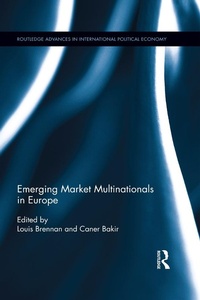
Emerging Market Multinationals in Europe
Published on 17. June 2016
232 pages
978-1-317-41767-5 (ISBN)
Description

This book makes a timely and highly stimulating contribution to the discourse on emerging-market multinationals, (EMNCs), as Foreign Direct Investment (FDI) in Europe from emerging countries (especially from the BRICs - Brazil, Russia, India, China) continues to grow in significance. Unsurprisingly, the emergence of EMNCs from emerging economies raises a wide range of challenges and opportunities for scholars, business professionals, and policymakers alike.
While explaining the sudden rise of these companies has become a major concern among scholars, we have very limited knowledge on drivers, motivations, strategies, and impact of these EMNCs in Europe and their policy implications. This volume provides fresh insights into EMNCs activities and their impact in Europe. The contributors argue that EMNCs combine various country specific advantages, existing firm-specific advantages (exploitation), and/or new FSAs (exploration) in their FDI, and that there is considerable heterogeneity across EMNCs, even those from the same southern economy.
Highlighting the importance of considering this divergent behaviour when implementing future European FDI policies, this book will be of interest to students and scholars of European Politics, International Political Economy, International Business and European Integration.
While explaining the sudden rise of these companies has become a major concern among scholars, we have very limited knowledge on drivers, motivations, strategies, and impact of these EMNCs in Europe and their policy implications. This volume provides fresh insights into EMNCs activities and their impact in Europe. The contributors argue that EMNCs combine various country specific advantages, existing firm-specific advantages (exploitation), and/or new FSAs (exploration) in their FDI, and that there is considerable heterogeneity across EMNCs, even those from the same southern economy.
Highlighting the importance of considering this divergent behaviour when implementing future European FDI policies, this book will be of interest to students and scholars of European Politics, International Political Economy, International Business and European Integration.
More details
Series
Language
English
Place of publication
London
United Kingdom
Publishing group
Taylor & Francis Ltd
Target group
College/higher education
Product notice
Reflowable
Illustrations
39 s/w Tabellen, 12 s/w Photographien bzw. Rasterbilder, 32 s/w Zeichnungen
39 Tables, black and white; 32 Line drawings, black and white; 12 Halftones, black and white
File size
6,02 MB
ISBN-13
978-1-317-41767-5 (9781317417675)
Copyright in bibliographic data and cover images is held by Nielsen Book Services Limited or by the publishers or by their respective licensors: all rights reserved.
Schweitzer Classification
Other editions
Additional editions
Louis Brennan | Caner Bakir
Emerging Market Multinationals in Europe
Book
06/2021
1st Edition
Routledge
€65.90
Shipment within 10-20 days
Louis Brennan | Caner Bakir
Emerging Market Multinationals in Europe
Book
07/2016
1st Edition
Routledge
€232.00
Shipment within 10-20 days
Persons
Louis Brennan is a Fellow of Trinity College and a Professor within the School of Business at Trinity College Dublin where he teaches International Business and Global and Operations Strategy. He was formerly Director of the Institute for International Integration Studies at Trinity College Dublin. Louis is the proposer and Chair of EU COST Action IS0905 which encompassed a 26 nation research network addressing the emergence of non-triad MNEs and their impact on Europe.
Caner Bakir is Associate Professor of Political Science, with a special focus on political economy and public policy at Koc University, Istanbul. Caner is Associate Editor of Policy Sciences and Co-director of Center for Globalisation, Peace and Democratic Governance. His work relates to comparative institutional analysis and policy change. His research interests include varieties of national financial systems, the political economy of central banking, financial regulation and governance, Turkish multinationals and economic bureaucracies.
Caner Bakir is Associate Professor of Political Science, with a special focus on political economy and public policy at Koc University, Istanbul. Caner is Associate Editor of Policy Sciences and Co-director of Center for Globalisation, Peace and Democratic Governance. His work relates to comparative institutional analysis and policy change. His research interests include varieties of national financial systems, the political economy of central banking, financial regulation and governance, Turkish multinationals and economic bureaucracies.
Content
Introduction
1. Introducing Emerging Market Multinationals in Europe
[Louis Brennan and Caner Bakir]
Characterizing and quantifying EMCs in Europe
2. Southern multinationals in Europe: An overview
[Filip De Beule and Andreja Jaklic]
3. TRACING EMERGING MARKET MNES AND FDI IN EUROPEAN COUNTRIES: DATA COVERAGE, DEFICIENCIES AND IMPLICATIONS
[Andreja Jaklic and Filip de Beule]
Drivers, motivations and strategies of emerging country multinationals
4. Drivers and motivations of emerging country multinationals (EMNEs) entry into the EU
[Dr Jagjit Singh Srai]
5. Motivations of EMNC-M&As in developed countries
M&A by EMNCs in developed countries: Motivation, success and implications
[Sebastian Weusthoff and Reinhard Meckl]
6. Emerging Multinational Companies from Russia: Drivers, Motivations and Strategies
[Dura Codru?a]
7 Turkish EMNCs' with Foreign Direct Investments into EU: Their Motivations, Degree of Internationalization and Company Performances
[Nuekhet VARDAR]
Country specific EMCs in Europe
8 Chinese investors in Europe Some idiosyncrasies
[Francoise Hay]
9. Greenfield Investments and Acquisitions of Turkish Multinationals: Trends, Motivations and Strategies
[Caner Bakir]
10. Indian firms in Europe: Main characteristics, competitive advantages and strategies
[Christian Milelli]
11 Collaborative innovation within Chinese MNCs' international networks. The role of cultural and institutional distances
[Stefano Elia and Lucia Piscitello]
Country and Industry Studies
12. Foreign direct investments: The BRIC countries and Norway
Foreign direct investments of the BRIC countries in Norway
[Per Heum and Armando J. Garcia Pires]
13. Network configurations in the white goods global value chain
[Michal Zdziarski, Jag Singh Srai and Rasha Rezk]
14. Central European Transition Economies' Multinationals - Are They Different From Third World Multinationals?
[Marjan Svetlicic]
15. Looking at Central European and BRIC FDI Through the Lens of Investment Development Path Theory
[Michal Zdziarski]
Conclusion
16. Emerging Market Multinationals in Europe - What have we learnt?
[Caner Bakir and Louis Brennan]
1. Introducing Emerging Market Multinationals in Europe
[Louis Brennan and Caner Bakir]
Characterizing and quantifying EMCs in Europe
2. Southern multinationals in Europe: An overview
[Filip De Beule and Andreja Jaklic]
3. TRACING EMERGING MARKET MNES AND FDI IN EUROPEAN COUNTRIES: DATA COVERAGE, DEFICIENCIES AND IMPLICATIONS
[Andreja Jaklic and Filip de Beule]
Drivers, motivations and strategies of emerging country multinationals
4. Drivers and motivations of emerging country multinationals (EMNEs) entry into the EU
[Dr Jagjit Singh Srai]
5. Motivations of EMNC-M&As in developed countries
M&A by EMNCs in developed countries: Motivation, success and implications
[Sebastian Weusthoff and Reinhard Meckl]
6. Emerging Multinational Companies from Russia: Drivers, Motivations and Strategies
[Dura Codru?a]
7 Turkish EMNCs' with Foreign Direct Investments into EU: Their Motivations, Degree of Internationalization and Company Performances
[Nuekhet VARDAR]
Country specific EMCs in Europe
8 Chinese investors in Europe Some idiosyncrasies
[Francoise Hay]
9. Greenfield Investments and Acquisitions of Turkish Multinationals: Trends, Motivations and Strategies
[Caner Bakir]
10. Indian firms in Europe: Main characteristics, competitive advantages and strategies
[Christian Milelli]
11 Collaborative innovation within Chinese MNCs' international networks. The role of cultural and institutional distances
[Stefano Elia and Lucia Piscitello]
Country and Industry Studies
12. Foreign direct investments: The BRIC countries and Norway
Foreign direct investments of the BRIC countries in Norway
[Per Heum and Armando J. Garcia Pires]
13. Network configurations in the white goods global value chain
[Michal Zdziarski, Jag Singh Srai and Rasha Rezk]
14. Central European Transition Economies' Multinationals - Are They Different From Third World Multinationals?
[Marjan Svetlicic]
15. Looking at Central European and BRIC FDI Through the Lens of Investment Development Path Theory
[Michal Zdziarski]
Conclusion
16. Emerging Market Multinationals in Europe - What have we learnt?
[Caner Bakir and Louis Brennan]
