

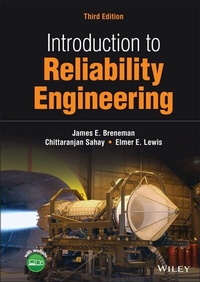
Introduction to Reliability Engineering
Description

A complete revision of the classic text on reliability engineering, written by an expanded author team with increased industry perspective
Introduction to Reliability Engineering provides a thorough and well-balanced overview of the fundamental aspects of reliability engineering and describes the role of probability and statistical analysis in predicting and evaluating reliability in a range of engineering applications. Covering both foundational theory and real-world practice, this classic textbook helps students of any engineering discipline understand key probability concepts, random variables and their use in reliability, Weibull analysis, system safety analysis, reliability and environmental stress testing, redundancy, failure interactions, and more.
Extensively revised to meet the needs of today's students, the Third Edition fully reflects current industrial practices and provides a wealth of new examples and problems that now require the use of statistical software for both simulation and analysis of data. A brand-new chapter examines Failure Modes and Effects Analysis (FMEA) and the Reliability Testing chapter has been greatly expanded, while new and expanded sections cover topics such as applied probability, probability plotting with software, the Monte Carlo simulation, and reliability and safety risk. Throughout the text, increased emphasis is placed on the Weibull distribution and its use in reliability engineering. Presenting
students with an interdisciplinary perspective on reliability engineering, this textbook:
* Presents a clear and accessible introduction to reliability engineering that assumes no prior background knowledge of statistics and probability
* Teaches students how to solve problems involving reliability data analysis using software including Minitab and Excel
* Features new and updated examples, exercises, and problems sets drawn from a variety of engineering fields
* Includes several useful appendices, worked examples, answers to selected exercises, and a companion website
Introduction to Reliability Engineering, Third Edition remains the perfect textbook for both advanced undergraduate and graduate students in all areas of engineering and manufacturing technology.
More details
Other editions
Additional editions
Persons
James E. Breneman established and headed the Engineering Technical University at Pratt and Whitney, which provided more than 450,000 hours of instruction to employees during his tenure. Now retired, Breneman has taught many public course offerings for the ASQ Reliability & Risk Division. In 2018 he was awarded the Eugene L. Grant Medal for outstanding leadership in educational programs in quality.
Chittaranjan Sahay holds the Vernon D. Roosa Distinguished Professor Chair in Manufacturing and Professorship in Mechanical Engineering at the University of Hartford, where he has held various offices including Associate Dean and Director of the Graduate Programs of the College of Engineering, Technology, and Architecture, and Chairman of the Mechanical Engineering Department.
Elmer E. Lewis is Professor of Mechanical Engineering at Northwestern University's McCormick School of Engineering and Applied Science. He has held appointments as Visiting Professor at the University of Stuttgart and as Guest Scientist at the Nuclear Research Center at Karlsruhe, Germany. He has been a frequent consultant to Argonne and Los Alamos National Laboratories as well as a number of industrial firms.
Content
1 INTRODUCTION
1.1 Reliability Defined
1.2 Performance, Cost and Reliability
1.3 Quality, Reliability and Safety Linkage
1.4 Quality, Reliability and Safety Engineering Tasks
1.5 Preview
2 PROBABILITY AND DISCRETE DISTRIBUTIONS
2.1 Introduction
2.2 Probability Concepts
Sample Space
Outcome
Event
Probability Axioms
More than two events
Combinations and Permutations
2.3 Discrete Random Variables
Properties of Discrete Variables
The Binomial Distribution
The Poisson Distribution
Confidence Intervals
Motivation for Confidence Intervals
Introduction to Confidence Intervals
Binomial Confidence Intervals
Cumulative sums of the Poisson Distribution (Thorndike Chart)
3 Exponential Distribution and Reliability Basics
3.1 Introduction
3.2 Reliability Characterization
Basic definitions
The Bathtub curve
3.3 Constant Failure Rate model
The Exponential Distribution
Demand failures
Time determinations
3.4 Time Dependent Failure rates
3.5 Component Failures and Failure Modes
Failure mode rates
Component counts
3.6 Replacements
3.7 Redundancy
Active and Standby Redundancy
Active Parallel
Standby Parallel
Constant Failure Rate Models
3.8 Redundancy limitations
Common-mode failures
Load sharing
Switching & Standby failures
Cool, Warm and Hot Standby
3.9 Multiply Redundant Systems
1/N Active Redundancy
1/N Standby Redundancy
m/N Active Redundancy
3.10 Redundancy Allocation
High and Low level redundancy
Fail-safe and Fail-to-Danger
Voting Systems
3.11 Redundancy in Complex Configurations
Serial-Parallel configurations
Linked configurations
4 Continuous Distributions- Part 1 Normal & Related Distributions
4.1 Introduction
4.2 Properties of Continuous Random variables
Probability Distribution Functions
Characteristics of a Probability Distribution
Sample Statistics
Transformation of Variables
4.3 Empirical Cumulative Distribution Function
4.4 Uniform Distribution
4.5 Normal and Related Distributions
The Normal Distribution
Central Limit Theorem
The Central Limit Theorem in Practice
The Log Normal Distribution
Log Normal Distribution from a Physics of Failure Perspective
4.6 Confidence Intervals
Point & Interval Estimates
Estimate of the Mean
Normal & Lognormal parameters
5 Continuous Distributions- Part 2 Weibull & Extreme Value Distributions
5.1 Introduction
The "weakest link" theory from a Physics of Failure point of view
Uses of Weibull and Extreme Value Distributions
Other Considerations
Age parameters and sample sizes
Engineering Changes, Maintenance Plan Evaluation and Risk Prediction
Weibulls with cusps or curves
System Weibulls
No failure Weibulls
Small sample Weibulls
5.2 Statistics of the Weibull Distribution
Weibull "Mathematics"
The Weibull Probability Plot
Probability Plotting Points-Median Ranks
How to do a "Weibull Analysis"
Weibull plots and their estimates of b, h
The 3-Parameter Weibull didn't work, what are my choices?
The data has a "dogleg" bend or cusp when plotted on Weibull paper.
Steep Weibull slopes (ß's) may hide problems.
Low Time Failures and close Serial numbers---Batch problems
Maximum Likelihood Estimates of ß and ¿
Weibayes Analysis
Weibayes background
Weibull Analysis with failure times only and unknown times on remaining population
Shifting Weibull Procedure
Confidence bounds and the Weibull Distribution
Arbitrary Censored Data
The Weibull Distribution in a System of Independent failure modes
5.3 Extreme Value Distributions
Smallest & Largest Extreme Value distributions
Extreme Value and Weibull Distribution Point Estimates & Confidence Intervals
5.4 Introduction to Risk analysis
Risk Analysis "Mathematics"
Supplement 1- Weibull derived from weakest link theory
Supplement 2: Comparing two distributions using Supersmith(TM)
6 RELIABILITY TESTING
6.1 Introduction
6.2 Attribute Testing (Binomial Testing)
The Classical Success Run
Zero Failure Attribute Tests
Non-ZERO Failure Attribute Tests
6.3 Constant Failure Rate Estimates
Censoring on the Right
MTTF Estimates
Confidence Intervals
6.4 Weibull Substantiation and Reliability Testing
Zero-Failure Test Plans for Substantiation Testing
Weibull Zero-Failure test Plans for Reliability Testing
Designing the Test Plan
Total Test Time
Why not Simply Test to Failure?
6.5 How to Reduce Test Time
Run (simultaneously) more test samples than you intend to fail
Sudden Death Testing
Sequential Testing
6.6 Normal & Lognormal Reliability Testing
6.7 Accelerated Life Testing
Compressed Time Testing
Advanced Stress Testing-Linear & Acceleration Models
Linear Model Stress testing
Advanced Stress Testing - Acceleration Models
The Arrhenius Model
The Inverse Power Law Model
Other Acceleration Models
6.8 Reliability Enhancement Procedures
Reliability Growth Modeling & Testing
Calculation of Reliability Growth parameters
Goodness of Fit tests for Reliability Growth Models
Environmental Stress Screening
What "Screens" are used for ESS?
Thermal cycling
Random Vibration
Other Screens
Highly Accelerated Life Tests
Highly Accelerated Stress Screening
Supplement 1 Substantiation Testing: Characteristic Life multipliers for Zero failure Test at 80%, 90%, 95%, 99% Confidence
Supplement 2 Substantiation Testing Tables for Zero failure Test at 80%, 90%, 95%, 99% Confidence
Supplement 3 CRITICAL VALUES FOR CRAMER-VON MISES GOODNESS-OF-FIT TEST
Supplement 4 Other Reliability Growth Models
Supplement 5 Chi-Square Table
7 Failure Modes & Effects Analysis (FMEA) - Design & Process
7.1 Introduction
7.2 Functional FMEA
7.3 Design FMEA
Design FMEA Procedure
7.4 Process FMEA(PFMEA)
7.5 FMEA Summary
FMEA Outputs
FMEA Pitfalls that can be prevented
Supplement 1 Shortcut tables for stalled FMEA Teams
Supplement 2 Future changes in FMEA Approaches
Supplement 3 DFMEA and PFMEA Forms
8 LOADS, CAPACITY, AND RELIABILITY
8.1 Introduction
8.2 Reliability with a Single Loading
Load Application
Definitions
8.3 Reliability and Safety Factors
Normal Distributions
Lognormal Distributions
Combined Distributions
8.4 Repetitive Loading
Loading Variability
Variable Capacity
8.5 The Bathtub Curve-Reconsidered
Single Failure Modes
Combined Failure Modes
Supplement 1: The Dirac Delta Distribution
9 MAINTAINED SYSTEMS
9.1 Introduction
9.2 Preventive Maintenance
Idealized Maintenance
Imperfect Maintenance
Redundant Components
9.3 Corrective Maintenance
Availability
Maintainability
9.4 Repair: Revealed Failures
Constant Repair Rates
Constant Repair Times
9.5 Testing and Repair: Unrevealed Failures
Idealized Periodic Tests
Real Periodic Tests
9.6 System Availability
Revealed Failures
Unrevealed Failures
10 FAILURE INTERACTIONS
10.1 Introduction
10.2 Markov Analysis
Two Independent Components
Load-Sharing Systems
10.3 Reliability with Standby Systems
Idealized System
Failures in the Standby State
Switching Failures
Primary System Repair
10.4 Multicomponent Systems
Multicomponent Markov Formulations
Combinations of Subsystems
10.5 Availability
Standby Redundancy
Shared Repair Crews
Markov Availability-Advantages & Disadvantages
11 SYSTEM SAFETY ANALYSIS
11.1 Introduction
11.2 Product and Equipment Hazards
11.3 Human Error
Routine Operations
Emergency Operations
11.4 Methods of Analysis
Failure Modes Effects and Criticality Analysis (FMECA)
Event Trees
11.5 Fault Trees
Fault-Tree Construction
Nomenclature
Fault Classification
Fault Tree Examples
Direct Evaluation of Fault Trees
Qualitative Evaluation
Quantitative Evaluation
Fault-Tree Evaluation by Cut Sets
Qualitative Analysis
Quantitative Analysis
11.6 Reliability/Safety Risk Analysis
APPENDICES
A USEFUL MATHEMATICAL RELATIONSHIPS
B BINOMIAL CONFIDENCE CHARTS
C STANDARD NORMAL CDF
D NONPARAMETRIC METHODS AND PROBABILITY PLOTTING
D1 Introduction
D2 Nonparametric Methods for Probability Plotting
D3 Parametric Methods
D4 Goodness-of-Fit
Supplement 1 Further Details of Weibull Probability plotting
Supplement 2 Median Rank adjustment for SUSPENDED TEST ITEMS
Supplement 3 Generating a Probability Plot in MINITAB
ANSWERS TO ODD-NUMBERED EXERCISES
INDEX
1
Introduction
"When an engineer, following the safety regulations of the Coast Guard or the Federal Aviation Agency, translates the laws of physics into the specifications of a steamboat boiler or the design of a jet airliner, he is mixing science with a great many other considerations all relating to the purposes to be served. And it is always purposes in the plural - a series of compromises of various considerations, such as speed, safety economy and so on."
Source: D. K Price, The Scientific Estate, 1968
1.1 Reliability Defined
The world demands that the performance of products and systems be improved while at the same time reducing their cost. The requirement to minimize the probability of failures, whether those failures simply increase costs and irritation or gravely threaten the public safety, has placed increased emphasis on reliability and safety. The formal body of knowledge that has been developed for analyzing such failures and minimizing their occurrence cuts across virtually all engineering disciplines, providing the rich variety of contexts in which reliability considerations appear. Indeed, deeper insight into failures and their prevention is to be gained by comparing and contrasting the reliability characteristics of systems of differing characteristics: computers, electromechanical machinery, energy conversion systems, chemical and materials processing plants, and structures, to name a few.
In the broadest sense, reliability is associated with dependability, with successful operation, and with the absence of breakdowns or failures. It is necessary for engineering analysis, however, to define reliability quantitatively as a probability.
Thus, reliability is defined as the probability that a system will perform its intended function for a specified period of time under a given set of conditions. System is used here in a generic sense so that the definition of reliability is also applicable to all varieties of products, subsystems, equipment, components, and parts.
A product or system is said to fail when it ceases to perform its intended function. When there is a total cessation of function - an engine stops running, a structure collapses, a piece of communication equipment goes dead - the system has clearly failed. Often, however, it is necessary to define failure quantitatively in order to take into account the more subtle forms of failure, through deterioration or instability of function. Thus, a motor that is no longer capable of delivering a specified torque, a structure that exceeds a specified deflection, a part that is seriously corroded or eroded (yet still working), or an amplifier that falls below a stipulated gain has failed. Intermittent operation or excessive drift in electronic equipment and the machine tool production of out-of-tolerance parts may also be defined as failures.
The way in which time is specified in the definition of reliability may also vary considerably, depending on the nature of the system under consideration. For example, in an intermittently operated system one must specify whether calendar time or the number of hours of operation is to be used. If the operation is cyclic, such as that of a switch, time is likely to be cast in terms of the number of operations. Some subsystems of the same system (e.g. jet engine) may have different time criteria that drives their failure. If reliability is to be specified in terms of calendar time, it may also be necessary to specify the frequency of starts and stops and the ratio of operating to total time.
In addition to reliability itself, other quantities are used to characterize the reliability of a system. The mean time to failure and failure rate are examples, and in the case of repairable systems, so also are the availability and mean time to repair. The definition of these and other terms will be introduced as needed.
1.2 Performance, Cost, and Reliability
Much of engineering endeavor is concerned with designing and building products for improved performance. We strive for lighter and therefore faster aircraft, for thermodynamically more efficient energy conversion devices, for faster computers, and for larger, longer lasting structures. The pursuit of such objectives, however, often requires designs incorporating features that more often than not may tend to be less reliable than older, lower performance systems, at least initially when the customer receives them. The trade-offs between performance, reliability, and cost are often subtle, involving loading, system complexity, and the employment of new materials and concepts.
Load is most often used in the mechanical sense of the stress on a structure. But here we interpret it more generally so that it also may be the thermal load caused by high temperature, the electrical load on a generator, or even the information load on a telecommunications system. Whatever the nature of the load on a system or its components may be, performance is frequently improved through increased loading. Thus, by increasing the weight of an aircraft, we increase the stress levels in its structure; by going to higher - thermodynamically more efficient - temperatures we are forced to operate materials under conditions in which there are heat-induced losses of strength and more rapid corrosion/erosion. By allowing for ever-increasing flows of information in communications systems, we approach the frequency limits at which switching or other digital circuits may operate.
As the physical limits of systems or their components are approached in order to improve performance, the number of failures increase unless appropriate countermeasures are taken. Thus, specifications for a purer material, tighter dimensional tolerance, and a host of other measures are required to reduce uncertainty in the performance limits and thereby permit one to operate close to those limits without incurring an unacceptable probability of exceeding them (i.e. failure). But in the process of doing so, the cost of the system is likely to increase. Even then, adverse environmental conditions, product deterioration, and manufacturing flaws all lead to higher failure probabilities in systems operating near their limit loads.
System performance may often be increased at the expense of increased complexity, the complexity usually being measured by the number of required components or parts. Once again, reliability will be decreased unless compensating measures are taken, for it may be shown that if nothing else is changed, reliability decreases with each added component. In these situations, reliability can only be maintained if component reliability is increased or if component redundancy is built into the system. But each of these remedies, in turn, must be measured against the incurred costs.
Probably the greatest improvements in performance have come through the introduction of entirely new technologies. For, in contrast to the trade-offs faced with increased loading or complexity, more fundamental advances may have the potential for both improved performance and greater reliability. Certainly, the history of technology is a study of such advances; the replacement of wood by metals in machinery and structures, the replacement of piston with jet aircraft engines, and the replacement of vacuum tubes with solid-state electronics all led to fundamental advances in both performance and reliability while costs were reduced. Any product in which these trade-offs are overcome with increased performance and reliability, without a commensurate cost increase, constitutes a significant technological advance.
With any major advance, however, reliability may be diminished, particularly in the early stages of the introduction of new technology. The engineering community must proceed through a learning experience to reduce the uncertainties in the limits in loading on the new product, to understand its susceptibilities to adverse environments, to predict deterioration with age, and to perfect the procedures for fabrication, manufacture, and construction. Thus, in the transition from wood to iron, the problem of dry rot was eliminated, but failure modes associated with brittle fracture had to be understood. In replacing vacuum tubes with solid-state electronics the ramifications of reliability loss with increasing ambient temperature and vibration had to be appreciated.
Whether in the implementation of new concepts or in the application of existing technologies, the way trade-offs are made between reliability, performance and cost, and the criteria on which they are based is deeply imbedded in the essence of engineering practice, for the considerations and criteria are as varied as the uses to which technology is put. The following examples illustrate this point.
- Consider an air conditioner. What is the worst that can happen if it quits? The customer is warm. So, when developing air conditioners, safety is not paramount, reliability is considered, but cost is "king." Hence, copper tubing for A/C units has given way to aluminum. Plastics for metal wherever possible for weight saving, less testing, and lower confidence levels in the testing are used.
- At the opposite extreme is the design of a commercial airliner, where mechanical breakdown could well result in a catastrophic accident. In this case, reliability is the overriding design consideration; degraded speed, payload, and fuel economy are accepted in order to maintain a very small probability of catastrophic failure. An intermediate example might be in the design...
