

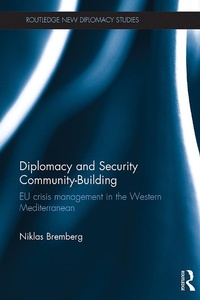
Diplomacy and Security Community-Building
EU Crisis Management in the Western Mediterranean
Published on 16. September 2015
200 pages
978-1-317-40663-1 (ISBN)
Description

This book contributes to the ongoing debate in IR on the role of security communities and formulates a new mechanism-based analytical framework.
It argues that the question we need to ask is how security communities work at a time when armed conflicts among states have become significantly less frequent compared to other non-military threats and trans-boundary risks (e.g. terrorism and the adverse effects of climate change). Drawing upon recent advances in practice theory, the book suggests that the emergence and spread of cooperative security practices, ranging from multilateral diplomacy to crisis management, are as important for understanding how security communities work as more traditional confidence-building measures.
Using the EU, Spain and Morocco as an in-depth case study, this volume reveals that through the institutionalization of multilateral venues, the EU has provided cooperative frameworks that otherwise would not have been available, and that the de-territorialized notion of security threats has created a new rationale for practical cooperation between Spanish and Moroccan diplomats, armed forces and civilian authorities. Within the broader context, this book provides a mechanism-based framework for studying regional organizations as security community-building institutions, and by utilizing that framework it shows how practice theory can be applied in empirical research to generate novel and thought-provoking results of relevance for the broader field of IR.
This book will be of much interest to students of multilateral diplomacy, European Politics, foreign policy, security studies and IR in general.
It argues that the question we need to ask is how security communities work at a time when armed conflicts among states have become significantly less frequent compared to other non-military threats and trans-boundary risks (e.g. terrorism and the adverse effects of climate change). Drawing upon recent advances in practice theory, the book suggests that the emergence and spread of cooperative security practices, ranging from multilateral diplomacy to crisis management, are as important for understanding how security communities work as more traditional confidence-building measures.
Using the EU, Spain and Morocco as an in-depth case study, this volume reveals that through the institutionalization of multilateral venues, the EU has provided cooperative frameworks that otherwise would not have been available, and that the de-territorialized notion of security threats has created a new rationale for practical cooperation between Spanish and Moroccan diplomats, armed forces and civilian authorities. Within the broader context, this book provides a mechanism-based framework for studying regional organizations as security community-building institutions, and by utilizing that framework it shows how practice theory can be applied in empirical research to generate novel and thought-provoking results of relevance for the broader field of IR.
This book will be of much interest to students of multilateral diplomacy, European Politics, foreign policy, security studies and IR in general.
Reviews / Votes
'This timely book tackles the crucial issue of European security in the neighbourhood with analytical sophistication, originality and a wealth of empirical material. A must read for anybody interested in practice approaches, security, European foreign policy and the future of the Mediterranean.' -- Federica Bicchi, London School of Economics, UK'Niklas Bremberg's fascinating book breaks new ground in the study of the European Union in security community-building by arguing that the EU's enlargement process creates a dynamic relationship between community-building and boundary-building. The book's unique contribution is its rich, detailed study of the post-Cold War evolution of Spanish-Moroccan diplomatic relations within the context of a highly-original use of practice theory in the EU's crisis management in the Western Mediterranean.' -- Ian Manners, University of Copenhagen, Denmark
More details
Series
Language
English
Place of publication
London
United Kingdom
Publishing group
Taylor & Francis Ltd
Target group
College/higher education
Professional and scholarly
Product notice
Reflowable
Illustrations
6 s/w Tabellen, 6 s/w Zeichnungen
6 Tables, black and white; 6 Line drawings, black and white
File size
1,70 MB
ISBN-13
978-1-317-40663-1 (9781317406631)
Copyright in bibliographic data and cover images is held by Nielsen Book Services Limited or by the publishers or by their respective licensors: all rights reserved.
Schweitzer Classification
Other editions
Additional editions
Niklas Bremberg
Diplomacy and Security Community-Building
EU Crisis Management in the Western Mediterranean
Book
10/2015
1st Edition
Routledge
€145.30
Shipment within 10-20 days
Person
Niklas Bremberg is a Research Fellow at the Swedish Institute of International Affairs, Stockholm, and has a Ph.D. in political science from Stockholm University.
Content
1. Introduction 2. Institutionalization of Multilateral Venues between the EU, Spain and Morocco 3. Practicing Cooperative Security beyond the EU 4. A Euro-Mediterranean Civil Protection Community in the Making 5. Conclusions: Re-Thinking Security Communities in the Post-Cold War Era
