

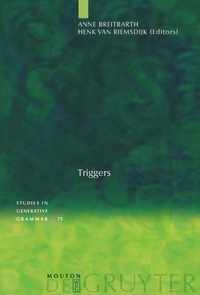
Triggers
Description

The concept of 'trigger' is a core concept of Chomsky's Minimalist Program. The idea that certain types of movement are triggered by some property of the target position is at least as old as the notion that the movement of noun phrases to the subject position is triggered by their need to receive nominative case. In more recent versions of syntactic theory, triggering mechanisms are thought to regulate all of movement. Furthermore, a quite narrow range of triggering mechanisms is permitted. As is to be expected, such a restrictive approach meets a variety of difficulties. Specifically, the question is whether all triggering elements required to cover displacement of all kinds in natural language can be independently motivated. Further, how can a trigger theory, which crucially relies on the idea that all movement is obligatory, deal with apparently optional movement processes? Are features an adequate means to express the triggering function in all cases? More radically, are all movement phenomena really the result of the checking of trigger features? And what about apparent triggering factors that are 'external' to syntax such as prosody - can they be captured in a rigid trigger theory? In other words, could certain aspects of triggered movement be due to interface conditions? Such is the range of questions addressed by the fourteen contributions to this book. They cover a considerable range of languages (including Afrikaans, Breton, Bulgarian, Dutch, English, French, German, Gungbe, Hungarian, Italian, Japanese, Kiswahili, Romanian). These papers present materials, both empirical and theoretical, that will not fail to have considerable impact on the further development of the concept of trigger in syntactic theory.
More details
Other editions
Additional editions
Persons
Content
- Frontmatter
- Contents
- The Role of Triggers in Linguistic Theory: Some Introductory Remarks
- Snowballing Movement and Generalized Pied-piping
- Optionality at the Interface: Triggering Focus in Romanian
- How N-words Move: Bipartite Negation and 'Split-NegP'
- The Agreement Parameter
- Some Notes on Emphatic Forms and Displacement in Dutch
- Scrambling, Optionality and Non-Lexical Triggers
- Phonological Content and Syntactic Visibility
- On Triggers of Movement and Effects at the Interfaces
- Scope Marking Constructions in Dayal-type Indirect Dependency
- Hyperbaton and Haplology
- On Scrambling as Defocusing in German and West Germanic
- Linear Compression as a Trigger for Movement
- A Case for Head Movement at PF: SAI in Comparatives
- The EPP in Breton: An Unvalued Categorial Feature
- Backmatter
