

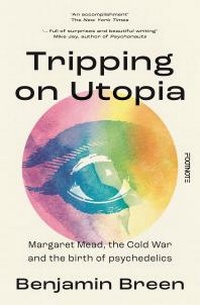
Tripping on Utopia
Margaret Mead, The Cold War and the Birth of Psychedelics
Published on 25. April 2024
384 pages
978-1-80444-110-7 (ISBN)
Description

'It was not the Baby Boomers who ushered in the first era of widespread drug experimentation. It was their parents.'
The generation that survived the second World War emerged with a profoundly ambitious sense of social experimentation. In the '40s and '50s, transformative drugs rapidly entered mainstream culture, where they were not only legal, but openly celebrated. American physician John C. Lilly infamously dosed dolphins (and himself) with LSD in a NASA-funded effort to teach dolphins to talk. A tripping Cary Grant mumbled into a Dictaphone about Hegel as astronaut John Glenn returned to Earth.
At the centre of this revolution were the pioneering anthropologists - and star-crossed lovers - Margaret Mead and Gregory Bateson. Convinced the world was headed toward certain disaster, Mead and Bateson made it their life's mission to reshape humanity through a new science of consciousness expansion, but soon found themselves at odds with the government bodies who funded their work, whose intentions were less than pure. Mead and Bateson's partnership unlocks an untold chapter in the history of the twentieth century, linking drug researchers with CIA agents, outsider sexologists and the founders of the Information Age.
The generation that survived the second World War emerged with a profoundly ambitious sense of social experimentation. In the '40s and '50s, transformative drugs rapidly entered mainstream culture, where they were not only legal, but openly celebrated. American physician John C. Lilly infamously dosed dolphins (and himself) with LSD in a NASA-funded effort to teach dolphins to talk. A tripping Cary Grant mumbled into a Dictaphone about Hegel as astronaut John Glenn returned to Earth.
At the centre of this revolution were the pioneering anthropologists - and star-crossed lovers - Margaret Mead and Gregory Bateson. Convinced the world was headed toward certain disaster, Mead and Bateson made it their life's mission to reshape humanity through a new science of consciousness expansion, but soon found themselves at odds with the government bodies who funded their work, whose intentions were less than pure. Mead and Bateson's partnership unlocks an untold chapter in the history of the twentieth century, linking drug researchers with CIA agents, outsider sexologists and the founders of the Information Age.
More details
Person
Benjamin Breen
Content
- Intro
- Half Title
- Title Page
- Copyright
- Dedication
- Epigraph
- Contents
- Maps
- Prologue: The Future That Never Arrived
- Part I. The Pattern (1923-49)
- 1. Prophet of the Long Future (1923-30)
- 2. Society Is the Patient (1930-33)
- 3. Artificial Paradises (1933-39)
- 4. "A Respectable Word for Hypnosis" (1939-43)
- 5. The Office of Strategic Services (1943-44)
- 6. Operation Bittersweet (1944-45)
- 7. "A Not Unpleasant, Intoxicated-Like Condition" (1945-46)
- 8. Deviants Like Myself (1946-48)
- 9. "The Scientist Is Not Outside" (1948-49)
- Part II. The Project (1949-59)
- 10. Lights Coming on in White Rooms (1949)
- 11. The Psychedelic Cold War (1950-51)
- 12. "Narcosynthesis Is Not Very Difficult" (1951-52)
- 13. The Telephone at the End of the World (1952-53)
- 14. Nembutal and Siamese Fighting Fish (Late 1953)
- 15. The LSD Sessions (1954)
- 16. Gadabout (1954-55)
- 17. The Learys and the Batesons (1955-57)
- 18. Out of the Lab (1957-59)
- Part III. The Noise (1959-80)
- 19. The Fine Line (1959-60)
- 20. Anthropologists from the Twenty-First Century (1960-61)
- 21. Planes of Fracture (1961-62)
- 22. The Deep End of the Pool (1963)
- 23. Carl Sagan at the Dolphin Lab (1963-65)
- 24. Dialectics of Liberation (1965-68)
- 25. "If Someone Throws Away the Box, Then What?" (1968-71)
- 26. Esalen Sunset (1971-77)
- 27. The Blue Glow of Life (1977 to July 4, 1980)
- Acknowledgments
- Appendix
- A Note on Sources
- Notes
- Index
- About the Author
