

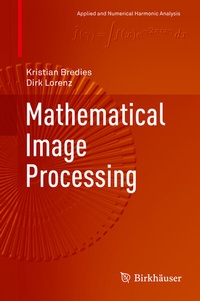
Mathematical Image Processing
Published on 6. February 2019
XIII, 473 pages
978-3-030-01458-2 (ISBN)
Description

This book addresses the mathematical aspects of modern image processing methods, with a special emphasis on the underlying ideas and concepts. It discusses a range of modern mathematical methods used to accomplish basic imaging tasks such as denoising, deblurring, enhancing, edge detection and inpainting. In addition to elementary methods like point operations, linear and morphological methods, and methods based on multiscale representations, the book also covers more recent methods based on partial differential equations and variational methods.
Review of the German Edition: The overwhelming impression of the book is that of a very professional presentation of an appropriately developed and motivated textbook for a course like an introduction to fundamentals and modern theory of mathematical image processing. Additionally, it belongs to the bookcase of any office where someone is doing research/application in image processing. It has the virtues of a good and handy reference manual. (zbMATH, reviewer: Carl H. Rohwer, Stellenbosch)
Review of the German Edition: The overwhelming impression of the book is that of a very professional presentation of an appropriately developed and motivated textbook for a course like an introduction to fundamentals and modern theory of mathematical image processing. Additionally, it belongs to the bookcase of any office where someone is doing research/application in image processing. It has the virtues of a good and handy reference manual. (zbMATH, reviewer: Carl H. Rohwer, Stellenbosch)
Reviews / Votes
"This book is devoted to researches in image processing and can be used for courses of applied mathematics. This book can be treated as a good starting point, since it introduces the reader into the base theory of mathematical image processing and shows the wide spectrum of approaches to typical image processing tasks." (Agnieszka Lisowska, zbMath 1418.94001, 2019)More details
Series
Language
English
Place of publication
Cham
Switzerland
Publishing group
Springer International Publishing
Product notice
Reflowable
Illustrations
XIII, 473 p. 129 illus., 22 illus. in color.
File size
12,74 MB
ISBN-13
978-3-030-01458-2 (9783030014582)
DOI
10.1007/978-3-030-01458-2
Schweitzer Classification
Other editions
Additional editions
Kristian Bredies | Dirk Lorenz
Mathematical Image Processing
Book
02/2019
Birkhäuser
€85.59
Shipment within 7-9 days
Persons
Dirk Lorenz is professor at TU Braunschweig, Institute for Analysis and Algebra. His research areas are: Inverse Problemes and Mathematical Image Processing.
Kristian Bredies is professor at Karl-Franzens-Universität Graz. His research interests include mathematical imaging, variational methods and numerical optimization.
Content
Introduction.- Mathematical preliminaries.- Basic tools.- Frequency and multiscale methods.- Partial differential equations in image processing.- Variational methods.
