
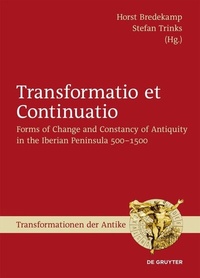
Transformatio et Continuatio
Description
Alles über E-Books | Antworten auf Fragen rund um E-Books, Kopierschutz und Dateiformate finden Sie in unserem Info- & Hilfebereich.
"Medieval thinkers were convinced that they themselves were still citizens of the empire, which had been founded by Augustus." This book is devoted to substantiate this claim of William Heckscher. It does so by tracing Antiquity's afterlife in various genres on the Iberian Peninsula. The book is a manifest for a special transformation and, moreover, continuation of antiquity in the so-called Middle Ages in Spain, going against the commonly held view that only the European Renaissance did justice to and came to the rescue of Antiquity. It describes how the Visigoths preserved classical Antiquity in the 6th and 7th century, how Roman influence manifests itself on the Pórtico de la Gloria of Santiago de Compostela, how the Iberian Peninsula was reluctant to adopt the European Gothic Art around 1200 and how the Catholic Kings went back to forms and ideas of late Antiquity around 1500. In doing so this book offers an alternative to the influential and, so far, widely accepted concept of the reception of Antiquity, which is Erwin Panofky's Principle of disjunction .
More details
Other editions
Additional editions

Persons
System requirements
File format: ePUB
Copy protection: Watermark-DRM (Digital Rights Management)
System requirements:
- Computer (Windows; MacOS X; Linux): Use a reading software that can process the file format ePUB: e.g., Adobe Digital Editions or FBReader – both free (see eBook Help).
- Tablet/Smartphone (Android; iOS): Before downloading, install the free app Adobe Digital Editions (see eBook Help).
- E-reader: Bookeen, Kobo, Pocketbook, Sony, Tolino and many more (not Kindle).
The file format ePUB works well for novels and non-fiction books – i.e., „flowing” text without complex layout. On an e-reader or smartphone, line and page breaks automatically adjust to fit the small displays.
This eBook uses Watermark-DRM, a „soft” copy protection. This means that there are no technical restrictions to prevent illegal distribution. However, there is a personalised watermark embedded in the eBook that can be used to identify the purchaser of the eBook in the event of misuse and to provide evidence for legal purposes.
For more information, see our eBook Help page.