

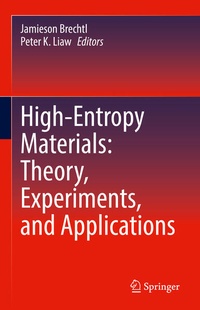
High-Entropy Materials: Theory, Experiments, and Applications
1st Edition
Published on 3. January 2022
VIII, 774 pages
978-3-030-77641-1 (ISBN)
Description

This book discusses fundamental studies involving the history, modelling, simulation, experimental work, and applications on high-entropy materials. Topics include data-driven and machine-learning approaches, additive-manufacturing techniques, computational and analytical methods, such as density functional theory and multifractal analysis, mechanical behavior, high-throughput methods, and irradiation effects. The types of high-entropy materials consist of alloys, oxides, and ceramics. The book then concludes with a discussion on potential future applications of these novel materials.
More details
Series
Language
English
Place of publication
Cham
Switzerland
Publishing group
Springer International Publishing
Target group
Professional and scholarly
Product notice
Reflowable
Illustrations
VIII, 774 p. 45 illus.
File size
30,20 MB
ISBN-13
978-3-030-77641-1 (9783030776411)
DOI
10.1007/978-3-030-77641-1
Schweitzer Classification
Other editions
Additional editions
Jamieson Brechtl | Peter K. Liaw
High-Entropy Materials: Theory, Experiments, and Applications
Book
01/2022
Springer
€139.09
Shipment within 7-9 days
Persons
Dr. Jamieson Brechtl
obtained his B.S. in Nuclear Engineering (with secondary majors in applied mathematics and physics) and his M.S. in Nuclear Engineering and Engineering Physics from the University of Wisconsin, Madison in 2012. He later obtained his Ph.D. in Energy Science and Engineering from the University of Tennessee, Knoxville in 2019. Currently, he works as a Postdoctoral Research Associate in the Multifunctional Equipment Integration Group at the Oak Ridge National Laboratory. His research interests include renewable energy, irradiation effects, plastic deformation, nanoindentation, X-ray and neutron diffraction, microscopy, ceramic and metallic powders, high-entropy alloys, bulk metallic glasses, data analysis, and applied mathematics. He has published over thirty journal papers and presented at numerous engineering conferences. In 2019, he was awarded the Chancellor's Citation for Extraordinary Professional Promise from the University of Tennessee. He is also acurrent member of The Minerals, Metals and Materials Society (TMS).
Professor Liaw obtained his B.S. in Physics from the National Tsing Hua University, Taiwan, and his Ph.D. in Materials Science and Engineering from Northwestern University in 1980. After working at the Westinghouse Research and Development (R&D) Center for thirteen years, he joined the faculty and became an Endowed Ivan Racheff Chair of Excellence in the Department of Materials Science and Engineering at The University of Tennessee (UT), Knoxville in March 1993. He has worked in the areas of fatigue, fracture, nondestructive evaluation, and life-prediction methodologies of structural alloys and composites. Since joining UT, his research interests include mechanical behavior, neutron and synchrotron diffraction, bulk-metallic glasses, high-entropy alloys, and processing of high-temperature alloys and ceramic-matrix composites and coatings, with the kind help of his team members and colleagues at UT and Oak Ridge National Laboratory, and throughout the world. He has published over one thousand journal papers, edited and written fifty seven books and book chapters, and presented numerous plenary, keynote, and invited talks at various national and international conferences. He was awarded the Royal E. Cabell Fellowship at Northwestern University. He is the recipient of numerous "Outstanding Performance" awards from the Westinghouse R&D Center. He was the Chairman of The Minerals, Metals and Materials Society (TMS) "Mechanical Metallurgy" Committee, and Chairman of the American Society for Metals (ASM) "Flow and Fracture" Committee. He has been the Chairman and Member of the TMS Award Committee on "Application to Practice, Educator, and Leadership Awards." He is a fellow of ASM and TMS. He has been given the Outstanding Teacher Award, the Moses E. and Mayme Brooks Distinguished Professor Award, the Engineering Research Fellow Awards, the National Alumni AssociationDistinguished Service Professor Award, the L. R. Hesler Award, and the John Fisher Professorship at UT, the TMS Distinguished Service Award, and a 2020 TMS Symposium dedicated to him. He has been the Director of the National Science Foundation (NSF) Integrative Graduate Education and Research Training (IGERT) Program, the Director of the NSF International Materials Institutes (IMI) Program, and the Director of the NSF Major Research Instrumentation (MRI) Program at UT. Several of his graduate students have been given awards for their research, papers, and presentations at various professional societies and conferences. Moreover, his students teach and conduct research at universities, industries, and government laboratories.
Professor Liaw obtained his B.S. in Physics from the National Tsing Hua University, Taiwan, and his Ph.D. in Materials Science and Engineering from Northwestern University in 1980. After working at the Westinghouse Research and Development (R&D) Center for thirteen years, he joined the faculty and became an Endowed Ivan Racheff Chair of Excellence in the Department of Materials Science and Engineering at The University of Tennessee (UT), Knoxville in March 1993. He has worked in the areas of fatigue, fracture, nondestructive evaluation, and life-prediction methodologies of structural alloys and composites. Since joining UT, his research interests include mechanical behavior, neutron and synchrotron diffraction, bulk-metallic glasses, high-entropy alloys, and processing of high-temperature alloys and ceramic-matrix composites and coatings, with the kind help of his team members and colleagues at UT and Oak Ridge National Laboratory, and throughout the world. He has published over one thousand journal papers, edited and written fifty seven books and book chapters, and presented numerous plenary, keynote, and invited talks at various national and international conferences. He was awarded the Royal E. Cabell Fellowship at Northwestern University. He is the recipient of numerous "Outstanding Performance" awards from the Westinghouse R&D Center. He was the Chairman of The Minerals, Metals and Materials Society (TMS) "Mechanical Metallurgy" Committee, and Chairman of the American Society for Metals (ASM) "Flow and Fracture" Committee. He has been the Chairman and Member of the TMS Award Committee on "Application to Practice, Educator, and Leadership Awards." He is a fellow of ASM and TMS. He has been given the Outstanding Teacher Award, the Moses E. and Mayme Brooks Distinguished Professor Award, the Engineering Research Fellow Awards, the National Alumni AssociationDistinguished Service Professor Award, the L. R. Hesler Award, and the John Fisher Professorship at UT, the TMS Distinguished Service Award, and a 2020 TMS Symposium dedicated to him. He has been the Director of the National Science Foundation (NSF) Integrative Graduate Education and Research Training (IGERT) Program, the Director of the NSF International Materials Institutes (IMI) Program, and the Director of the NSF Major Research Instrumentation (MRI) Program at UT. Several of his graduate students have been given awards for their research, papers, and presentations at various professional societies and conferences. Moreover, his students teach and conduct research at universities, industries, and government laboratories.
Content
Introduction.- Exotic Material Systems.- Unstable Plastic Dynamics and Serration Behavior.- Irradiation Materials Science.- Experimental Techniques.- Modeling and Analysis.- Irradiation Studies.- Conclusions.
