

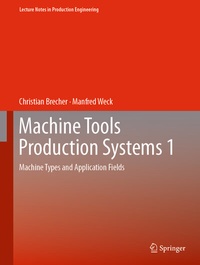
Machine Tools Production Systems 1
Description

The first part of the Machine Tools and Production Systems Compendium presents the wide range of machine tools and a comprehensive overview of different machine types. Based on the categorization of manufacturing processes according to the German standard DIN 8580, the different areas of application of machine tools are delineated and the various machine designs, the mechanical structure as well as the functions of the machine types are explained. Numerous three-dimensional illustrations of the principles, color photos, section drawings and schematic diagrams supplement the explanations and provide visual support. First, the machine types for the different manufacturing processes are described - before the multi-machine systems are explained. This is followed by a detailed presentation of the various equipment components of machine tools. In the last newly introduced chapter, the volume is concluded by a comprehensive and detailed explanation of three design examples of selected machine tools based on assembly drawings.
The German Machine Tools and Production Systems Compendium has been completely revised. The previous five-volume series has been condensed into three volumes in the new ninth edition with colored technical illustrations throughout. This first English edition is a translation of the German ninth edition.
More details
Other editions
Additional editions
Persons
Prof. Dr.-Ing. Christian Brecher was appointed University Professor for the subject Machine Tools at the Machine Tool Laboratory WZL of RWTH Aachen University and member of the Board of Directors of WZL and IPT (Fraunhofer Institute for Production Technology) in January 2004. His main areas of expertise include machine, gearbox and control technology. Since 2012, he has also headed the Aachen Center for Integrative Lightweight Design AZL at RWTH Aachen University as a founding member together with Prof. Hopmann. Furthermore, in 2018, he became the Institute Director of the Fraunhofer Institute for Production Technology IPT.
Prof. em. Dr.-Ing. Dr.-Ing. E. h. Dr.-Ing. E. h. Manfred Weck held the Chair of Machine Tools at the Laboratory for Machine Tools and Production Engineering (WZL) of RWTH Aachen University from 1973 to 2004 and was Director and Head of the Division Production Machines of the Fraunhofer Institute for Production Technology IPT, Aachen, fromits foundation in 1980 until 2004, as well as founder of the AiF Research Association "Ultra-Precision Technology e.V." Over the years, he has received numerous honors and awards including the SME Frederick W. Taylor Research Medal in 2007 and induction into Manager Magazine's Hall of Fame in 2015. Prof. Weck is the recipient of the Aachen Engineering Award, honoring him for his life's achievements in 2017.
Content
Introduction.- Primary forming machines and systems.- Forming and severing machines.- Metal cutting machines for tools with geometrically defined cutting edge (chip removal).- Metal cutting machines for tools with geometrically undefined cutting edges (chip removal).- Material removal machines.- Machines for laser machining.- Single-purpose machines.- Multi-machine systems.- Equipment components for machine tools.- Design examples of selected machine tools.
