

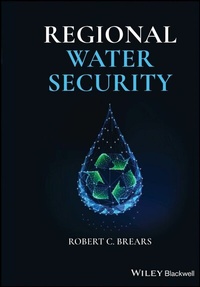
Regional Water Security
Description

Regional Water Security provides new research on policy innovations that promote the application of demand management and green infrastructure (GI) in managing water resources across regions sustainably. In particular, with regional water security around the world at risk from climatic and non-climatic challenges impacting water quantity and water quality, this book, in addition to providing examples of demand management and GI being implemented in various locations globally, contains in-depth case studies that illustrate how regions, of differing climates, lifestyles, and income levels, have implemented policy innovations that promote the application of demand management and GI to achieve regional water security for humans while protecting and restoring the natural environment.
Regional Water Security will be of interest to regional water resource managers, town and regional planners, resource conservation managers, policymakers, international companies, and organizations as well as environmental NGOs, researchers, and graduate and undergraduate students.
More details
Other editions
Additional editions
Person
About the Author
Robert C. Brears is the founder of Our Future Water, Mark and Focus, and Mitidaption. He has published widely on water security, water resources management, and related issues, and has conducted field research worldwide, including Antarctica.
Content
Acknowledgments vii
1 Introduction 1
2 Water Security 6
Part I Demand Management 21
3 Water Allocation 23
4 Water Augmentation 39
5 Water Efficiency 56
6 Water Reuse and Water Recycling 73
Part II Green Infrastructure 89
7 Green Buildings and Green Streets 91
8 Green Parks and Urban Forests 110
9 Water Bodies 128
10 Agriculture and Forestry 144
Part III Case Studies, Best Practices, and Conclusions 161
11 Case Studies of Regions Implementing Demand Management and Green Infrastructure to Achieve Regional Water Security 163
12 Best Practices 183
13 Conclusions 198
Index 207
1
Introduction
Regional water security around the world is at risk from both climatic and nonclimatic challenges impacting water quantity and water quality. For instance, climate change is projected to decrease the availability of renewable surface water and groundwater resources significantly, intensifying competition for water resources among users, as well as to reduce the availability of good-quality drinking water, even with conventional treatment processes (Arnell et al. 2015; Brears 2016a). Rapid population growth and urbanization will lead to increased water scarcity and ecosystem degradation due to excess water withdrawal, eutrophication, land-use changes, and pollution (Brears 2016a, 2018), while peri-urban water competition is likely to increase with further urbanization (McDonald et al. 2014). With economic growth, global demand for water will significantly increase due to manufacturing, industry, and domestic consumption (PwC 2015; UN Water 2014). At the same time, household water demand is projected to increase due to higher incomes and living standards, as well as a shift in diet to water-intensive meat and dairy products (Harlan et al. 2009; Kearney 2010; UNESCO 2012; UN Water 2014). In many locations, a large portion of the water infrastructure is approaching or has already reached the end of its useful life, with aging infrastructure often resulting in high water loss from physical leakage (Lam et al. 2017). In addition, sewage and contaminated groundwater can enter leaking pipes and travel throughout the water distribution network, causing public health concerns, such as outbreaks of gastrointestinal illness (Fox et al. 2016; Säve-Söderbergh et al. 2017). Between now and 2040, it is projected that the amount of energy used in the water sector will double, with the most substantial increase coming from desalination, followed by large-scale water transfer and increasing demand for (higher levels of) wastewater treatment (IEA 2016). Finally, by 2050, the world will require at the minimum 60 percent more food production to maintain current consumption patterns, leading to a significant increase in the volume of global water withdrawn for irrigation. Agriculture is one of the most significant contributors to non-point-source pollution impacting rivers, streams, and lakes - as well as wetlands and groundwater supplies - harming public health, creating dead zones in water, increasing water treatment costs, and impacting industries dependent on clean water (FAO 2015; Brears 2016b).
Regional development, which can be defined as community development (social, economic, environmental, technological, cultural, and recreational) of a particular territory, has proved challenging in practice as sustainable development at the regional level implies the implementation of complementary and coordinated actions in different areas, resulting in economic growth that also supports social and environmental objectives (Jovovic et al. 2017). In the context of water resource management, managing water in regions to achieve various economic, environmental, and social goals is particularly challenging given that the majority of the world's water resources are transboundary, crossing both intra- and interstate administrative and political lines.
In response to decreasing water quantity and diminishing water quality, water authorities, at multiple levels of governance around the world, are implementing a variety of policies to encourage the transition toward water security for both humans and nature, focusing on balancing rising demand with limited - and often variable - supplies of water and developing green infrastructure to mitigate climatic risks and improve water quality, all the while realizing multiple regional development goals.
Traditionally, water managers have relied on large-scale, supply-side infrastructural projects such as dams and reservoirs to meet increased demands for water (supply-side management). However, these projects are costly, both economically and environmentally. Also, with most water resources being transboundary, supply-side projects can create political tensions. Therefore, there is a need to move toward managing actual demand for water (demand management), as ultimately it is society's attitudes and behaviors toward water that determine the amount of that needs to be supplied. Demand management involves making better use of existing water supplies before attempting to increase them further. Specifically, it promotes water conservation under both normal and abnormal conditions, through changes in practice, culture, and people's attitudes toward water resources. It seeks to reduce the loss and misuse of water, optimize its use, and facilitate major financial and infrastructural savings by minimizing the need to meet increasing demand with new water supplies. Demand management also involves the development of alternative water supplies as a means of diversification in order to meet various potable and nonpotable water needs (Brears 2016a).
The most common means of mitigating risks from climatic extremes has been increasing investment in conventional - or "gray" - infrastructures such as dams and levees. However, engineers and decision-makers have come to realize the economic and environmental costs of these solutions, including high capital costs, amplified downstream flooding risks, and ecosystem degradation. As such, there has been a turn to more long-term economically and environmentally sustainable "green" infrastructure solutions that provide equivalent or similar benefits to gray infrastructure. For instance, gray infrastructure utilizes natural and semi-natural systems to manage excess water while enhancing ecosystems. It can also be used to mitigate the impacts of droughts, ensuring there is sufficient water for both humans and nature. Furthermore, gray infrastructure can purify water using natural filtration processes. A unique feature of gray infrastructure is that it can appreciate over time (Brears 2018).
Nonetheless, our understanding of the role regional water managers have in implementing demand management strategies and green infrastructure to enhance water security and reduce environmental degradation lags significantly behind our engineering knowledge of water resources management. As such, little has been written on the actual implementation of green policy innovations across entire regions that not only ensure water security for humans but also restore ecosystems and the numerous services they provide. Also, because the application of demand management and green infrastructure requires holistic planning, little has been written on how innovative policies have been developed to ensure they fulfil multiple functions and policy goals and create multiple benefits for society and ecosystems.
Regional Water Security provides new research on policy innovations that promote the application of demand management and green infrastructure in managing water resources across regions sustainably. In particular, it offers in-depth case studies that illustrate how different regions - of differing climates, lifestyles, and income levels - are implementing policy innovations which promote the application of demand management and green infrastructure to achieve regional water security for humans while protecting and restoring the natural environment. A summary runs as follows:
Chapter 2: Water Security This chapter discusses the concept of water security and defines what it means at the regional level. It then looks at the various climatic and nonclimatic challenges to regional water security.
Part I: Demand Management
Chapter 3: Water Allocation This chapter discusses how water allocation involves implementing technologies and establishing arrangements for sharing existing resources among users equitably and to the maximum benefit of all, including the environment. Technologies discussed (with examples of their implementation around the world) include basin-level modelling and seasonal forecasting, seasonal water rationing, and water reallocation.
Chapter 4: Water Augmentation This chapter discusses how water augmentation aims to increase the available supply of water through active recharge or protection of water recharge areas. It provides global examples of technologies being implemented, including the combined use of surface and groundwater, aquifer recharge, and source water protection.
Chapter 5: Water Efficiency This chapter discusses how residential, irrigation, and industrial water efficiency can be increased through more effective leak detection and repair of water pipes, improved irrigation efficiency to minimize water use within the agricultural sector while continuing to maintain crop productivity rates, and the use of new and more efficient technologies in industrial facilities.
Chapter 6: Water Reuse and Water Recycling This chapter discusses a range of water reuse and water recycling technologies and initiatives that have been implemented around the world, including rainwater and stormwater harvesting systems, potable and nonpotable reuse systems, and other types of alternative water source technologies.
Part II: Green Infrastructure
Chapter 7: Green Buildings and Green Streets This chapter reviews the various types of green...
