

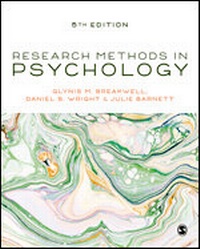
Research Methods in Psychology
5th Edition
Published on 5. October 2020
584 pages
978-1-5297-3193-4 (ISBN)
Description

The world of Research Methods is always changing and becoming ever more complex. Now completely up to date with the latest innovations, this book engages with recent controversies to give you the best start with your research.
In each chapter you will find:
? Key concept boxes to help you stay on track and focus on what's most important
? Real life examples which make the theory easier to understand
? Exercises to check you've understood the chapter
? Questions to help you develop your critical thinking.
Also available online are:
? Multiple choice questions to test your understanding
? Datasets to allow you to practice your skills
? A flashcard glossary to help with revision.
Offering a complete package to anyone taking a research methods course as part of their degree.
In each chapter you will find:
? Key concept boxes to help you stay on track and focus on what's most important
? Real life examples which make the theory easier to understand
? Exercises to check you've understood the chapter
? Questions to help you develop your critical thinking.
Also available online are:
? Multiple choice questions to test your understanding
? Datasets to allow you to practice your skills
? A flashcard glossary to help with revision.
Offering a complete package to anyone taking a research methods course as part of their degree.
More details
Edition
Fifth Edition
Language
English
Place of publication
London
United Kingdom
Publishing group
Sage Publications Ltd (Digital)
Target group
College/higher education
ISBN-13
978-1-5297-3193-4 (9781529731934)
Copyright in bibliographic data and cover images is held by Nielsen Book Services Limited or by the publishers or by their respective licensors: all rights reserved.
Schweitzer Classification
Other editions
Additional editions
Glynis M. Breakwell | Daniel B. Wright | Julie Barnett
Research Methods in Psychology
Book
10/2020
5th Edition
SAGE Publications Ltd
€237.50
Shipment within 15-20 days
Glynis M. Breakwell | Daniel B. Wright | Julie Barnett
Research Methods in Psychology
Book
10/2020
5th Edition
SAGE Publications Ltd
€147.20
Shipment within 15-20 days
Persons
Dame Glynis M. Breakwell is Professor Emeritus at the University of Bath in the Department of Psychology and has Visiting Professorships at Imperial College, London and the University of Surrey. Her research focuses upon identity process theory, social influence and social representation processes, leadership in complex organisations, and the psychology of risk management, perception, and communication. She has published more than 20 books, several of which are on research methods. She has been an adviser to both public and private sector organisations on the use of psychological methods and theories, especially concerning responses to public crises and major emergencies.
Daniel B. Wright is Professor of Educational Assessment, in the Department of Educational Psychology and Higher Education, University of Nevada, Las Vegas. His interests are in methodology and applied cognitive science.
Julie Barnett is a Professor of Health Psychology at the University of Bath. She is a social psychologist with research interests around risk appreciation, risk communication, public responses to new environmental and health technologies and managing food allergy. Over the last 10 years she has been part of a range of interdisciplinary projects funded by research councils, charities and government departments and agencies.
Daniel B. Wright is Professor of Educational Assessment, in the Department of Educational Psychology and Higher Education, University of Nevada, Las Vegas. His interests are in methodology and applied cognitive science.
Julie Barnett is a Professor of Health Psychology at the University of Bath. She is a social psychologist with research interests around risk appreciation, risk communication, public responses to new environmental and health technologies and managing food allergy. Over the last 10 years she has been part of a range of interdisciplinary projects funded by research councils, charities and government departments and agencies.
Content
Chapter 1: Research Questions, Design, Strategy and Choice of Methods - Glynis M Breakwell, Daniel B. Wright and Julie Barnett
Chapter 2: Ethics - Daniel B Wright, Julie Barnett and Glynis M Breakwell
Chapter 3: Big Questions and New Methods - Glynis M Breakwell, Daniel B Wright and Julie Barnett
Chapter 4: Capturing and Recording Information - Julie Barnett and Konstantina Vasileiou
Chapter 5: Telling Others about Your Research - Julie Barnett, Glynis M Breakwell and Daniel B Wright
Chapter 6: Psychology as a Science: What is Science? - Daniel B. Wright, Julie Barnett, and Glynis M. Breakwell
Chapter 7: Accessing Difficult to Access Information - Glynis Breakwell and Julie Barnett
Chapter 8: Quasi-experimental Designs (including observational methods) - Chris Fife-Schaw
Chapter 9: Experimental Design - Graham Hole
Chapter 10: Interviewing and Focus Groups - Glynis M. Breakwell and Lada Timotijevic
Chapter 11: Descriptive Statistics: Graphical and Numerical Methods - Marianna E. Carlucci and Daniel B. Wright
Chapter 12: Content Analysis, Thematic Analysis and Discourse Analysis - Rusi Jaspal
Chapter 13: Self-Report Data - Jeff Gavin and Karen Rodham
Chapter 14: Questionnaire Design - Chris Fife-Schaw
Chapter 15: Surveys and Sampling - Patrick Sturgis
Chapter 16: Inferential Statistics - Marianna E. Carlucci and Daniel B. Wright
Chapter 17: Factorial ANOVA - Katherine McGuire and Kamala London
Chapter 18: Correlation and Regression - Jeremy Miles
Chapter 19: Creating Latent Variables - Daniel B. Wright and Sarah M. Wells
Chapter 2: Ethics - Daniel B Wright, Julie Barnett and Glynis M Breakwell
Chapter 3: Big Questions and New Methods - Glynis M Breakwell, Daniel B Wright and Julie Barnett
Chapter 4: Capturing and Recording Information - Julie Barnett and Konstantina Vasileiou
Chapter 5: Telling Others about Your Research - Julie Barnett, Glynis M Breakwell and Daniel B Wright
Chapter 6: Psychology as a Science: What is Science? - Daniel B. Wright, Julie Barnett, and Glynis M. Breakwell
Chapter 7: Accessing Difficult to Access Information - Glynis Breakwell and Julie Barnett
Chapter 8: Quasi-experimental Designs (including observational methods) - Chris Fife-Schaw
Chapter 9: Experimental Design - Graham Hole
Chapter 10: Interviewing and Focus Groups - Glynis M. Breakwell and Lada Timotijevic
Chapter 11: Descriptive Statistics: Graphical and Numerical Methods - Marianna E. Carlucci and Daniel B. Wright
Chapter 12: Content Analysis, Thematic Analysis and Discourse Analysis - Rusi Jaspal
Chapter 13: Self-Report Data - Jeff Gavin and Karen Rodham
Chapter 14: Questionnaire Design - Chris Fife-Schaw
Chapter 15: Surveys and Sampling - Patrick Sturgis
Chapter 16: Inferential Statistics - Marianna E. Carlucci and Daniel B. Wright
Chapter 17: Factorial ANOVA - Katherine McGuire and Kamala London
Chapter 18: Correlation and Regression - Jeremy Miles
Chapter 19: Creating Latent Variables - Daniel B. Wright and Sarah M. Wells
