

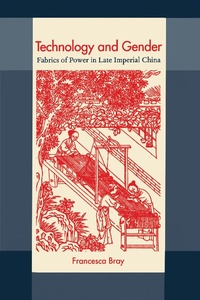
Technology and Gender
Fabrics of Power in Late Imperial China
1st Edition
Published on 28. July 2023
444 pages
978-0-520-91900-6 (ISBN)
Description

In this feminist history of eight centuries of private life in China, Francesca Bray inserts women into the history of technology and adds technology to the history of women. Bray takes issue with the Orientalist image that traditional Chinese women were imprisoned in the inner quarters, deprived of freedom and dignity, and so physically and morally deformed by footbinding and the tyrannies of patriarchy that they were incapable of productive work. She proposes a concept of gynotechnics, a set of everyday technologies that define women's roles, as a creative new way to explore how societies translate moral and social principles into a web of material forms and bodily practices.
Bray examines three different aspects of domestic life in China, tracing their developments from 1000 to 1800 A.D. She begins with the shell of domesticity, the house, focusing on how domestic space embodied hierarchies of gender. She follows the shift in the textile industry from domestic production to commercial production. Despite increasing emphasis on women's reproductive roles, she argues, this cannot be reduced to childbearing. Female hierarchies within the family reinforced the power of wives, whose responsibilities included ritual activities and financial management as well as the education of children.
This title is part of UC Press's Voices Revived program, which commemorates University of California Press's mission to seek out and cultivate the brightest minds and give them voice, reach, and impact. Drawing on a backlist dating to 1893, Voices Revived makes high-quality, peer-reviewed scholarship accessible once again using print-on-demand technology. This title was originally published in 1998.
In this feminist history of eight centuries of private life in China, Francesca Bray inserts women into the history of technology and adds technology to the history of women. Bray takes issue with the Orientalist image that traditional Chinese women were
Bray examines three different aspects of domestic life in China, tracing their developments from 1000 to 1800 A.D. She begins with the shell of domesticity, the house, focusing on how domestic space embodied hierarchies of gender. She follows the shift in the textile industry from domestic production to commercial production. Despite increasing emphasis on women's reproductive roles, she argues, this cannot be reduced to childbearing. Female hierarchies within the family reinforced the power of wives, whose responsibilities included ritual activities and financial management as well as the education of children.
This title is part of UC Press's Voices Revived program, which commemorates University of California Press's mission to seek out and cultivate the brightest minds and give them voice, reach, and impact. Drawing on a backlist dating to 1893, Voices Revived makes high-quality, peer-reviewed scholarship accessible once again using print-on-demand technology. This title was originally published in 1998.
In this feminist history of eight centuries of private life in China, Francesca Bray inserts women into the history of technology and adds technology to the history of women. Bray takes issue with the Orientalist image that traditional Chinese women were
More details
Other editions
Additional editions
Book
07/1997
1st Edition
University of California Press
€38.38
Article not available at the moment

Book
07/1997
1st Edition
University of California Press
€55.71
Article exhausted; check different version
Person
Francesca Bray is Professor of Anthropology at the University of California, Santa Barbara, and author of The Rice Economies: Technology and Development in Asian Societies (California, 1994).
Content
List of Illustrations and Table
List of Chinese Dynasties
Acknowledgments
Introduction: The Framework of Everyday Life:
Technology, Women and Cultural History
PART ONE / BUILDING A TRADITION:
THE CONSTRUCTION OF CHINESE SOCIAL SPACE
1 House Form and Meaning
Spaces and Sources
The House in Late Imperial China: Material Design
Some Aesthetics of House Design
Rusin Domo
The Convergence of Architecture
2 Encoding Patriarchy
A Walled Domain
A Moral Building Block
The Heart of the House: Altar and Stove
Continuing the Family Line: The Coffin and the Bed
Inner Divisions: Marking the Moral Order
3 The Text of the Chinese House
Writing the Text
Textual Experts
PART TWO / WOMEN'S WORK:
WEAVING NEW PATTERNS IN THE SOCIAL FABRIC
4 Fabrics of Power: The Canonical Meanings of Women's Work
The Concept of "Womanly Work": Women as Subjects
Cloth and Society
Medieval Divisions of Labor and the Value of Female Work
5 Economic Expansion and Changing Divisions of Labor
Wealth, Fashion and a New Elite: Changes in the Song Silk Industry
The Cotton Boom
Silk Production in the Ming and Qing
6 Women's Work and Women's Place
Skills, Knowledge and Status
Womanly Virtue and the Preservation of the Social Order
Women's Work and Family Status
Connection and Seclusion: Cloth and the Separation of Spheres
Women's Work and Patriarchy
PART THREE / MEANINGS OF MOTHERHOOD:
REPRODUCTIVE TECHNOLOGIES AND THEIR USES
7 Medical History and Gender History
Through a Glass Darkly: The Question of Efficacy
What is a Body?
Physicians, Orthodoxy and Power
Case Histories: Whose Voices?
8 Reproductive Medicine and the Dual Nature of Fertility
Generation in Medical Theory
Orthodox Uses of Abortion
Menstrual Regulation, Fertility and Health: A Dual Image
of Womanhood
9 Reproductive Hierarchies
Children: A Qualified Blessing
Nature, Nurture and the Bond between Mother and Child
Maternal Doubles: Wives, Concubines and Maids
The Wifely Role
Conclusion: Gynotechnics and Civilization
Glossary of Technical Terms
References Cited
Index
List of Illustrations
List of Chinese Dynasties
Acknowledgments
Introduction: The Framework of Everyday Life:
Technology, Women and Cultural History
PART ONE / BUILDING A TRADITION:
THE CONSTRUCTION OF CHINESE SOCIAL SPACE
1 House Form and Meaning
Spaces and Sources
The House in Late Imperial China: Material Design
Some Aesthetics of House Design
Rusin Domo
The Convergence of Architecture
2 Encoding Patriarchy
A Walled Domain
A Moral Building Block
The Heart of the House: Altar and Stove
Continuing the Family Line: The Coffin and the Bed
Inner Divisions: Marking the Moral Order
3 The Text of the Chinese House
Writing the Text
Textual Experts
PART TWO / WOMEN'S WORK:
WEAVING NEW PATTERNS IN THE SOCIAL FABRIC
4 Fabrics of Power: The Canonical Meanings of Women's Work
The Concept of "Womanly Work": Women as Subjects
Cloth and Society
Medieval Divisions of Labor and the Value of Female Work
5 Economic Expansion and Changing Divisions of Labor
Wealth, Fashion and a New Elite: Changes in the Song Silk Industry
The Cotton Boom
Silk Production in the Ming and Qing
6 Women's Work and Women's Place
Skills, Knowledge and Status
Womanly Virtue and the Preservation of the Social Order
Women's Work and Family Status
Connection and Seclusion: Cloth and the Separation of Spheres
Women's Work and Patriarchy
PART THREE / MEANINGS OF MOTHERHOOD:
REPRODUCTIVE TECHNOLOGIES AND THEIR USES
7 Medical History and Gender History
Through a Glass Darkly: The Question of Efficacy
What is a Body?
Physicians, Orthodoxy and Power
Case Histories: Whose Voices?
8 Reproductive Medicine and the Dual Nature of Fertility
Generation in Medical Theory
Orthodox Uses of Abortion
Menstrual Regulation, Fertility and Health: A Dual Image
of Womanhood
9 Reproductive Hierarchies
Children: A Qualified Blessing
Nature, Nurture and the Bond between Mother and Child
Maternal Doubles: Wives, Concubines and Maids
The Wifely Role
Conclusion: Gynotechnics and Civilization
Glossary of Technical Terms
References Cited
Index
List of Illustrations
