

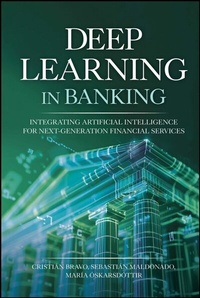
Deep Learning in Banking
Description

Unlock the potential of artificial intelligence to transform financial services for a new era
Deep Learning in Banking; Leveraging Artificial Intelligence for Next-Generation Financial Services by Cristián Bravo, Sebastián Maldonado, and María Óskarsdóttir is a compelling resource that highlights the critical intersection of AI and banking. It offers actionable insights and practical solutions for leveraging deep learning in lending institutions. With increasing regulatory challenges and the need for sophisticated models, this book provides essential strategies to navigate the evolving landscape of financial services.
Structured for both academic and professional use, Deep Learning in Banking delivers a comprehensive examination of the methodological frameworks of AI applications in lending. You'll learn to combine images, text, time series, graphs and structured data to develop multimodal deep learning and large-scale models, and how they relate to explainability and fairness, with practical examples and real-world case studies that ensure effective implementation.
Inside the book:
- Learn how to develop AI models within the modern regulatory environment.
- Explore multimodal data to develop deep learning models for financial institutions
- Discover case studies highlighting the application of advanced machine learning techniques in banking
Deep Learning in Banking is written for academics, financiers, banking professionals, and data scientists eager to revolutionize their approach to financial services. The book empowers its readers with the knowledge and tools needed to harness AI's full potential, paving the way for innovative and compliant solutions in the banking industry.
More details
Other editions
Additional editions
Persons
CRISTIÁN BRAVO, PHD, is a Professor and the Canada Research Chair in Banking and Insurance Analytics at the University of Western Ontario, Canada, and Director of the Banking Analytics Lab. He is a co-author of Profit Driven Business Analytics and regularly appears as a panelist on the CBC News' Weekend Business Panel discussing banking, finance, and artificial intelligence.
SEBASTIÁN MALDONADO, PHD, is Full Professor at the Department of Management Control and Information Systems, School of Economics and Business, University of Chile. He is the author of the books Analytics and Big Data: Data Science Applied to the Business World and Artificial Intelligence Applied in Chile: Business Vision and Success Stories.
MARÍA ÓSKARSDÓTTIR, is a Lecturer (Assistant Professor) of Mathematical Modelling and Data Science at the School of Mathematical Sciences at the University of Southampton and an Associate Professor at the Department of Computer Science of Reykjavik University. She's an Editor for Springer's Machine Learning and an Associate Editor of the International Journal of Forecasting.
Content
Contents
List of Figures
Foreword
Preface
Acknowledgments
Acronyms
Chapter 1: Introduction
Chapter 2: Image Processing and Convolutional Neural Networks
Chapter 3: Time Series and Panel Data in Banking
Chapter 4: Text Data and Transformers
Chapter 5: Financial Contagion and Network Models
Chapter 6: Generative AI and Large Language Models
Chapter 7: Multimodel Data and Information Fusion
Chapter 8: Fairness, Accountability, Explainability, and Causality
Chapter 9: Perspectives on the Future of AI in Banking
Bibliography
About the Authors
Index
Chapter 1
Introduction
Summary
After reading this chapter, you will be able to:
- Understand who this book is for.
- Understand the basic building blocks of a neural network.
- Understand the current relevant regulatory frameworks and their impact in deep learning in model development.
The world is complex and multifaceted. This is not a controversial opinion. In fact, nuance and care in the development of models is paramount in banking. For decades, borrower behavior has been modeled and managed through data science models of increasing complexity. In credit scoring, for example, we have moved from tree-based models in the 1970s to logistic regression dominating the landscape until very recently. Currently, however, there has been a shift toward tree ensembles such as XGBoost and Random Forests in jurisdictions that allow it. This last shift is relevant as it shows how banking, while slow to adapt, can move toward more advanced models when the profits are clear and the regulatory hurdles can be overcome.
This book is our vision on what we believe is the next evolution of banking: the use of alternative data, that is, data that go beyond simple tabular variables, into new models that can consider complex inputs in a transparent and explainable manner. The pages in this book discuss this in detail, trying to always solve the balancing act that we believe makes artificial intelligence (AI) in banking so interesting. It must arise from a specific business need and show that it is a profitable endeavor, while at the same time it needs to balance the rights of individuals as reflected in the specific regulation that is pertinent to its customers. Solving this puzzle requires creativity, strong intuition for data capabilities, computational skills, computational resources, regulatory acumen, and business sense. There are very few areas where data science is applied that require all of these skills to work together simultaneously.
1.1 Why We Wrote This Book and Who It Is For
Answering the first question: we wrote a book we wanted to have on our desks and to point our business partners, students, and interested parties to. Books on deep learning are easy to find, but comprehensive texts on banking regulation are far scarcer. Separately, while numerous books address topics like credit risk and model risk, they treat them as distinct subjects. What has been missing is a unified guide that combines all three areas. The book discusses, through its nine chapters, alternative unstructured data, where such data appear in banking, the regulation that applies to it, the techniques that are relevant to tackle the problem of modeling these data using deep learning, and case studies with real data applying everything we have discussed. Our intention is that the book points you, the reader, in the right direction and guides you as you first identify a source of data that can help you solve a problem, then develop your own models to tackle the problem, and evaluate them using both quantitative and qualitative measures common in banking. Chapter 9 also discusses briefly how to deploy these models in practice and where future regulation may go.
Answering the second question: this is a technical book. We do not shy away from mathematical formulas, from computational code and algorithms, from regulatory discussions, nor from complex descriptions of advanced models and how they are applied. Although we try our best to keep the language simple and direct, this is a book intended for a mature audience with some knowledge in the area. We expect the readers to have training in data science, data management, and model development and deployment. We start by assuming that the reader has some knowledge in these areas, although we do not assume deep learning knowledge. From a data science point of view, we assume that the reader understands how to train and deploy an XGBoosting model and is familiar with neural networks, to give a slight benchmark, at a level consistent with an undergraduate course in data science. The book will guide you to gain the necessary knowledge (through the methodological sections) and skills (through the case studies) to become effective at deploying deep learning models on top of your traditional modeling skills.
From a regulatory point of view, we expected the reader to understand the frameworks that are relevant to the practice of banking. We focus mainly on risk modeling regulations (Basel & IFRS 9, AML/CFT accords, and local regulations in selected territories), AI regulations (AI Act in Europe and similar proposals worldwide), and data privacy regulations (EU GDPR and comparable legislation). If you are unfamiliar with these, we do try to explain further what parts of these legislations, particularly for AI and consumer privacy, apply for deep learning, although some background knowledge is required of the banking-specific ones.
If you are an academic and are wondering whether this book would help your courses, we intend this book for either a follow-up to a data science algorithms course, when the new course focus is on applied deep learning with an orientation in banking, and also for banking analytics or applied deep learning courses at a graduate level. This is a book in banking and deep learning, and we believe courses that provide these specific skills, or general applied deep learning courses that are looking for complementary texts in a specific area, would be well-served by this textbook and labs.
Now that you have decided that this book is for you, the next question you need to answer is whether your problem actually needs deep learning.
1.2 Do You Need Deep Learning?
Let us start by thinking about whether there is even a need to deploy deep learning. There are three questions that a savvy manager can ask themselves:
- Is there a problem that we have not been able to solve with traditional models?
- Do we have data in our data lakes/data warehouses that is not being used or is underutilized?
- What is our current technical capacity?
Within different organizations, there will most likely be a mix of answers to these questions. Let us imagine a traditional bank that has been collecting the social media mentions of their Small and Medium-sized Enterprise (SME) customers. This information is used in their marketing propensity models by simply counting the number of mentions in a 90-day period to identify whether the SME is generating buzz and may have a need for funds the bank can provide. This information is combined with financial transactions, and a simple regression model generates a propensity probability. Starting with the first question, the answer may be that the model fails to identify negative buzz, and thus generates incorrect offers to companies that are in a downturn or subject to media controversy. The second question follows, and the answer is that we are indeed underutilizing the text data in the data lake, as we are only generating this buzz indicator, without considering the context that a more sophisticated model can bring. The third question is much more complex to answer. If the managers of our example institution desire to move forward with a more complex multimodal model, they would need to identify if they have the correct collaborators who can develop the model in their data science teams, and whether there is on-premise or cloud infrastructure that can be used to develop the models. Cloud Graphics Processing Unit (GPU) infrastructure can get expensive fast, and on-premise infrastructure may not be sufficient to train a model only to deploy them (inference).
One of our own coauthors recently published a paper arguing against the use of deep learning for tabular data (Gunnarsson et al., 2021). If you are simply expecting that plugging structured, tabular, data into a fancy deep learning model will lead to immediate gains, we are sorry to tell you that it probably will not. Most likely, this will increase your inference costs hundredfold and will provide, at best, a marginal gain. Moving from a logistic regression-based model to a tree-based ensemble is probably a much better use of resources, as was shown a decade ago by our good friends in Lessmann et al. (2015). Deep learning shines in three aspects: when your data is unstructured, when you need to combine different sources of data, and when you have complex data structures that you need to use, such as time series of different or unknown lengths. Otherwise, traditional models will serve you best.
If your data is beyond tabular (which it probably is), then the question of using deep learning is much more interesting. This book is for those cases. Let us consider a few examples where this book may help.
- When evaluating a mortgage, structured data can be misleading. For example, a specific community may have invested much in better greenery, more trees, a nice park, or any other kind of improvements that can make a specific valuation of a property significantly out-value neighboring properties. What alternatives are there to evaluate these intangibles? In Chapter 2, we show the case of evaluating mortgages using Light Detection and Ranging (LiDAR) data to assess environmental characteristics and value properties more effectively, complementing traditional data.
- In Tavakoli et al. (2025), we showed that, in times of crisis (in particular COVID-19), the predictive power of earning calls over future rating changes. Effective managers can provide context that would otherwise be missing, and such context is, in turn, a good predictor of future performance. In Chapter...
