

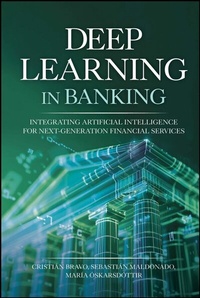
Deep Learning in Banking
Description

Unlock the potential of artificial intelligence to transform financial services for a new era
Deep Learning in Banking; Leveraging Artificial Intelligence for Next-Generation Financial Services by Cristián Bravo, Sebastián Maldonado, and María Óskarsdóttir is a compelling resource that highlights the critical intersection of AI and banking. It offers actionable insights and practical solutions for leveraging deep learning in lending institutions. With increasing regulatory challenges and the need for sophisticated models, this book provides essential strategies to navigate the evolving landscape of financial services.
Structured for both academic and professional use, Deep Learning in Banking delivers a comprehensive examination of the methodological frameworks of AI applications in lending. You'll learn to combine images, text, time series, graphs and structured data to develop multimodal deep learning and large-scale models, and how they relate to explainability and fairness, with practical examples and real-world case studies that ensure effective implementation.
Inside the book:
- Learn how to develop AI models within the modern regulatory environment.
- Explore multimodal data to develop deep learning models for financial institutions
- Discover case studies highlighting the application of advanced machine learning techniques in banking
Deep Learning in Banking is written for academics, financiers, banking professionals, and data scientists eager to revolutionize their approach to financial services. The book empowers its readers with the knowledge and tools needed to harness AI's full potential, paving the way for innovative and compliant solutions in the banking industry.
More details
Other editions
Additional editions
Persons
CRISTIÁN BRAVO, PHD, is a Professor and the Canada Research Chair in Banking and Insurance Analytics at the University of Western Ontario, Canada, and Director of the Banking Analytics Lab. He is a co-author of Profit Driven Business Analytics and regularly appears as a panelist on the CBC News' Weekend Business Panel discussing banking, finance, and artificial intelligence.
SEBASTIÁN MALDONADO, PHD, is Full Professor at the Department of Management Control and Information Systems, School of Economics and Business, University of Chile. He is the author of the books Analytics and Big Data: Data Science Applied to the Business World and Artificial Intelligence Applied in Chile: Business Vision and Success Stories.
MARÍA ÓSKARSDÓTTIR, is a Lecturer (Assistant Professor) of Mathematical Modelling and Data Science at the School of Mathematical Sciences at the University of Southampton and an Associate Professor at the Department of Computer Science of Reykjavik University. She's an Editor for Springer's Machine Learning and an Associate Editor of the International Journal of Forecasting.
Content
Contents
List of Figures
Foreword
Preface
Acknowledgments
Acronyms
Chapter 1: Introduction
Chapter 2: Image Processing and Convolutional Neural Networks
Chapter 3: Time Series and Panel Data in Banking
Chapter 4: Text Data and Transformers
Chapter 5: Financial Contagion and Network Models
Chapter 6: Generative AI and Large Language Models
Chapter 7: Multimodel Data and Information Fusion
Chapter 8: Fairness, Accountability, Explainability, and Causality
Chapter 9: Perspectives on the Future of AI in Banking
Bibliography
About the Authors
Index
