

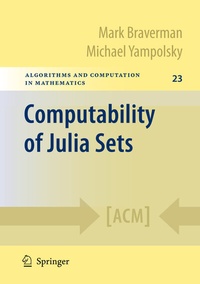
Computability of Julia Sets
Description

Among all computer-generated mathematical images, Julia sets of rational maps occupy one of the most prominent positions. Their beauty and complexity can be fascinating. They also hold a deep mathematical content.
Computational hardness of Julia sets is the main subject of this book. By definition, a computable set in the plane can be visualized on a computer screen with an arbitrarily high magnification. There are countless programs to draw Julia sets. Yet, as the authors have discovered, it is possible to constructively produce examples of quadratic polynomials, whose Julia sets are not computable. This result is striking - it says that while a dynamical system can be described numerically with an arbitrary precision, the picture of the dynamics cannot be visualized.
The book summarizes the present knowledge (most of it from the authors' own work) about the computational properties of Julia sets in a self-contained way. It is accessible to experts and students with interest in theoretical computer science or dynamical systems.
Reviews / Votes
From the reviews:
"The study of dynamical systems has at its core . a very computational feel. . One can feel the book trying to be self-contained . . The subject of the book is timely and important. . The questions posed and answered in the present book are natural and the approach well-suited to produce enlightening results. . The book is also generous . . It has the potential to inspire considerable future work in this intriguing field." (Wesley Calvert, SIGACT News, Vol. 41 (1), 2010)
"Written in an accessible way with many explications, examples and illustrations. . this book sees the meeting of two worlds: computability theory and iteration of rational maps. It is a fruitful one . and a share of surprises. It is also a compendium of several years of research by the authors . together with a lot of new results. . a nice and quick introduction to both topics, and much of it is pleasant to read . . includes interesting discussions and presents stimulating conjectures." (Arnaud Chéritat, Foundations of Computational Mathematics, Vol. 12, 2012)
More details
Other editions
Additional editions
Persons
M. Braverman is an expert in Theoretical Computer Science, particularly in applications of computability to Complex Analysis and Dynamical Systems
M. Yampolsky is an expert in Dynamical Systems, particularly in Holomorphic Dynamics and Renormalization Theory
