

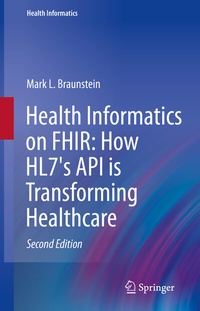
Health Informatics on FHIR: How HL7's API is Transforming Healthcare
Description

This extensively revised textbook describes and defines the US healthcare delivery system, its many systemic challenges and the prior efforts to develop and deploy informatics tools to help overcome these problems. Now that electronic health record systems are widely deployed, the HL7 Fast Healthcare Interoperability standard is being rapidly accepted as the means to access and share the data stored in those systems and analytics is increasing being used to gain new knowledge from that aggregated clinical data, this book goes on to discuss health informatics from an historical perspective, its current state and likely future state. It then turns to some of the important and evolving areas of informatics including electronic healt\h records, clinical decision support,. population and public health, mHealth and analytics. Numerous use cases and case studies are employed in all of these discussions to help readers connect the technologies to real world challenges.
Health Informatics on FHIR: How HL7's API is Transforming Healthcare is for introductory health informatics courses for health sciences students (e.g., doctors, nurses, PhDs), the current health informatics community, computer science and IT professionals interested in learning about the field and practicing healthcare providers. Though this textbook covers an important new technology, it is accessible to non-technical readers including healthcare providers, their patients or anyone interested in the use of healthcare data for improved care, public/population health or research.
Reviews / Votes
"Dr. Mark Braunstein's latest book is a "must read" for any serious student of biomedical informatics. It is an essential foundation text suitable for an introductory course. Dr. Braunstein doesn't just talk about a technical standard; he talks about why standards are so essential in to a field heavily focused on data science. Dr. Braunstein places technology in the context of the broader healthcare system, contemporary challenges, and important historical developments in the field. Taking a "real world" approach, Braunstein gives clinical readers an appreciation of technology and gives technical readers an understanding of the importance of their work. The book is an easy read; clinicians and administrators can quickly gain a deeper technical understanding of vital technology issues. This is an essential read for any student or teacher in the field." (Mark Frisse, MD, Vanderbilt University Medical Center, Nashville, USA)
"This is a great book - lots of history to put things in perspective, lots of high-level examples to show how FHIR fits into all this and lots of examples of what is under the hood to make it all work. As I start to develop applications in the FHIR environment, this book well be a very valuable tutorial to help me get started." (James Cimino, MD, University of Alabama at Birmingham, USA)
More details
Other editions
Additional editions
Person
Mark Braunstein, MD, an author and thought leader in the field, taught health informatics in the School of Interactive Computing of the College of Computing at the Georgia Institute of Technology for over a decade. After a successful career as a health IT entrepreneur, he joined Georgia Tech in 2007 as a Professor of the Practice. He developed the first Massive Open Online Course (MOOC) in the field and his unique health informatics graduate seminar was the first to be centered on HL7's Fast Healthcare Interoperability Resource (FHIR) standard. In it, student teams work with domain experts to solve problems posed by them.
He is a Visiting Scientist at the Australian eHealth Research Centre and created a similar educational program at the University of Queensland in Brisbane. Previously he wrote Practitioner's Guide to Health Informatics (Springer 2015) and Contemporary Health Informatics (AMIA 2014).Dr. Braunstein isactively involved with HL7's development of the Fast Healthcare Interoperability Resource (FHIR) standard.
He earned a BS from MIT in 1969, an MD from the Medical University of South Carolina in 1974 and served as a resident at Washington University.
He was a 1996 Entrepreneur of the Year Award for the Southeast Region, received a 1995 Innovation in Medical Management Award from the American Society of Physician Executives and received the 2006 Founder's Award from the American-Israel Chamber of Commerce, Southeast Region. In 2013 he was honored as a Distinguished Alumnus by MUSC's College of Medicine.