

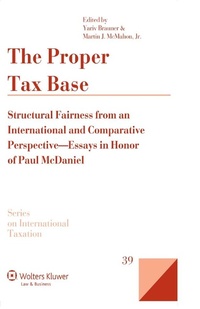
The Proper Tax Base
Structural Fairness from an International and Comparative Perspective - Essays in Honor of Paul McDaniel
Published on 20. March 2012
280 pages
978-90-411-4198-9 (ISBN)
Description

Virtually all objections to taxation schemes spring from perceptions of unfairness. Is tax fairness possible? The question is certainly worth investigating in depth, and that is the purpose of this book. Today, as governments are busily making new tax rules in the wake of staggering budget deficits, is perhaps an appropriate time to pay heed to fairness so it can be incorporated as far as possible into tax reform. With twelve contributions from some of the world's most respected international tax experts-including the late Paul McDaniel, in whose honor these essays were assembled-this invaluable book focuses on tax expenditure analysis, the quest for a just income tax, and division and/or harmonization of the income tax base among jurisdictions. Among the areas of taxation ripe for reform from a fairness point of view the authors single out the following:
tax expenditure budget construction;
tax expenditure reporting;
modern welfare economics as a driver of tax reform;
grantor trust rules;
the notion of "horizontal equity";
the international tax norm of "income source";
transfer pricing; and
jurisdictional application of VAT.
Specific ongoing reforms in the United States, Australia, and other countries-as well a detailed analysis of the EU's proposed common consolidated corporate tax base (CCCTB)-are also examined for fairness.
tax expenditure budget construction;
tax expenditure reporting;
modern welfare economics as a driver of tax reform;
grantor trust rules;
the notion of "horizontal equity";
the international tax norm of "income source";
transfer pricing; and
jurisdictional application of VAT.
Specific ongoing reforms in the United States, Australia, and other countries-as well a detailed analysis of the EU's proposed common consolidated corporate tax base (CCCTB)-are also examined for fairness.
More details
Other editions
Additional editions
Yariv Brauner | Martin James McMahon
The Proper Tax Base
Structural Fairness from an International and Comparative Perspective - Essays in Honour of Paul McDaniel
Book
03/2012
1st Edition
Kluwer Law International
€248.09
Shipment within 10-20 days
Content
- Intro
- Title
- Copyright
- Summary of Contents
- Table of Contents
- Preface
- Part I Tax Expenditures
- Chapter 1 The Staff of the Joint Committee on Taxation Revision of Tax Expenditure Classification Methodology: What Is To Be Made of a Change That Makes No Changes?
- 1.1 Introduction
- 1.2 Methodology Historically Used To Classify Code Provisions
- 1.2.1 The Tax Base
- 1.2.2 Tax Rates
- 1.2.3 The Taxable Unit
- 1.2.4 Accounting Rules
- 1.2.5 International Tax System
- 1.2.6 Tax Administration
- 1.3 Methodology Adopted by JCT Staff
- 1.3.1 Tax Subsidies
- 1.3.2 Tax-Induced Structural Distortions
- 1.3.3 The 2008 Tax Expenditure Estimates
- 1.4 Critique of the Reasons for the JCT Staff's Changes
- 1.5 Conclusions
- Chapter 2 Taxing Tax Expenditures?
- 2.1 Introduction
- 2.2 "Tax Reform" Versus "Spending Reform"
- 2.3 The Failure of Criticism of Tax Expenditure Analysis
- 2.4 Taxing Tax Expenditures
- 2.4.1 Determining Which Tax Expenditure Subsidies Should Be Taxed
- 2.4.2 Determining How to Tax Taxable Expenditure Subsidies
- 2.4.3 Taxing Tax Expenditures is Unadministrable
- 2.5 Revenue Enhancement, Spending Reform, and Tax Reform-Curbing Tax Expenditures
- 2.5.1 Tax Expenditures Are Both Inefficient and Inequitable
- 2.5.2 Tax Expenditures Are of Questionable Efficacy
- 2.5.3 The Case for Curbing Tax Expenditures
- 2.6 Conclusion
- Chapter 3 The Tax Expenditure Concept Globally
- 3.1 Introduction
- 3.2 Global Trends in Tax Expenditure Reporting
- 3.3 Country Case Studies
- 3.3.1 India
- 3.3.2 Chile
- 3.3.3 South Africa
- 3.4 Purpose and Challenges of Tax Expenditure Reporting
- 3.4.1 Purpose
- 3.4.2 Tax Expenditure Management as an Effective Element of the Budget Process
- 3.4.3 Two Challenges
- 3.5 Conclusion
- Chapter 4 Tax Reform and Tax Expenditures in Australia
- 4.1 Introduction
- 4.2 The Approach to Tax Reform
- 4.3 Taxation of Labor Income
- 4.4 Saving and Taxation of Investment Income
- 4.5 Pension Plans and the Family Home
- 4.6 Conclusion
- Chapter 5 Tax Reform Paul McDaniel Style: The Repeal of the Grantor Trust Rules
- 5.1 Introduction
- 5.2 The Grantor Trust Rules
- 5.3 The Intentionally Defective Grantor Trust
- 5.3.1 Basic IDGT Transaction
- 5.3.2 IDGT Installment Sale Transaction
- 5.4 The Argument for Repeal
- 5.5 Conclusion
- Part II The Fair Tax Base and International Tax Reform
- Chapter 6 Horizontal Equity Revisited
- 6.1 Introduction
- 6.2 Why HE and VE Lack Normative Content?
- 6.3 Efforts to Sustain a Design Role for HE
- 6.4 Critique of the Assertion that HE Lacks Normative Content
- 6.4.1 HE as a Process Requirement
- 6.4.2 HE as Even-Handed Enforcement
- 6.5 Conclusion
- Chapter 7 What Is This Thing Called Source?
- 7.1 Introduction
- 7.2 The Model
- 7.3 Applications of the Model
- 7.3.1 Generally
- 7.3.2 Interest Income
- 7.3.3 Interest by Analogy
- 7.4 Conclusion
- Chapter 8 Formula Based Transfer Pricing
- 8.1 Introduction
- 8.2 The Current Debate Over the Desirability of a Formula Based International Tax Reform
- 8.2.1 Formulaic Reform Proposals
- 8.2.2 The Main Arguments in the Debate
- 8.2.2.1 Economic Based versus Arbitrary Taxation
- 8.2.2.2 The Three Factor Formula
- 8.2.2.3 Unilateral versus Multilateral Solutions
- 8.2.2.4 Costliness-Simplicity, Compliance and Enforcement
- 8.2.3 Distinguishing the Debate over Formulaic International Tax Reform from Transfer Pricing Reform
- 8.3 The Logic of Our Transfer Pricing Regime and the Domination of Arm's Length
- 8.3.1 Arm's Length in the United States
- 8.3.2 The Universality of Arm's Length
- 8.3.3 Defense of Arm's Length
- 8.3.4 Critique of Arm's Length
- 8.4 The Design of a Formula-Based Transfer Pricing Regime
- 8.4.1 Unilateral Adoption of Formulaic Transfer Pricing
- 8.4.2 A Bilateral Approach
- 8.4.3 A Multilateral Solution
- 8.5 Conclusion
- Part III A Comparative Perspective
- Chapter 9 The EU proposed CCCTB-Some Tax Treaty Issues
- 9.1 Introduction
- 9.2 A Very Brief Outline of the Proposed CCCTB rales
- 9.3 Some Issues Under Tax Treaties
- 9.3.1 Introduction
- 9.3.2 A CCCTB Company Receives Interest Income from Outside the EU
- 9.3.2.1 Double Taxation
- 9.3.2.2 Treaty Application by the Third-Country State ?
- 9.3.2.3 Treaty Application by CCCTB States MS CI and MS C2
- 9.3.3 Third-Country Company Corporation ? derives Income from CCCTB States MS-C1 and MS-C2
- 9.3.3.1 No Issue in Case of Income from Single Business Activity
- 9.3.3.2 Multiple Active Income Items
- 9.3.3.3 Passive income
- 9.4 Conclusion
- Chapter 10 Shared Legal Orders: Some Thoughts about the Influence of EU Case Law on International Tax Law Rules of the EU Member States
- 10.1 Introduction
- 10.2 Standards Developed by the ECJ Concerning the Powers of the Member States
- 10.3 The Exemption with Progression Method and EU Law: The German Experience
- 10.3.1 Introduction
- 10.3.2 Case law of the ECJ
- 10.3.2.1 Lidl Belgium
- 10.3.2.2 Krankenheim
- 10.3.3 Case Law of the German Federal Finance Court (BFH)
- 10.3.3.1 BFH, February 3, 2010, I R 23/09
- 10.3.3.2 BFH, June 9, 2010, I R 23/09
- 10.3.4 Case law of the ECJ regarding third countries: Stahlwerk Ergste Westig GmbH
- 10.3.5 Evaluation
- 10.3.6 Change in Dutch Exemption Method as from January 1, 2012
- 10.4 Transfer Pricing Rules and EU Law: The Belgian Experience
- 10.4.1 Introduction
- 10.4.2 SGI
- 10.4.3 Evaluation
- 10.5 Wrap up of ECJ Standards, Principles and Tests
- 10.6 Some Thoughts on Transplanting the ECJ Standards, Principles and Tests in the OECD Commentary
- 10.6.1 Introduction
- 10.6.2 The "Always-Somewhere Principle"
- 10.6.3 The Commercial Justification Test and the Burden of Proof
- 10.7 Conclusion
- Chapter 11 Intra Group Loans-A Swedish Perspective
- 11.1 Introduction
- 11.2 RA2010ref. 67
- 11.3 Pricing of Cross-Border Loans
- 11.4 Conclusions
- Chapter 12 European VAT and Jurisdiction to Tax
- 12.1 Place of Supply: Relevance and Underlying Principles
- 12.2 The Place of Supply of Goods
- 12.2.1 Overview
- 12.2.2 General Rules
- 12.2.3 Special Rules
- 12.2.3.1 Generically Applicable to International Trade
- 12.2.3.2 Specifically Applicable to Intra-Community Trade
- 12.2.3.3 Chain Transactions
- 12.3 The Place of Intra-Community Acquisitions of Goods
- 12.3.1 Overview
- 12.3.2 Chain Transactions
- 12.4 The Place of Supply of Services
- 12.4.1 Overview
- 12.4.2 General Rules
- 12.4.2.1 Supply of Services to Taxable Persons
- 12.4.2.2 Supply of Services to Nontaxable Persons
- 12.4.3 Special Rules
- 12.4.3.1 General Exceptions
- 12.4.3.2 Particular Exceptions
- 12.4.4 Forthcoming Modifications
- 12.4.5 Use and Enjoyment Rule
- 12.5 The Place of Importation of Goods
