

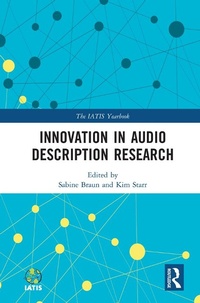
Innovation in Audio Description Research
1st Edition
Published on 29. July 2020
214 pages
978-1-000-08067-4 (ISBN)
Description

This state-of-the-art volume covers recent developments in research on audio description, the professional practice dedicated to making audiovisual products, artistic artefacts and performances accessible to those with supplementary visual and cognitive needs. Harnessing the power of the spoken word, the projects covered in this book illustrate the value of audiovisual content descriptions not only in relation to the role of breaking down physical, cognitive and emotional barriers to entertainment, but also in informing broader media practices such as video archive retrieval, video gaming development and application software creation.
The first section maps out the field, discusses key concepts in relation to new developments and illustrates their application; the second part focuses on new audiences for AD, whilst the third part covers the impact of new technologies. Throughout this book contributors focus on methodological innovation, regarding audio description as an opportunity to engage in multi-dimensional linguistic and user-experience analysis, as it intersects with and contributes to a range of other research disciplines.
This book is key reading for researchers, advanced students and practitioners of audiovisual translation, media, film and performance studies, as well as those in related fields including cognition, narratology, computer vision and artificial intelligence.
The first section maps out the field, discusses key concepts in relation to new developments and illustrates their application; the second part focuses on new audiences for AD, whilst the third part covers the impact of new technologies. Throughout this book contributors focus on methodological innovation, regarding audio description as an opportunity to engage in multi-dimensional linguistic and user-experience analysis, as it intersects with and contributes to a range of other research disciplines.
This book is key reading for researchers, advanced students and practitioners of audiovisual translation, media, film and performance studies, as well as those in related fields including cognition, narratology, computer vision and artificial intelligence.
Reviews / Votes
A well-balanced volume providing a timely reflection on how far AD has come in the past decade, both in terms of its practice, its contexts, and as a field of research. Impressive in breadth, this will doubtlessly be a baseline for the field in years to come.Jan-Louis Kruger, Macquarie University, Australia
This volume mirrors new and exciting developments in the robustly developing area of audio description. It is a much needed and very useful guide to all the latest technologies, new applications and new audiences.
Agnieszka Chmiel, Adam Mickiewicz University, Poland
More details
Series
Edition
1. Auflage
Language
English
Place of publication
London
United Kingdom
Publishing group
Taylor & Francis Ltd
Target group
College/higher education
Product notice
Reflowable
Illustrations
30 Tables, black and white; 3 Line drawings, black and white; 52 Halftones, black and white; 55 Illustrations, black and white
ISBN-13
978-1-000-08067-4 (9781000080674)
Copyright in bibliographic data and cover images is held by Nielsen Book Services Limited or by the publishers or by their respective licensors: all rights reserved.
Schweitzer Classification
Other editions
Additional editions
Sabine Braun | Kim Starr
Innovation in Audio Description Research
Book
08/2022
1st Edition
Routledge
€67.10
Shipment within 15-20 days
Sabine Braun | Kim Starr
Innovation in Audio Description Research
Book
07/2020
1st Edition
Routledge
€207.50
Shipment within 10-20 days
Persons
Sabine Braun is Professor of Translation Studies and Director of the Centre for Translation Studies at the University of Surrey (UK).
Kim Starr is a Research Fellow at the Centre for Translation Studies, University of Surrey.
Kim Starr is a Research Fellow at the Centre for Translation Studies, University of Surrey.
Content
List of Contributors
Introduction: Mapping new horizons in audio description research
Chapter 1: Immersion, presence and engagement in audio described material
Chapter 2: New approaches to accessibility and audio description in museum environments
Chapter 3: Easier audio description: exploring the potential of Easy-to-Read principles in simplifying AD
Chapter 4: Film language, film experience and film interpretation in a reception study comparing conventional and interpretative audio description styles
Chapter 5: Audio description 2.0: re-versioning audiovisual accessibility to assist emotion recognition
Chapter 6: Towards a user specification for immersive audio description
Chapter 7: Mainstreaming audio description through technology
Chapter 8: Comparing human and automated approaches to visual storytelling
Index
Introduction: Mapping new horizons in audio description research
Chapter 1: Immersion, presence and engagement in audio described material
Chapter 2: New approaches to accessibility and audio description in museum environments
Chapter 3: Easier audio description: exploring the potential of Easy-to-Read principles in simplifying AD
Chapter 4: Film language, film experience and film interpretation in a reception study comparing conventional and interpretative audio description styles
Chapter 5: Audio description 2.0: re-versioning audiovisual accessibility to assist emotion recognition
Chapter 6: Towards a user specification for immersive audio description
Chapter 7: Mainstreaming audio description through technology
Chapter 8: Comparing human and automated approaches to visual storytelling
Index
