

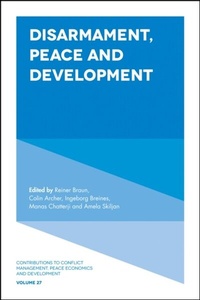
Disarmament, Peace and Development
1st Edition
Published on 13. December 2018
208 pages
978-1-78743-854-5 (ISBN)
Description

Excessive
military spending reduces the available financial reserves for health,
education, and other human needs. For poor countries, it increases poverty,
unemployment, and destitution. It also strengthens dictatorial tendencies
in politics and acts against democratic values. If we want to achieve peace,
eliminate poverty, decrease inequality, and achieve social justice, we should
devote all our energies to reducing military spending and using the released
resources for economic development. For that, we need a concerted effort to
encourage disarmament.
This new
volume provides reflections and insights from
leading public figures and activists who oppose military expenditure in any
form. Many of the contributions to this volume were presented as speeches at
the 'Disarm!
For a Climate of Peace' meeting
held in Berlin in 2016, organized by the International Peace Bureau. The volume also includes additional research-oriented chapters to complement the transcripts
from the International Peace Bureau meeting.
military spending reduces the available financial reserves for health,
education, and other human needs. For poor countries, it increases poverty,
unemployment, and destitution. It also strengthens dictatorial tendencies
in politics and acts against democratic values. If we want to achieve peace,
eliminate poverty, decrease inequality, and achieve social justice, we should
devote all our energies to reducing military spending and using the released
resources for economic development. For that, we need a concerted effort to
encourage disarmament.
This new
volume provides reflections and insights from
leading public figures and activists who oppose military expenditure in any
form. Many of the contributions to this volume were presented as speeches at
the 'Disarm!
For a Climate of Peace' meeting
held in Berlin in 2016, organized by the International Peace Bureau. The volume also includes additional research-oriented chapters to complement the transcripts
from the International Peace Bureau meeting.
Reviews / Votes
During September-October 2016, the International Peace Bureau, with other partners, held an international congress in Berlin, and this volume contains 18 main plenary papers from it. They cover disarmament for development, sustainable peace, peace and development, a nuclear weapon free world, military spending and peace economics, and the challenge of peace today. Among their topics are creating an active disgust for war, the political conditions for a lasting global peace, recent trends in global military spending: the shallowest down cycle since World War II, trade unions and a sustainable policy of peace, and learning to disarm: educating to realize the International Peace Bureau action agenda. -- Annotation (c)2019 * (protoview.com) *More details
Series
Language
English
Place of publication
Bingley
United Kingdom
Target group
Professional and scholarly
File size
1,34 MB
ISBN-13
978-1-78743-854-5 (9781787438545)
Copyright in bibliographic data and cover images is held by Nielsen Book Services Limited or by the publishers or by their respective licensors: all rights reserved.
Schweitzer Classification
Other editions
Additional editions
Reiner Braun | Colin Archer | Ingeborg Breines
Disarmament, Peace and Development
Book
12/2018
Emerald Publishing Limited
€145.80
Article exhausted; check different version
Persons
Reiner Braun is Co-president of the International Peace Bureau, Switzerland, Executive Director of the International Association of Lawyers against Nuclear Arms (IALANA), and a founding member of the International Network of Engineers and Scientists for Global Responsibility (INES).Colin Archer is a former
Secretary-General of the International Peace Bureau, Switzerland. For 10 years he was the Coordinator of a solidarity center in the developing world, and he has been involved in a wide range of peace
and disarmament projects.
Ingeborg Breines is a former director of UNESCO on Women and a Culture of Peace, and a UNESCO
representative to Pakistan and to the UN in Geneva, Switzerland.
Manas Chatterji is a Professor of Management at Binghamton University at State University of New
York, USA. He is the
author of 35 books and several articles in the areas of peace science, military spending, disarmament, conflict management, and environmental and urban management.
Amela Skiljan is the Coordinator of the International Peace Bureau (IPB) in Berlin, Germany.
Secretary-General of the International Peace Bureau, Switzerland. For 10 years he was the Coordinator of a solidarity center in the developing world, and he has been involved in a wide range of peace
and disarmament projects.
Ingeborg Breines is a former director of UNESCO on Women and a Culture of Peace, and a UNESCO
representative to Pakistan and to the UN in Geneva, Switzerland.
Manas Chatterji is a Professor of Management at Binghamton University at State University of New
York, USA. He is the
author of 35 books and several articles in the areas of peace science, military spending, disarmament, conflict management, and environmental and urban management.
Amela Skiljan is the Coordinator of the International Peace Bureau (IPB) in Berlin, Germany.
Content
Foreword; Manas ChatterjiAcknowledgements
Part 1. Introduction
Chapter
1. Introductory Remarks; Reiner Braun, Ingeborg Breines, and Colin Archer
Chapter
2. Creating an Active Disgust for War; Ingeborg Breines
Chapter
3. Military Expenditure and Peace; His Excellency, Archbishop Nikola
Eterovic
Part 2. Disarmament for Development
Chapter
4. The Road Map for the Future; Michael Moller
Part
3. Sustainable Peace
Chapter
5. Towards Sustainable Peace Building; Tawakkol Karman
Chapter
6. The Political Conditions for a Lasting Global Peace; Samir Amin
Part
4. Peace and Development
Chapter
7. Peace through Work and Development; Frank Bsirske
Chapter
8. Peace, Conflicts and the Armament Race in South-East Asia; Corazon Fabros
Part
5. A Nuclear Weapon Free World
Chapter
9. A Nuclear Weapon Free World: Mirage or Achievable Target? Jayantha
Dhanapala
Chapter
10. The Treaty on the Prohibition of Nuclear Weapons; Arielle Denis
Part
6. Military Spending and Peace Economics
Chapter
11. Recent Trends in Global Military Spending: The Shallowest Down Cycle Since World War II? Aude
Fleurant
Chapter
12. A Survey of Literature on Military Expenditure and Development; Manas
Chatterji
Chapter
13. Disarmament for Development: From a Culture of War to a Culture of Peace and Non Violence; Federico
Mayor Zaragoza
Part
7. The Challenge of Peace Today
Chapter
14. Trade Unions and a Sustainable Policy of Peace; Reiner
Hoffmann
Chapter 15. Game of Thrones, Patriarchy,
Feminism and Peacebuilding: How to Reconcile the Unreconcilable! Madeleine Rees
Chapter
16. Brief Introduction to the Intersection of Racism and Militarism; Meena
Jagannath
Chapter
17. Breakthrough: How to Claim Back Our Future; Jakob von
Uexkull
Chapter
18. The Labor Movement and the Path to Peace; Philip
Jennings
Chapter
19. Learning to Disarm: Education to Realize the IPB Action Agenda; Betty
Reardon
Part
8. Conclusion: Disarm! For a Climate of Peace
Chapter 20. IPB Action Agenda
Chapter
21. IPB Youth Declaration
Appendix 1. Military
Expenditure and Economic Development (a Partial Bibliography)
Appendix 2. World
Military Expenditure
Part 1. Introduction
Chapter
1. Introductory Remarks; Reiner Braun, Ingeborg Breines, and Colin Archer
Chapter
2. Creating an Active Disgust for War; Ingeborg Breines
Chapter
3. Military Expenditure and Peace; His Excellency, Archbishop Nikola
Eterovic
Part 2. Disarmament for Development
Chapter
4. The Road Map for the Future; Michael Moller
Part
3. Sustainable Peace
Chapter
5. Towards Sustainable Peace Building; Tawakkol Karman
Chapter
6. The Political Conditions for a Lasting Global Peace; Samir Amin
Part
4. Peace and Development
Chapter
7. Peace through Work and Development; Frank Bsirske
Chapter
8. Peace, Conflicts and the Armament Race in South-East Asia; Corazon Fabros
Part
5. A Nuclear Weapon Free World
Chapter
9. A Nuclear Weapon Free World: Mirage or Achievable Target? Jayantha
Dhanapala
Chapter
10. The Treaty on the Prohibition of Nuclear Weapons; Arielle Denis
Part
6. Military Spending and Peace Economics
Chapter
11. Recent Trends in Global Military Spending: The Shallowest Down Cycle Since World War II? Aude
Fleurant
Chapter
12. A Survey of Literature on Military Expenditure and Development; Manas
Chatterji
Chapter
13. Disarmament for Development: From a Culture of War to a Culture of Peace and Non Violence; Federico
Mayor Zaragoza
Part
7. The Challenge of Peace Today
Chapter
14. Trade Unions and a Sustainable Policy of Peace; Reiner
Hoffmann
Chapter 15. Game of Thrones, Patriarchy,
Feminism and Peacebuilding: How to Reconcile the Unreconcilable! Madeleine Rees
Chapter
16. Brief Introduction to the Intersection of Racism and Militarism; Meena
Jagannath
Chapter
17. Breakthrough: How to Claim Back Our Future; Jakob von
Uexkull
Chapter
18. The Labor Movement and the Path to Peace; Philip
Jennings
Chapter
19. Learning to Disarm: Education to Realize the IPB Action Agenda; Betty
Reardon
Part
8. Conclusion: Disarm! For a Climate of Peace
Chapter 20. IPB Action Agenda
Chapter
21. IPB Youth Declaration
Appendix 1. Military
Expenditure and Economic Development (a Partial Bibliography)
Appendix 2. World
Military Expenditure
