

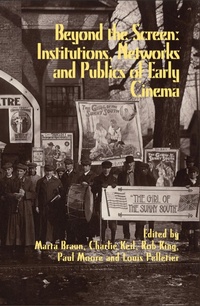
Beyond the Screen
Institutions, Networks, and Publics of Early Cinema
Published on 22. August 2012
350 pages
978-0-86196-913-5 (ISBN)
Description

This scholarly anthology presents a new framework for understanding early cinema through its usage outside the realm of entertainment.
From its earliest origins until the beginning of the twentieth century, cinema provided widespread access to remote parts of the globe and immediate reports on important events. Reaching beyond the nickelodeon theatres, cinema became part of numerous institutions, from churches and schools to department stores and charitable organizations.
Then, in 1915, the Supreme Court declared moviemaking a "busines, pure and simple," entrenching the film industry's role as a producer of "harmless entertainment." In Beyond the Screen, contributors shed light on how pre-1915 cinema defined itself through institutional interconnections and publics interested in science, education, religious uplift, labor organizing, and more.
From its earliest origins until the beginning of the twentieth century, cinema provided widespread access to remote parts of the globe and immediate reports on important events. Reaching beyond the nickelodeon theatres, cinema became part of numerous institutions, from churches and schools to department stores and charitable organizations.
Then, in 1915, the Supreme Court declared moviemaking a "busines, pure and simple," entrenching the film industry's role as a producer of "harmless entertainment." In Beyond the Screen, contributors shed light on how pre-1915 cinema defined itself through institutional interconnections and publics interested in science, education, religious uplift, labor organizing, and more.
More details
Language
English
Place of publication
New York
United States
Target group
Professional and scholarly
US School Grade: College Graduate Student and over
Illustrations
65 b&w illus.
File size
4,62 MB
ISBN-13
978-0-86196-913-5 (9780861969135)
Copyright in bibliographic data and cover images is held by Nielsen Book Services Limited or by the publishers or by their respective licensors: all rights reserved.
Schweitzer Classification
Other editions
Additional editions
Marta Braun | Charles Keil | Rob King
Beyond the Screen
Institutions, Networks, and Publics of Early Cinema
Book
08/2012
John Libbey Publishing Ltd
€33.00
Shipment within 3-4 weeks
Persons
Marta Braun is Professor and Director of the Graduate Program in Photographic Preservation and Collections Management at Ryerson University in Toronto.
Charles Keil is Director of the Cinema Studies Institute and Associate Professor in the Department of History, University of Toronto.
Rob King is Assistant Professor of Cinema Studies and History, University of Toronto.
Paul Moore is Associate Professor of Communication and Culture at Ryerson University.
Louis Pelletier is a PhD candidate at Concordia University, where he is researching the history of film exhibition in Montreal.
Content
- Intro
- Contents
- Introduction
- PART I: Charity and Religion
- 1. "Neutrality-Humanity": The Humanitarian Mission and the Films of the American Red Cross
- 2. Early Missionary Filming and the Emergence of the Professional Camera man
- 3. Mission on Screen: the Church Army and its Multi-Media Activities
- 4. "Baits to Entrap the Pleasure-Seeker and the Worldling": Charity Bazaars Introduce Moving Pictures to Irela nd
- 5. Paroles éducatives et religieuses lors des projections de films en France avant 1915
- 6. Mütter, verzaget nicht! (1911) [Mothers, Despair Not!]: Henny Porten's Promotion for Mothers' Welfare
- PART II: Government and Civics
- 7. The Tsar and The Kinemat ograph: Film as History and The Chronicle of the Russian Monarchy
- 8. "Wheelbarrows" and "Real Soldiers": Advertising, Audiences and War Films of all Varieties
- 9. "What is a Picture?": Film as Defined in British Law Before 1910
- 10. Le cinéma et les élections au Québec: de l'attraction à la banalité
- 11. A Moving Picture Farce: Public Opinion and the Beginnings of Film Censorship in Quebec
- PART III: Education and Advocacy
- 12. Health Instruction on Screen: The Department of Health in New York City, 1909-1917
- 13. John Collier, Thomas Edison and the Educational Promotion of Moving Pictures
- 14. "And They Can See Half-Naked Dancers, Catching Young Men In Their Nets": Teachers and the Cinema in Norway, 1907-1913
- 15. Documentaries, Family Film Nights and the First Film University: The Early Works and Big Ideas of Belgian Film Pioneer Hippolyte De Kempeneer (1876-1944)
- PART IV: Science and Magic
- 16. The School of the Future or Ganot's Physics?: Edison's Foray into Educational Cinema
- 17. Multi-Purposing Early Cinema: A Psychological Experiment Involving Van Bibber's Experiment (Edison, 1911)
- 18. Dissecting the Medical Training Film
- 19. Corporal Permeability and Shadow Pictures: Reconsidering Uncle Josh at the Moving Picture Show (1902)
- 20. Eroticism and Death: The Skeleton in the Trick Film
- 21. Magies en images, les prestidigitateurs et la machine
- PART V: Art and Aesthetics
- 22. Early Film Colour, Today and Yesterday
- 23. Salvage Ethnography and the Exoticisation of Decay in Peter Delpeut's Lyrical Nitrate and Bill Morrison's Decasia
- 24. Picture Craft, Visual Education and the Lantern: A Lecture Fantasy
- 25. The Scope of Those Scopes: Production Diversity for the Mutoscope and Biograph During the Movies' Early Years
- 26. The High-Stakes History of the French Camera Operators' Union before the First World War
- PART VI: Exhibition and Showmanship
- 27. Les séries culturelles de la conférence-avec-projection et de la projection-avec-boniment: continuités et ruptures
- 28. Les "conférenciers de cinéma" en France (1896-1930): Historique à travers différents lieux de projection, genres filmiques et réseaux
- 29. Les images en mouvement au théâtre de variétés: le cas de l'Apollo de Düsseldorf
- 30. Royals, Rembrandts and Luxors: Patterns and Clusters in the Nomenclature of Dutch Cinemas
- 31. Local Showmanship in the Early Feature Era: The Case of Stanley Mastbaum
- 32. A Transformative Moment: Samuel Rothafel and the Rise of Multi-Class Moviegoing in the Midwest, 1911-1913
- PART VII: Community and thePublic Sphere
- 33. "This Splendid Temple": Watching Movies in the Wanamaker Department Store
- 34. "Boost Your Town in the Movies": Municipal Film Companies in the United States, 1910-1917
- 35. Early Cinema and the Public Sphere of the Neighbourhood Meeting Hall: The Longue Durée of Working-Class Sociability
- 36. Trans-Inter-National Public Spheres
- 37. Turning the Social Problem into Performance: Slumming and Screen Culture in Victorian Lantern Shows
- Editors and contributors
- Index of Films
- Index of Names
