


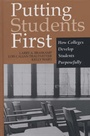
Putting Students First
Description

More details
Other editions
Additional editions

Persons
Content
Foreword xi
Acknowledgements xiii
Introduction xvii
Putting Students First 1
Introduction
Why Is It Important to Put Students and Their Development First?
Who Are Today's College Students?
Who Develops These Students?
In What Context Is Holistic Development Occurring?
Why Study Church-Related Colleges and Universities?
Summary
Conceptual Framework and Design of the Project 19
Introduction
Theoretical Bases for Holistic Student Development
Faith, Spirituality, and Student Development
Student Development and the Church-Related Context
Conceptual Framework: Personal Investment Theory
Project Design
Summary
Culture 43
Introduction
Discerning and Acting on Institutional Mission
Building on a Legacy
Communicating Institutional Mission and Identity
Leadership
College Location
Campus Facilities
Expectations and Contributions of Faculty
Faculty as Role Models
Using a Career Perspective on Faculty Development
Faculty Evaluation as a Reflection of Culture
Support and Challenge
Summary
Questions for Campus Conversations
Curriculum 87
Introduction
Philosophical Foundations of the Curriculum
Centrality of a Liberal Arts Education
Integrating Faith and Learning
Worldviews
Pedagogy
Developmentally Tailored Experiences for Students
Pedagogy of Engagement: Field-Based and Community-Based Learning
Summary
Questions for CampusConversations
Cocurriculum 129
Introduction
Mutual Reinforcement of Learning
Campus Rituals
Residence Life
Student Leadership
Relationships With Coaches, Professional Staff, and Campus Ministry
Faculty Interactions
Immersion Experiences
Summary
Questions for Campus Conversations
Community 159
Introduction
Shared Governance
Defining Community
Maintaining Community Amidst Change
Diversity Within Community
Communities Beyond the Campus
Dealing With Difference and External Communities
Summary
Questions for Campus Conversations
Creating Communities That Put Students First 191
Introduction
Chapter Overview
Mission Is Reality, Not Rhetoric
Learning and Development Are Integrated
The Campus Community Fosters Support and Challenge
Summary
Bibliography 219
Index 241
1
PUTTING STUDENTS FIRST
"I came here to invest in my students."
-Faculty member, Whitworth College
"If there is one sentence everyone around here can quote it is 'Creighton University exists for students'."
-Dean, Creighton University
Introduction
These remarks and many more like them directed us to title this book Putting Students First. Faculty and administrators at the colleges we studied made their perspectives on student development known by the way they talk of investing in students. Generally they use language that reflects a view of student development that is holistic and encompasses the intellectual, moral, psychological, and faith development of students. They press students to acquire knowledge and to develop a life of purpose; they challenge students to obtain and improve competencies and to "know themselves"; and they encourage students to engage the world and to probe the relevance and power of religious commitments and perspectives and their shortcomings. In all the colleges in the study, educational leaders were most interested in investing in students such that they might live holistically.
This book is based on our desire to learn more about why and how colleges foster students' holistic development. In doing so, we addressed questions such as-What do colleges desire students to become? What skills and patterns of behavior do students need to learn and develop? What are the learning and developmental goals of a college education? How do colleges create and sustain a campus environment that fosters holistic student development? How do members of the campus community-faculty, staff, and administrators-contribute to the development of students by who they are as well as what they do? When we posed such questions, we heard repeatedly about the concept of putting students first. In a nutshell, faculty involvement in students' holistic development is about investment-faculty dedicating themselves more fully to the totality of student life, colleges making an investment (literally and figuratively) in students as whole beings, and students themselves becoming personally invested in their collegiate experience. This book is about how faculty and their colleagues in student affairs, administration, and ministry put students first.
The purpose of this chapter is to set the stage for the book by addressing the following questions: Why is it important to put students and their development first? Who are today's students? Who is developing these students? In what context is holistic development occurring? Why study church-related colleges and universities?
Why Is It Important to Put Students and Their Development First?
Increasingly, educators refer to the importance of all dimensions of student development, not just formal learning. After all, Aristotle argued that minds must be developed in relation to the use of reason and character must be developed in relation to passions and feelings. Leaders of colleges and universities organize their campus activities-curriculum, cocurricular events and programs, culture, and collaborations with organizations external to the campus-in ways that they consider develop students most effectively. Moreover, they organize educational endeavors by first considering desired ends: "What do we wish students to be and to become," often framed in terms of student learning and developmental goals. For some, the desired end of an education is mastery of skills needed for a specific career; for others, moral and civic responsibility is emphasized; for still others, character development and religious formation are primary. In varying degrees of intentionality, colleges pay attention to the interior lives of students-values, spirituality, identity, purpose, and meaning-and the exterior lives of students-observable patterns of behavior.
In this book, we use the term student development to include our spectrum of holistic student learning and developmental goals. Defined in these terms, this spectrum includes the following dimensions:
- Vocational knowledge and skills
- Professional practices and skills
- Intellectual, critical thinking, and reasoning
- Academic, disciplinary, and interdisciplinary knowledge
- Physical well-being
- Social responsibility
- Civic and political responsibility
- Moral and ethical responsibility
- Personal values and character
- Self-awareness, self-authorship, and identity
- Spirituality
- Faith and the practice of faith
- Religious commitment, conviction, and worldviews
Student development defined to include a wide array of learning and developmental goals is not a new way of viewing the college experience. Holistic student development was the core of the mission of the first colleges and universities in America; they were founded to assist young men and women to be persons of character and integrity. "The early American college did not doubt its responsibility to educate the whole person-body, mind, and spirit; head, heart, and hands" (Boyer, 1987, p. 177). Almost a century ago, professionals in student affairs viewed college life in terms of an inclusive student-centered perspective. The American Council on Education (1937/1994) referenced that the student personnel point of view "emphasized the importance of education for the whole student" (p. 76). Recently, attempts to develop the "whole student" have been advocated in terms of fostering civic and moral engagement of college students. For example, the Kellogg Commission (1997) states, "The biggest educational challenge we face revolves around developing character, conscience, citizenship, tolerance, civility, and individual and social responsibility in our students" (p. 26-27).
In terms of combining intellectual and character development, Boyer (1987) argued,
We need educated men and women who not only pursue their own personal interests but are also prepared to fulfill their social and civic obligations. And, it is during the undergraduate experience, perhaps more than at any other time, that these essential qualities of mind and character are refined. (p. 7)
Dalton, Russell, and Kline (2004) state, "American higher education has always been deeply invested in the development of character as an outcome of the college experience. The notion of character is imbedded in the most basic concepts of liberal education, public service, and student development" (p. 4). Colby, Ehrlich, Beaumont, and Stephens (2003) argue that "moral and civic learning should be a central goal for both liberal and professional education" (p. xi). The Association of American Colleges and Universities (2002) proposes five learning goals that colleges need to fulfill if they are to educate American students. The goals are analytical and communication skills; understanding and experiences in the disciplines; intercultural knowledge and collaborative problem-solving skills; civic, social, and personal responsibility; and integrative thinking and problem solving. In short, they advocate a practical liberal arts education, an education in which students begin to apply their knowledge and understanding to be good workers and citizens.
Most recently, Nathan Hatch (2005), former provost at Notre Dame University and new president of Wake Forest University, called for an education of college students that links intellectual and moral development. In his review of Catholic higher education in recent decades, he concludes, "What is evident is a commitment to the holistic nurturing of students-body, mind, and spirit" (Hatch, 2005, p. B16). In summary, the academy as a whole has always advanced the dual goals of forming and informing students while in college.
Who Are Today's College Students?
Holistic student development calls for us to understand the students we are developing. The college student today cannot be described easily and simply. No single generalization does justice to the complex and conflicting portrayal. They are increasingly commuterbased, older, and diverse in gender, race, and ethnicity; for example, more than 40% of students are 25 years or older. Since most research in higher education is focused on traditional-age undergraduate college students, including our own, the findings that we offer may be inadequate if applied to the total college population today.
The most common image of traditional-age college students today is the one known as the millennials, referring to students born after 1982. They are described as
smart, ambitious, incredibly busy, very ethnically diverse and dominated by girls [sic]. . . . They make decisions jointly with parents ("co-purchasing" a college) and believe in big brands (with "reputation" counting for a lot). And they are numerous, very intent on going to college, and have very demanding parents. (Howe & Strauss, 2003, p. 4)
Their "helicopter" parents are always hovering over campus ready and willing on a moment's notice to become involved in the affairs of their son or daughter. With the help of technology like cell phones and email communication, they are never far away. Parents have also become more vocal in their expectations to college leaders and faculty.
In addition,...
