

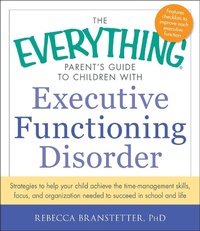
The Everything Parent's Guide to Children with Executive Functioning Disorder
Strategies to help your child achieve the time-management skills, focus, and organization needed to succeed in school and life
Published on 8. November 2013
256 pages
978-1-4405-6686-8 (ISBN)
Description

The vital skills children need to achieve their full potential!
Being organized. Staying focused. Controlling impulses and emotions.
These are some of the basic executive functioning (EF) skills children need to function and succeed as they grow. But what can you do if your child is struggling with one or all of these skills? With this hands-on guide, you'll learn what EF difficulties look like and how you can help your child overcome these challenges. Psychologist Rebecca Branstetter teaches you how to help improve the executive functions, including:
With checklists to help enforce skills and improve organization, The Everything Parent's Guide to Children with Executive Functioning Disorder is your step-by-step handbook for helping your child concentrate, learn, and thrive!
Being organized. Staying focused. Controlling impulses and emotions.
These are some of the basic executive functioning (EF) skills children need to function and succeed as they grow. But what can you do if your child is struggling with one or all of these skills? With this hands-on guide, you'll learn what EF difficulties look like and how you can help your child overcome these challenges. Psychologist Rebecca Branstetter teaches you how to help improve the executive functions, including:
- Task initiation
- Response inhibition
- Focus
- Time management
- Working memory
- Flexibility
- Self-regulation
- Completing tasks
- Organization
With checklists to help enforce skills and improve organization, The Everything Parent's Guide to Children with Executive Functioning Disorder is your step-by-step handbook for helping your child concentrate, learn, and thrive!
More details
Other editions
Additional editions
Rebecca Branstetter
The Everything Parent's Guide to Children with Executive Functioning Disorder
Strategies to help your child achieve the time-management skills, focus, and organization needed to succeed in school and life
Book
12/2013
Everything
€17.50
No shipping information available
Person
Dr. Rebecca Branstetter is a school psychologist, speaker, parent educator, and author on a mission to help students thrive. She collaborates with school psychologists across the country to help them move from surviving in the profession to thriving. Dr. Branstetter is a sought-after speaker for professional development for school psychologists and parents. Her expertise in supporting school psychologists, parents, teachers, and students in the public school system has appeared in media outlets such as the Huffington Post, NPR, Education.com, and Parents magazine.
Content
- Intro
- Title Page
- Dedication
- Contents
- Introduction
- Chapter 1: What Is Executive Functioning?
- Defining Executive Functioning
- Being a Parent: The Ultimate Test in Executive Functioning
- The "Boss in Your Brain"
- "Smooth Sailors" versus "Boat Rockers"
- Parenting a "Boat Rocker"
- Chapter 2: The "Big Ten" Executive Functions
- Task Initiation
- Response Inhibition
- Focus
- Time Management
- Working-Memory
- Flexibility
- Self-Regulation
- Emotional Self-Control
- Task Completion
- Organization
- Prioritizing Interventions
- Chapter 3: How Does Executive Functioning Develop in Children and Adolescents?
- Typical Development: The Smooth Sailors
- When Challenges Arise: The Boat Rockers
- Delay or Disorder?
- Assessment of Executive Functioning Difficulties
- Chapter 4: Disorders with Symptoms of Executive Functioning Weaknesses
- Executive Functioning: "The Big Umbrella"
- Attention Deficit Hyperactivity Disorder (ADHD)
- Autism Spectrum Disorders
- Learning Disabilities
- Medical Conditions
- Emotional Disorders
- Chapter 5: Task Initiation: Taming Your Child's Procrastination Monster
- What Is Task Initiation?
- The Young Child (Ages 1-4)
- The Elementary-Aged Child (Ages 5-12)
- The Adolescent (Ages 13-18+)
- Social Media and Procrastination
- Chapter 6: Response Inhibition: Teaching Your Child to Control Impulses
- The Importance of Controlling Impulses
- Stanford Marshmallow Study
- Strategies for Kids Who Act First and Think Later
- Strategies for Kids Who Make Careless Errors
- Chapter 7: Focus
- What Do Focus Problems Look Like?
- Sustained Focus
- Divided Focus
- TV or Not TV? There Is No Question!
- Music and Focus
- Mindfulness
- Chapter 8: Time Management: Strengthening Your Child's Internal Clock
- Development of Time Management Skills
- Getting Out the Door on Time
- Getting Homework Done Efficiently
- Teaching Activity Scheduling
- Chapter 9: Working-Memory
- The Importance of Working-Memory
- The "RAM" in Your Brain
- Remembering and Following Directions
- Remembering Appointments and Assignments
- Can You Strengthen Working-Memory?
- Chapter 10: Flexibility: Rolling with Changes
- What Does Flexibility Entail?
- Learning How to Reset
- Changing Plans Midstream
- Repairing
- Chapter 11: Self-Regulation: Thinking about Thinking
- What Is Self-Regulation?
- Self-Regulation in Reading
- Self-Regulation in Writing
- Self-Regulation in Math
- Educational Media
- Developing Self-Regulation
- Chapter 12: Emotional Self-Control
- Why Emotional Self-Control Is Important
- The Tale of Phineas Gage
- Labeling Feelings
- Providing Behavioral Choices
- Tracking Emotions to Build Awareness
- Dealing with "Meltdowns"
- Chapter 13: Task Completion
- What Is Task Completion?
- Short-Term Tasks
- Reading Assignments
- Long-Term Projects
- Chapter 14: Organization
- Organization Is in the Eye of the Beholder
- Finding the Floor in Your Child's Bedroom
- The Backpack Vortex
- Binder Systems
- Homework Systems
- Planners
- Helping Lost-and-Found "Frequent Flyers" Keep Track of Belongings
- Chapter 15: Setting Up Your Home Environment to Support Executive Functioning Development
- Making the Home Environment Positive for Teaching Executive Functioning
- Routines Are Your Friends!
- Stop the Homework Battles
- Getting Your Child to Do Chores
- Chapter 16: How to Advocate for Support for Your Child at School
- Bridging the Home-School Gap
- Special Services
- Supporting Transition to Middle School
- Supporting Transition to High School
- Chapter 17: Parenting Children with Executive Functioning Challenges
- Your Changing Role
- Parent as Orchestrator
- Parent as Monitor
- Parent as Facilitator/Supporter
- Chapter 18: Manager or Micromanager?
- Helicopter Parenting
- Lending Your Child Your Frontal Lobe
- How to Pull Back Support Without the Crash and Burn
- After High School: College and Beyond
- Chapter 19: What If You Also Have Executive Functioning Challenges?
- Genetics versus Environment
- The Importance of Modeling
- Getting Support
- Chapter 20: Building Resilience
- Smoothing Out the Ocean versus Riding the Waves
- Success Factors
- The 1:5 Rule
- Appendix: Checklists for Supporting the "Big Ten" Executive Functions
- Acknowledgments
- Copyright
