

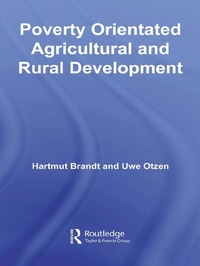
Poverty Orientated Agricultural and Rural Development
Published on 20. December 2006
384 pages
978-1-134-20514-1 (ISBN)
Description

Over the last twenty years the proportion of development cooperation resources earmarked for agricultural development has dwindled to between six and seven per cent of total bi- and multilateral Official Development Assistance. This is despite the fact that eighty per cent of the world's poor live in rural agricultural areas and that the poor are disproportionately affected when political, military and natural events lead to regional or global food shortages.
Brandt and Otzen's key book fills a gap in current literature, undertaking a wide-ranging conceptual reorientation of development cooperation, criticizing the current orthodoxy and its bias towards urban areas, and arguing that in order to effectively alleviate poverty across the world, agricultural and rural development measures need to be implemented both by central and subnational governments, aid agencies and the private sector. The authors investigate the world food question, the current pressures it is under and its link to rural poverty, and set out the policies that need to be undertaken to reduce global poverty.
Brandt and Otzen's key book fills a gap in current literature, undertaking a wide-ranging conceptual reorientation of development cooperation, criticizing the current orthodoxy and its bias towards urban areas, and arguing that in order to effectively alleviate poverty across the world, agricultural and rural development measures need to be implemented both by central and subnational governments, aid agencies and the private sector. The authors investigate the world food question, the current pressures it is under and its link to rural poverty, and set out the policies that need to be undertaken to reduce global poverty.
More details
Series
Language
English
Place of publication
London
United Kingdom
Publishing group
Taylor & Francis Ltd
Target group
College/higher education
File size
12,28 MB
ISBN-13
978-1-134-20514-1 (9781134205141)
Copyright in bibliographic data and cover images is held by Nielsen Book Services Limited or by the publishers or by their respective licensors: all rights reserved.
Schweitzer Classification
Other editions
Additional editions
Hartmut Brandt | Uwe Otzen
Poverty Orientated Agricultural and Rural Development
Book
03/2009
1st Edition
Routledge
€66.20
Shipment within 15-20 days
Hartmut Brandt | Uwe Otzen
Poverty Orientated Agricultural and Rural Development
Book
12/2006
1st Edition
Routledge
€197.20
Shipment within 15-20 days
Persons
Hartmut Brandt began his professional education with three years of farming practice (1960-62) and continued with eight years of academic study and research in agricultural sciences and economics at Kiel University, Technical University of Berlin and Makerere University College, Kampala. Thereafter, followed thirty-two years of applied research, consulting work and postgraduate training based at the German Development Institute (GDI). Dr Brandt retired in 2002 but continues his consultative activities.
Uwe Otzen is senior research fellow at the German Development Institute (GDI). He studied international agricultural science at the Technical University of Berlin, where he obtained his PhD in 1973. He worked four years in Malawi as agricultural consultant and project manager for a regional development project of the GTZ, the German Agency for Technical Cooperation, before he joined the German Development Institute in 1977, where he worked as research fellow in the Africa Department. Between 1982 and 1986 he spent four years in Zimbabwe as agricultural and rural development advisor to the Ministry of Lands, Resettlement and Rural Development in Harare.
Uwe Otzen is senior research fellow at the German Development Institute (GDI). He studied international agricultural science at the Technical University of Berlin, where he obtained his PhD in 1973. He worked four years in Malawi as agricultural consultant and project manager for a regional development project of the GTZ, the German Agency for Technical Cooperation, before he joined the German Development Institute in 1977, where he worked as research fellow in the Africa Department. Between 1982 and 1986 he spent four years in Zimbabwe as agricultural and rural development advisor to the Ministry of Lands, Resettlement and Rural Development in Harare.
Content
Part A: Approaches to Poverty Reduction through Agricultural Development 1. Background to the Problem: World Food Question 2. Motive for the Study: New Urban Bias in Development Cooperation 3. Poverty Reduction in the Conceptual Experience of Agricultural Development 4. Economic Growth, Agricultural Development, Poverty Reduction 5. Fazit Part B: Institutional and Organizational Ways for Rural Communities of Sub-Saharan Africa to Reduce Poverty 1. Global Framework for Sustainable and Poverty-Reducing Agricultural and Rural Development 2. Realistic Problem-Solving Approaches 3. Importance for Development Policy of Preconditions for and Effects of Decentralization 5. Decentralization and Development Cooperation Priorities 5. Institutional and Organizational Implementation Options 6. Summary
