

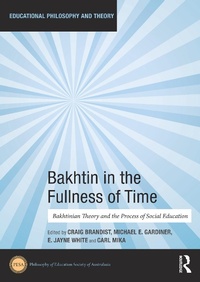
Bakhtin in the Fullness of Time
Bakhtinian Theory and the Process of Social Education
1st Edition
Published on 21. May 2020
160 pages
978-1-000-08230-2 (ISBN)
Description

This book takes the works of Mikhail Bakhtin as its inspiration in the contemplation of the potential of dialogic scholarship for philosophy of education. While Bakhtin's work has been widely received in educational studies in recent years, the academic literature does not sufficiently convey the sophistication of his cultural-historical works.
Selected works on the limits and perspectives of Mikhail Bakhtin are presented in the book. In doing so, the contributors seek to interpret the work of the Bakhtin Circle in a complex contemporary world. Layering and drawing from the many ideas explored by the Circle during their collective lifetimes and those that influenced their work, each chapter offers a different dimension of thought concerning issues facing societies remote (or perhaps not so remote) from the world of post-revolutionary Russia.
In the post-2008 era, during which financial crises have morphed into global recession and which characterise growing social inequities, widespread political instabilities and further environmental decline and resource depletion, what is needed more than ever is a twenty-first century Bakhtin, one that is occupied with the distinct challenges our times present to all of us. The individual contributors to Bakhtin in the Fullness of Time aim to contribute to a revisioning and reassessment of Bakhtin, through a diverse series of engagements with both his legacy and future promise. In contemplating Bakhtin in the fullness of time, historical perspectives and contributions must be encountered in a contemporary understanding that will contribute to philosophy of education today.
The chapters in this book were originally published in the journal Educational Philosophy and Theory.
Selected works on the limits and perspectives of Mikhail Bakhtin are presented in the book. In doing so, the contributors seek to interpret the work of the Bakhtin Circle in a complex contemporary world. Layering and drawing from the many ideas explored by the Circle during their collective lifetimes and those that influenced their work, each chapter offers a different dimension of thought concerning issues facing societies remote (or perhaps not so remote) from the world of post-revolutionary Russia.
In the post-2008 era, during which financial crises have morphed into global recession and which characterise growing social inequities, widespread political instabilities and further environmental decline and resource depletion, what is needed more than ever is a twenty-first century Bakhtin, one that is occupied with the distinct challenges our times present to all of us. The individual contributors to Bakhtin in the Fullness of Time aim to contribute to a revisioning and reassessment of Bakhtin, through a diverse series of engagements with both his legacy and future promise. In contemplating Bakhtin in the fullness of time, historical perspectives and contributions must be encountered in a contemporary understanding that will contribute to philosophy of education today.
The chapters in this book were originally published in the journal Educational Philosophy and Theory.
More details
Edition
1. Auflage
Language
English
Place of publication
London
United Kingdom
Publishing group
Taylor & Francis Ltd
Target group
College/higher education
Product notice
Reflowable
ISBN-13
978-1-000-08230-2 (9781000082302)
Copyright in bibliographic data and cover images is held by Nielsen Book Services Limited or by the publishers or by their respective licensors: all rights reserved.
Schweitzer Classification
Other editions
Additional editions
Craig Brandist | Michael Gardiner | E. Jayne White
Bakhtin in the Fullness of Time
Bakhtinian Theory and the Process of Social Education
Book
06/2024
1st Edition
Routledge
€64.50
Shipment within 10-20 days
Craig Brandist | Michael Gardiner | E. Jayne White
Bakhtin in the Fullness of Time
Bakhtinian Theory and the Process of Social Education
Book
03/2020
1st Edition
Routledge
€192.04
Shipment within 15-20 days
Persons
Craig Brandist is Professor of Cultural Theory and Intellectual History at the University of Sheffield, UK. He has written extensively on the work of the Bakhtin Circle, including the monograph The Bakhtin Circle: Philosophy, Culture and Politics (2002); early Soviet theories of language, including the collection Politics and the Theory of Language in the USSR 1919-1938 (2010); and more widely on the intellectual history of the early USSR. His most recent monograph is Dimensions of Hegemony: Language, Culture and Politics in the USSR (2015; 2016). He is currently exploring relations between radical Indian and Russian intellectuals in the 1920s and 1930s.
Michael E. Gardiner is Professor of Sociology at the University of Western Ontario, Canada. His research interests include the political economy of affect, everyday life and utopianism. Author of several books and numerous journal articles and book chapters, his latest books include Weak Messianism: Studies in Everyday Utopianism (2013) and Boredom Studies Reader: Frameworks and Perspectives (co-edited with Julian Jason Haladyn) (2017).
E. Jayne White crosses multi-disciplinary and theoretical barriers to negotiate historical and contemporary limitations that cast young children as little more than objects for adult scrutiny. In her role as inaugural co-editor of the Video Journal of Education and Pedagogy, President of the Association for Visual Pedagogies and Director of the recently established PoPLab at RMIT, Australia, she promotes visual modes of knowledge production and dissemination. She is also a fellow of the Philosophy of Education Society of Australasia (PESA) and life member of L'Organisation Pour Le Mondiale Pour L'Prescholaire (OMEP).
Carl Mika is Maori of the Tuhourangi tribe, and is Associate Professor in the Division of Education, University of Waikato, New Zealand. He works almost entirely in the area of Maori thought/philosophy, with a particular focus on its revitalisation within a colonised reality. He also has an interest in current debates on apparent crossovers between Maori thought/philosophy and science. He is Director of the Centre for Global Studies, University of Waikato.
Michael E. Gardiner is Professor of Sociology at the University of Western Ontario, Canada. His research interests include the political economy of affect, everyday life and utopianism. Author of several books and numerous journal articles and book chapters, his latest books include Weak Messianism: Studies in Everyday Utopianism (2013) and Boredom Studies Reader: Frameworks and Perspectives (co-edited with Julian Jason Haladyn) (2017).
E. Jayne White crosses multi-disciplinary and theoretical barriers to negotiate historical and contemporary limitations that cast young children as little more than objects for adult scrutiny. In her role as inaugural co-editor of the Video Journal of Education and Pedagogy, President of the Association for Visual Pedagogies and Director of the recently established PoPLab at RMIT, Australia, she promotes visual modes of knowledge production and dissemination. She is also a fellow of the Philosophy of Education Society of Australasia (PESA) and life member of L'Organisation Pour Le Mondiale Pour L'Prescholaire (OMEP).
Carl Mika is Maori of the Tuhourangi tribe, and is Associate Professor in the Division of Education, University of Waikato, New Zealand. He works almost entirely in the area of Maori thought/philosophy, with a particular focus on its revitalisation within a colonised reality. He also has an interest in current debates on apparent crossovers between Maori thought/philosophy and science. He is Director of the Centre for Global Studies, University of Waikato.
Content
Introduction: Bakhtin in the fullness of time: Bakhtinian theory and the process of social education
1. Tawhiao's Unstated Heteroglossia: Conversations with Bakhtin
2. Bakhtinian Bildung and the Educational Process: Some Historical Considerations
3. Chronotopoi of the Good Life and Utopia: Bakhtin on Goethe's Bildungsroman Wilhelm Meister and the carnivalesque
4. Bakhtin and the 'general intellect'
5. Dialogic Ruptures: An Ethical Imperative
6. Bakhtin and the Russian Avant Garde in Vitebsk: Creative understanding and the collective dialogue
7. Bakhtin and Freire: Dialogue, dialectic and boundary learning
8. Bakhtinian dialogic and Vygotskian dialectic: Compatibilities and contradictions in the classroom?
9. 'Are you 'avin a laff?': A pedagogical response to Bakhtinian carnivalesque in early childhood education
1. Tawhiao's Unstated Heteroglossia: Conversations with Bakhtin
2. Bakhtinian Bildung and the Educational Process: Some Historical Considerations
3. Chronotopoi of the Good Life and Utopia: Bakhtin on Goethe's Bildungsroman Wilhelm Meister and the carnivalesque
4. Bakhtin and the 'general intellect'
5. Dialogic Ruptures: An Ethical Imperative
6. Bakhtin and the Russian Avant Garde in Vitebsk: Creative understanding and the collective dialogue
7. Bakhtin and Freire: Dialogue, dialectic and boundary learning
8. Bakhtinian dialogic and Vygotskian dialectic: Compatibilities and contradictions in the classroom?
9. 'Are you 'avin a laff?': A pedagogical response to Bakhtinian carnivalesque in early childhood education
