

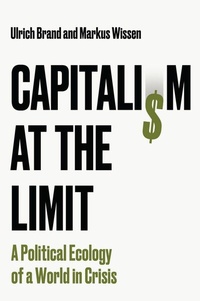
Capitalism at the Limit
Description

More details
Other editions
Additional editions
Persons
Markus Wissen is Professor of Social Sciences at the Berlin School of Economics and Law.
Content
Acknowledgements
1. Capitalism and the Climate Crisis
2. Monstrous Normality
3. The Limits of Externalisation
4. Green Capitalism
5. Eco-Imperial Tensions
6. Authoritarian Politics
7. Perspectives of Solidarity
Notes
Bibliography
1
Capitalism and the Climate Crisis
In 2022, an international team of renowned climate researchers made headlines as they warned against the danger of a climate endgame.1 They argued that the climate crisis could develop into a global catastrophe, which would not only cause social collapse, but also potentially result in the total extinction of humankind. The more commonly cited climate scenarios had underestimated this possibility, instead concentrating too narrowly on predicting the effects of a rise in temperatures of 1.5 or 2 degrees Celsius compared to the pre-industrial era. Currently, the scholars asserted, the world is heading for a rise of between 2.1 and 3.9 degrees Celsius by the year 2100. The related risks, particularly those emerging from the mutual amplification of distinct crises - the climate crisis, the loss of biodiversity, or pandemics - remain too underexplored as to rule out the worst case at this point. In this sense, we should also take these potential worst-case scenarios absolutely seriously in our analyses. In order to do just that, the climate scientists proposed studies that not only model cascading risks and extreme temperature rises, but also conduct research into previous instances of societies collapsing throughout human history.
Two aspects of the 'climate endgame' text are quite remarkable. On the one hand, the authors raise extremely urgent and relevant questions. Their suggestion that things may well become a lot worse than existing models have predicted certainly appears plausible: for example, a study by the European Union's (EU's) Copernicus Climate Change Service has shown that 2023 was probably the hottest year the planet has experienced in 125,000 years.2 Added to this are the most recent political developments, including wars, the failure to introduce adequate environmental policies, and the rise of an authoritarian (far) right.
On the other hand, it is all the more obvious that the proposed research agenda leaves the social causes of the climate crisis essentially unaddressed: that is, the underlying social relations and the actors who might still be able to prevent a catastrophe. What exactly is at stake in the 'climate endgame'? Who are the players involved? Do they all enter the game from similar starting points, or are most of the useful cards concentrated only in a few hands while the majority have been dealt a bad hand? Who decides the rules? And are all the players in this grim game really working as much as they can towards preventing the worst-case scenario? These kinds of questions are nowhere to be found in the text. With some exaggeration, we may translate the authors' implicit premise along the following lines: seeing as it is the fate of humanity as a whole that is at stake, hard natural scientific facts must take absolute precedence over everything else. We have no time to waste dealing with social scientific differentiations. After all, we are all in the same boat. And that boat is running the imminent risk of sinking.
The authors of the endgame text can be classed with the field of earth systems sciences which deal with the really big questions: with 'planetary boundaries' or the transition of humanity into a new era called the 'Anthropocene'. They increasingly also do make a side-glance at the social dimension of the ecological crisis: they acknowledge that social inequality is a catalyst of crisis, critically noting that those who are least responsible for the crisis are affected by it the most severely. And yet they only rarely raise questions about the social relations that produce these inequalities.3 Instead, the predominant understanding appears to be that the dramatic findings will eventually galvanize the public, so that 'the powers that be', in the form of decision-makers in government and society, will ultimately be unable to go on refusing to listen to 'the truth', namely science, and thus will translate the latter's insights into a more effective climate policy. 'Effective communication of research results will be key,' the endgame authors hopefully write.4
That such hopes are an illusion is well illustrated by the experience of the (now) former German government, made up of Social Democrats (SPD), Greens, and Liberals (FDP). In 2021, these parties had formed a supposed 'coalition of progress' ('Fortschrittskoalition'), proclaiming the re-foundation of the social market economy as a socio-ecological market economy.5 Their failure to live up to their promises was due only in part to the involvement of the FDP, a clientelistic party resisting any kind of progressive reforms, which held considerable power to blackmail its coalition partners - and used this power at every opportunity. This was the main reason why the coalition failed and Chancellor Scholz eventually kicked the Liberals out of the government coalition and announced early elections - a year sooner than the regaular election date. The roots of the issue go deeper: the apparatuses of the capitalist state possess a massive capacity to minimize or even ignore the greatest problem faced. Yet whenever anyone dares to advance a more ambitious political plan, it rapidly ends up in a conservative-populist propaganda maelstrom amplified by the yellow press.
This is no coincidence, nor is it exclusively a matter of the specific party coalition that may hold a majority in a particular parliament. Instead - and here we may cite a phrase by Claus Offe, which is still as accurate today as it was some fifty years ago - it is the outcome of 'the non-accidental (i.e. systematic) restriction of a scope of possibility'6: under capitalism, the state's policies are structurally limited by societal orientations and deeply entrenched relations of domination, which are inscribed in the state apparatuses (ministries, parliaments, or central banks) and internalized by civil servants and government personnel, and which delineate the horizon of what is considered politically possible.
For instance, environmental policy-makers fighting for the transition to electric automobility may face resistance from advocates of untrammelled fossil fuel use, but their objective is ultimately compatible with the fundamental logics that govern society and the state bureaucracy. Which is to say, it could fit with the logics of innovation; of strengthening a core industry of the German export model; of the protection of jobs for a mostly male industrial workforce; of the expansion of automotive infrastructures; and of the car-based mode of living. By contrast, whoever proposes overcoming the automobile-centred transport system and mode of living as such - as is urgently needed with a view to slowing down climate change - inevitably comes into conflict with these logics. For such an objective goes beyond the horizon of what is considered conceivable or feasible. It is at odds with oft-invoked 'realism' - although this is a very particular realism, of course, which systematically refuses to recognize and engage with the climate crisis in a way that would match the scale of the problem. To pin all one's hopes on galvanizing the masses once they learn about the scientific findings - which apparently only need to be more effectively communicated - is an inadequate and most certainly a frustrating approach.
This is even truer with regard to international organizations, in which the power imbalances of a fossil fuel-driven global economy are reproduced much more directly than in the national arenas, which are at least still somewhat balanced out by liberal democratic systems. The fact that the two recent World Climate Conferences took place in oil states - COP28 in Dubai, United Arab Emirates, in 2023, and COP29 in Baku, Azerbaijan, in 2024 - is particularly remarkable in this respect. It symbolizes the collision between the supposed force of the better argument (i.e. based on scientific insight) and the interests of a fossil politics and economy seeking to co-opt the ecological policy arenas.
Capitalism at its limits
We are not implying that (international) state politics and public opinion should not be taken seriously, or that there should be no attempts to expand the horizon of what is imaginable and possible in the here and now. However, it is important to always be aware of the systemic limits of such an endeavour, as well as of the fact that it can only succeed when pushed forward by the tailwind of progressive social forces. Ultimately, the task at hand is to expand the possibilities for political action by overcoming the social relations that restrict it: relations which not only destroy nature and non-human life on a vast scale, but in which the human being - as a part of the natural world - is 'a debased, enslaved, forsaken, despicable being'.7
In order to do this, we need a clear understanding of the social relations and of the logics - often taken for granted or seen as entirely natural - that govern our mode of living, and which are neither self-evident nor without alternative. We must comprehend capitalism and its many links with patriarchal, racialized, and colonial relations of domination. And, given the depth of the crisis we are currently in, we need, above all, a clear concept of the limits of capitalism. More specifically, we need an understanding of the many boundaries that capitalist societies are today encountering due to their inherent...
