

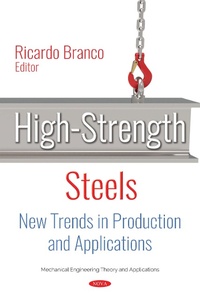
High-Strength Steels: New Trends in Production and Applications
New Trends in Production and Applications
Published on 1. June 2018
327 pages
978-1-5361-3907-5 (ISBN)
Description

High strength steels cover a broad spectrum of applications and are being increasingly used in different areas due to their distinguished features, namely excellent strength-to-weight ratio, good corrosion resistance, deep hardenability, high ductility, high toughness and high strength. These features make them ideal for critical structural applications undergoing severe service conditions and aggressive environments. Long-term durability requires a systematic identification of failure risks and the development of accurate design methodologies. This book covers leading-edge research in these areas. The topics addressed include temperature and stress triaxiality effects on deformation and fracture, analysis of hydrogenation via local electrochemical techniques, second-order direct design methods of columns, hydrogen-steel interactions in automotive transmissions subjected to low-cycle fatigue histories, strain-based design methods for crossing fault rupture in pipelines, metallurgical and technological weldability of quenched and tempered steels, and local-overall interaction buckling phenomena in welded thin-walled columns and beam-columns.
More details
Other editions
Additional editions
Book
07/2018
Nova Science Publishers Inc
€362.47
Shipment within 15-20 days
Content
- Intro
- Contents
- Preface
- Chapter 1
- Effects of Temperature and Stress Triaxiality on Deformation and Fracture Behaviour of High-Strength Rail Steels
- Abstract
- Introduction
- Theoretical Background
- Extended Strain Energy Density Model
- Equivalent Plastic Fracture Strain of Pre-Cracked SENB Specimen
- Experiments
- Materials and Test Specimens
- Tensile Test of Smooth Specimens
- Tensile Test of Short-Gauged Specimens
- Three-Point Bending Test
- Finite Element Modelling
- Temperature Effect on Mechanical Properties
- Smooth and Short-Gauged Tensile Specimens
- Fracture Toughness
- KSc Prediction Based on an Extended SED Model
- Constitutive Equation
- Average Stress Triaxiality
- Fracture Locus
- KSc Prediction
- Conclusion
- Acknowledgments
- References
- Chapter 2
- Hydrogen Entry and Distribution in Steel: Assessments by Different Local Electrochemical Techniques
- Abstract
- Introduction
- Results and Discussion
- Scanning Electrochemical Microscopy (SECM)
- Scanning Vibrating Electrode (SVET) and Local Electrochemical Impedance (LEIS) Techniques
- Scanning Kelvin Probe (SKP) Technique
- SKP Application for Determination of Localized Stress
- SKP Technique for Determination of the Hydrogen in Steels
- Conclusion
- References
- Chapter 3
- New Design Theory of Second-Order Direct Analysis for High-Strength Steel Columns
- Abstract
- Introduction
- Background and Literature Review
- High-Strength Steel Materials
- Residual Stress
- High-Strength Steel Columns
- Second-Order Direct Analysis Method
- Design by Second-Order Direct Analysis Method for High-Strength Steel Columns
- Beam-Column Element Formulations
- Plastic Fibre Hinge Model
- Cross Section Analysis Technique
- Analysis Examples
- Verification of Sectional Analysis Technique with Residual Stress
- (a) Box-Section with Residual Stress
- (b) H-Section with Residual Stress
- Direct Analysis of High-Strength Steel Columns
- (a) Welded Box-Column with Q460 High-Strength Steel
- (b) Welded H-Column with Q460 High-Strength Steel
- Conclusion
- Acknowledgments
- References
- Chapter 4
- Interactions and Effects of Hydrogen on High Strength Steels
- Abstract
- Introduction
- Experimetal Methods
- Hydrogen in Fatigue
- Fatigue Behavior
- Fractography
- Thermal Analysis
- Silver Decoration Technique
- Conclusion
- References
- Chapter 5
- Strain-Based Design Method for High-Strength Steel Pipelines in Active Fault Crossing Areas
- Abstract
- Introduction
- Material Model for High Strength Pipe Steel
- Ramberg-Osgood Model
- Novel Material Stress-Strain Characterization Model Proposed by UOA
- Strain Demand Analysis Method for Buried Pipe Subjected to Fault Displacements
- Fault Displacement Magnitudes
- Numerical Model for Strain Demand Calculation
- Modeling Soil Constraints on Pipe
- Modeling Pipe
- Load and Boundary Conditions
- Strain Capacity Models for High-Strength Pipe
- Tensile Strain Capacity Model
- Compressive Strain Capacity Model
- Allowable Strain for Pipeline Design
- SBD Procedure for Buried High-Strength Pipe
- SBD Procedure
- Case Study for Xinyuezhe X80 Gas Pipeline in China
- Case Description
- Stress-Strain Material Characteristic of X80 Steel
- Allowable Strain Values of X80 Steel
- Soil Parameters in This Case
- SBD Procedure
- Conclusion
- References
- Chapter 6
- High Strength Quenched and Tempered Steels: Weldability and Welding
- Abstract
- 1. Introduction
- 2. Weldability
- 2.1. Definition
- 2.1.1. Evaluation of the Weldability Based on Carbon Equivalent
- 2.1.2. Continuous - Cooling - Transformation Diagram
- 2.1.3. Technological Tests
- 2.1.4. Physical Simulation
- 2.1.4.1. Physical Simulation of Steel S890Q (St-890)
- 2.1.4.2. Physical Simulation of Steel S960Q (XABO 960) Steel
- 2.1.4.3. Physical Simulation of Steel Weldox 1100 Steel
- 2.1.4.4. Physical Simulation of Steel Weldox 1300 Steel
- 2.1.4.5. Physical Simulation of High Strength Steels - Summary
- 2.2. Weldability of the High Strength Steel - Summary
- 2.2.1. Cold Cracking
- 2.2.2. Hot Cracking
- 2.2.3. Lamellar Cracking
- 2.2.4. Soft Layer Issue
- 2.2.5. Failing to Obtain Required Toughness in the Weld and HAZ
- 3. Welding of High Strength Steel
- 3.1. Introduction
- 3.2. Filler Material
- 3.3. Preheating, Interpass and Postweld Heat Treatment - Procedures
- 3.4. Welding Processes
- 3.4.1. GTA Welding
- 3.4.2. Manual Metal Arc Welding
- 3.4.3. Submerged Arc Welding
- 3.4.4. GMA Welding
- 3.4.5. Flux Cored Arc Welding
- 3.4.6. Laser Hybrid Welding
- 3.4.7. Electron Beam Welding
- 3.4.8. Repair Welding of High Strength Steel
- 4. Economic Aspect of Welding of High Strength Steels
- Conclusion
- References
- Chapter 7
- Local-Overall Interaction Buckling of HSS Welded Thin-Walled Columns and Beam-Columns
- Abstract
- 1. Introduction
- 2. Cross-Sections of HSS Thin-Walled Columns and Beam-Columns
- 2.1. American Specification ANSI/AISC 360-16
- 2.2. European Standard EN 1993-1-1: 2005
- 2.3. Chinese Code GB 50017-2003
- 3. Material Models for HSSs
- 3.1. HSS Material Property Tests
- 3.2. HSS Material Models
- 4. Residual Stress Distribution Models in HSS Welded Cross-Sections
- 4.1. Welded I-Sections
- 4.2. Welded Box-Sections
- 4.3. Welded Tube-Sections
- 5. Finite Element Model for HSS Welded Thin-Walled Columns
- 5.1. Finite Element Model
- 5.2. Verification of the Finite Element Model
- 6. Local-Overall Interaction Buckling Behavior of HSS Welded Thin-Walled Columns
- 6.1. Load-Deformation Responses
- 6.2. The Effect of Different Parameters on the Strength of Welded Thin-Walled Box Columns
- 6.2.1. Amplitudes of the Geometrical Imperfections
- 6.2.2. Residual Stresses
- 6.2.3. Strain Hardening of Material
- 6.2.4. Yield Strengths of HSSs
- 6.2.5. Width-To-Thickness Ratio
- 6.2.6. Column Slenderness Ratio
- 7. Calculation Formulas for the Strength of HSS Welded Thin-Walled Columns in Some Steel Structural Standards
- 7.1. EWM
- 7.1.1. American Standard ANSI/AISC 360-16
- 7.1.2. Eurocode EN 1993-1
- 7.1.3. Chinese Code GB50017-2003
- 7.2. DSM
- 8. Proposed New Methods for Calculation of HSS Welded Thin-Walled Columns
- 8.1. Modified EWM
- 8.2. Modified DSM
- 8.3. EYSM
- 9. Finite Element Model for HSS Welded Thin-Walled Beam-Columns
- 9.1. Geometrical Imperfections
- 9.2. Boundary Conditions and Load Application
- 10. Local and Overall Interaction Buckling Behavior of HSS Welded Thin-Walled Beam-Columns
- 10.1. Load-Displacement or Load-Rotation Curve
- 10.2. The Effect of Parameters on the Ultimate Load Carrying Capacity
- 10.2.1. Slenderness Ratio
- 10.2.2. Width-to-Thickness Ratio
- 10.2.3. Height-to-Thickness Ratio
- 10.2.4. Relative Eccentricity Ratio
- 10.3. Axial Load and Bending Moment Interaction Curves
- 11. Calculation Formulas for the Strength of HSS Welded Thin-Walled Beam-Columns in Some Steel Structural Standards
- 11.1. American Standard ANSI/AISC 360-16 and AISI S100 2016
- 11.2. Eurocode EN 1993-1-1:2005
- 11.3. Chinese Code GB 50017-2003
- 12. Proposed New Methods for Calculation of HSS Welded Thin-Walled Beam-Columns
- Conclusion
- References
- Editor's Contact Information
- Index
- Blank Page
