

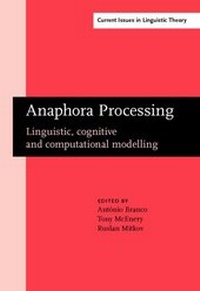
Anaphora Processing
Linguistic, cognitive and computational modelling
1st Edition
Published on 27. January 2005
X, 449 pages
978-90-272-9467-8 (ISBN)
Description

Anaphora processing is a central topic in the study of natural language and has long been the object of research in a wide range of disciplines. The correct interpretation of anaphora has also become increasingly important for real-world natural language processing applications, including machine translation, automatic abstracting, information extraction and question answering.
This volume provides a unique overview of the processing of anaphora from a multi- and inter-disciplinary angle. It will be of interest and practical use to readers from fields as diverse as theoretical linguistics, corpus linguistics, computational linguistics, computer science, natural language processing, artificial intelligence, human language technology, psycholinguistics, cognitive science and translation studies.
The readership includes but is not limited to university lecturers, researchers, postgraduate and senior undergraduate students.
This volume provides a unique overview of the processing of anaphora from a multi- and inter-disciplinary angle. It will be of interest and practical use to readers from fields as diverse as theoretical linguistics, corpus linguistics, computational linguistics, computer science, natural language processing, artificial intelligence, human language technology, psycholinguistics, cognitive science and translation studies.
The readership includes but is not limited to university lecturers, researchers, postgraduate and senior undergraduate students.
More details
Other editions
Additional editions
Antonio Branco | Tony McEnery | Ruslan Mitkov
Anaphora Processing
Linguistic, cognitive and computational modelling
Book
01/2005
John Benjamins Publishing Co
€127.20
Shipment within 10-15 days
Persons
Content
- ANAPHORA PROCESSING
- Editorial page
- Title page
- LCC data
- Contents
- EDITORS' FOREWORD
- I. Computational Treatment
- A Sequenced Model of Anaphora and Ellipsis Resolution
- References
- How to Deal with Wicked Anaphora?
- Acknowledgments
- References
- A Machine Learning Approach to Preference Strategies for Anaphor Resolution
- References
- Decomposing Discourse
- Acknowledgements
- References
- A Lightweight Approach to Coreference Resolution for Named Entities in Text
- References
- A Unified Treatment of Spanish se
- References
- II. Theoretical, Psycholinguistic and Cognitive Issues
- Binding and Beyond: Issues in Backward Anaphora
- References
- Modelling Referential Choice in Discourse
- References
- Appendix
- Degrees of Indirectness: Two Types of Implicit Referents and their Retrieval via Unaccented Pronouns
- References
- Appendix
- Pronominal Interpretation and the Syntax-Discourse Interface: Real-time Comprehension and Neurological Properties
- References
- Top-down and Bottom-up Effects on the Interpretation of Weak Object Pronouns in Greek
- Acknowledgments
- References
- Different Forms Have Different Referential Properties: Implications for the Notion of 'Salience'
- References
- Referential Accessibility and Anaphor Resolution
- References
- III. Corpus-Based Studies
- The Predicate-Argument Structure of Discourse Connectives
- References
- Annex
- Combining Centering-Based Models of Salience and Information Structure for Resolving Intersentential Pronominal Anaphora
- References
- Pronouns Without NP Antecedents
- 7 References
- Syntactic Form and Discourse Accessibility
- References
- Coreference and Anaphoric Relations of Demonstrative Noun Phrases in Multilingual Corpus
- Acknowledgments
- References
- Anaphoric Demonstratives: Dealing with the Hard Cases
- References
- Focus, Activation, and This-Noun Phrases: An Empirical Study
- Acknowledgments
- References
- Index of Subjects and Terms
- The series Current Issues in Linguistic Theory
