

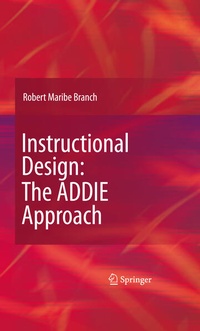
Instructional Design: The ADDIE Approach
Description

The Analyze, Design, Develop, Implement, and Evaluate (ADDIE) process is used to introduce an approach to instruction design that has a proven record of success. Instructional Design: The ADDIE Approach is intended to serve as an overview of the ADDIE concept. The primary rationale for this book is to respond to the need for an instruction design primer that addresses the current proliferation of complex educational development models, particularly non-traditional approaches to learning, multimedia development and online learning environments.
Many entry level instructional designers and students enrolled in related academic programs indicate they are better prepared to accomplish the challenging work of creating effective training and education materials after they have a thorough understanding of the ADDIE principles. However, a survey of instructional development applications indicate that the overwhelming majority of instructional design models are based on ADDIE, often do not present the ADDIE origins as part of their content, and are poorly applied by people unfamiliar with the ADDIE paradigm.
The purpose of this book is to focus on fundamental ADDIE principles, written with a minimum of professional jargon. This is not an attempt to debate scholars or other educational professionals on the finer points of instructional design, however, the book's content is based on sound doctrine and supported by valid empirical research. The only bias toward the topic is that generic terms will be used as often as possible in order to make it easy for the reader to apply the concepts in the book to other specific situations.
More details
Other editions
Additional editions
Person
Robert Maribe Branch is a tenured Professor of Instructional Design and Technology at the University of Georgia. Rob earned an Associate degree from New York City Technical College in Brooklyn, New York; a Bachelor of Science degree from Elizabeth City State University, North Carolina; and a Masters degree from Ball State University in Muncie, Indiana. Dr. Branch taught high school in Botswana as a Peace Corps volunteer and later returned to the United States, and completed a Doctor of Education degree from Virginia Tech in Blacksburg, Virginia in 1989 specializing in curriculum development and instructional design. Dr. Branch joined the faculty at Syracuse University and taught graduate courses and conducted research in the Department of Instructional Design, Development and Evaluation, and earned tenure during his seven years there. Dr. Branch is a former Fulbright Lecturer/Researcher to the University of Natal in South Africa where he helped to inaugurate a Masters degree program in Media Studies. Dr. Branch has co-edited the Educational Media and Technology Yearbook since 1997, and co-authored the two recent editions of the popular Survey of Instructional Development Models book. Dr. Branch emphasizes student-centered learning, teaches courses related to instructional systems design, and consults regularly with governments, businesses and other educational institutions. Dr. Branch's published research focuses on diagramming complex conceptual relationships and other flow processes.
