

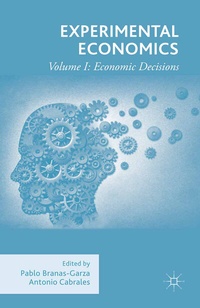
Experimental Economics
Volume I: Economic Decisions
Published on 22. September 2015
XVII, 189 pages
978-1-137-53819-2 (ISBN)
Description

How do humans make choices, both when facing nature and when interacting with one another? Experimental Economics Volume I seeks to answer these questions by examining individual's choices in strategic settings and predicting choices based on experimental methodology.
More details
Other editions
Additional editions
Book
09/2015
Palgrave Macmillan
€128.39
Shipment within 10-20 days

Pablo Branas-Garza | Antonio Cabrales | Pablo Branas-Garza
Experimental Economics
Volume I: Economic Decisions
Book
01/2014
Palgrave Macmillan
€96.29
The article will not be published
Persons
Pablo Branas-Garza joined Middlesex University as Professor of Behavioural Economics in October 2012. Previously he was Professor of Economic Theory at the University of Granada, Spain, since 2008. He did his PhD in Quantitative Economics (1997) in the University of Córdoba, Spain. His research focuses on experimental games and economic behaviour. More specifically he works on altruism and cooperative behaviour, cognitive abilities and preferences.
He has published in leading journals such as Proceedings Royal Society B, Games & Economic Behavior, PLoS ONE, Journal of Conflict Resolution, Journal of Economic Behavior & Organization, Journal of Behavioral Decision Making, Economics Letters, Experimental Economics, Journal of Economic Psychology, Journal of Money, Credit & Banking. He is an Academic Editor of PLoS ONE and Associate Editor of The Journal of Experimental and Behavioral Economics.
Antonio Cabrales is Professor of Economics at University College London. Formerly, he was a Professor at Universitat Pompeu Fabra in Barcelona, Spain and Universidad Carlos III in Madrid, Spain. He holds a PhD in Economics from the University of California, San Diego, US. He has worked in a wide range of topics: learning and evolutionary games, experimental economics, industrial organization, the economics of networks and mechanism design. He is an associate editor at the Journal of Economic Theory, and SERIEs. He has been an Editor of the Berkeley ElectronicJournal of Economic Analysis and Policy and Investigaciones Económicas; and Associate Editor of the Journal of the European Economic Association. He is founding partner of a financial consultant (Serfiex S.A.) and has been a consultant on competition policy issues.
He has published in the American Economic Review, Journal of Political Economy, the Review of Economic Studies, Physical Review Letters, PLoS ONE, Scientific Reports and other scholarly journals.
He has published in leading journals such as Proceedings Royal Society B, Games & Economic Behavior, PLoS ONE, Journal of Conflict Resolution, Journal of Economic Behavior & Organization, Journal of Behavioral Decision Making, Economics Letters, Experimental Economics, Journal of Economic Psychology, Journal of Money, Credit & Banking. He is an Academic Editor of PLoS ONE and Associate Editor of The Journal of Experimental and Behavioral Economics.
Antonio Cabrales is Professor of Economics at University College London. Formerly, he was a Professor at Universitat Pompeu Fabra in Barcelona, Spain and Universidad Carlos III in Madrid, Spain. He holds a PhD in Economics from the University of California, San Diego, US. He has worked in a wide range of topics: learning and evolutionary games, experimental economics, industrial organization, the economics of networks and mechanism design. He is an associate editor at the Journal of Economic Theory, and SERIEs. He has been an Editor of the Berkeley ElectronicJournal of Economic Analysis and Policy and Investigaciones Económicas; and Associate Editor of the Journal of the European Economic Association. He is founding partner of a financial consultant (Serfiex S.A.) and has been a consultant on competition policy issues.
He has published in the American Economic Review, Journal of Political Economy, the Review of Economic Studies, Physical Review Letters, PLoS ONE, Scientific Reports and other scholarly journals.
Content
1. Experiments In Economics; Pablo Brañas Garza, Middlesex University London And Iván Barreda, LEE And Jaume I University, Castellon
2. Individual Decision Making; Manel Baucells, Darden School Of Business, University Of Virginia And Konstantinos V. Katsikopoulos, Max Planck Institute For Human Development, Berlin
3. Game Theory: The Basics; Penelope Hernandez, ERI-CES And University Of Valencia Marina Pavan, LEE And Jaume I University, Castellon
4. Coordination Games; Maria Paz Espinosa, University Of The Basque Country And Penelope Hernandez, ERI-CES And University Of Valencia
5. Initial Responses In Strategic Situations; Nagore Iriberri, Ikerbasque And University Of The Basque Country And Pedro Rey Biel, BGSE And Autonomous University Of Barcelona
6. Social Preferences; Antonio Cabrales, University College London And Giovanni Ponti, University Of Alicante And LUISS Guido Carli, Rome
7. Cooperation; Juan A. Lacomba, GLOBE And University Of Granada And Raul Lopez, Autonomous University Of Madrid
8. Bargaining; Aurora García Gallego, LEE And Jaume I University, Castellon And Luis M. Miller, University Of The Basque Country
9. Responses From The Body: An Introduction To Neuroeconomics; Giorgio Coricelli, University Of Southern California, Los Angeles And Rosemarie Nagel, ICREA, Pompeu Fabra University And BGSE, Barcelona
10. Gender Differences In Cooperation And Competition; Roberto Hernán, Nottingham University And Praveen Kujal, Middlesex University London
2. Individual Decision Making; Manel Baucells, Darden School Of Business, University Of Virginia And Konstantinos V. Katsikopoulos, Max Planck Institute For Human Development, Berlin
3. Game Theory: The Basics; Penelope Hernandez, ERI-CES And University Of Valencia Marina Pavan, LEE And Jaume I University, Castellon
4. Coordination Games; Maria Paz Espinosa, University Of The Basque Country And Penelope Hernandez, ERI-CES And University Of Valencia
5. Initial Responses In Strategic Situations; Nagore Iriberri, Ikerbasque And University Of The Basque Country And Pedro Rey Biel, BGSE And Autonomous University Of Barcelona
6. Social Preferences; Antonio Cabrales, University College London And Giovanni Ponti, University Of Alicante And LUISS Guido Carli, Rome
7. Cooperation; Juan A. Lacomba, GLOBE And University Of Granada And Raul Lopez, Autonomous University Of Madrid
8. Bargaining; Aurora García Gallego, LEE And Jaume I University, Castellon And Luis M. Miller, University Of The Basque Country
9. Responses From The Body: An Introduction To Neuroeconomics; Giorgio Coricelli, University Of Southern California, Los Angeles And Rosemarie Nagel, ICREA, Pompeu Fabra University And BGSE, Barcelona
10. Gender Differences In Cooperation And Competition; Roberto Hernán, Nottingham University And Praveen Kujal, Middlesex University London
