

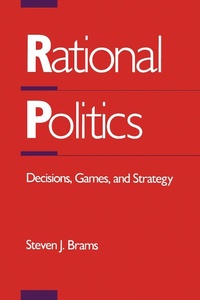
Rational Politics
Decisions, Games, and Strategy
Published on 10. May 2014
248 pages
978-1-4832-5857-7 (ISBN)
Description

Rational Politics: Decisions, Games, and Strategy focuses on the unified presentation of politics as a rational human activity, including the paradox of voting and proportional representation. The publication first offers information on the study of rational politics, political intrigue in the Bible, and candidate strategies. Topics include the factor of timing in presidential primaries, rational positions in a multicandidate race, primacy of issues and their spatial representation, and politics in the story of Esther. The text then elaborates on voting paradoxes and the problems of representation, voting power, and threats and deterrence. Discussions focus on a sequential view of the Cuban missile crisis, use of threat power in Poland, power anomalies in the European Community Council of Ministers, probability of the paradox of voting, empirical examples of the paradox of voting, and problems in achieving proportional representation. The book is a valuable reference for researchers interested in rational politics.
More details
Other editions
Additional editions

Book
01/1989
Academic Press
€26.00
Article exhausted; check different version
Content
¿Preface1 The Study of Rational Politics2 Political Intrigue in the Bible: Esther 2.1 Introduction 2.2 The Demise of Queen Vashti 2.3 Esther's Intercession 2.4 Vindication 2.5 Politics in Esther 2.6 Ethics in Esther3 Candidate Strategies 3.1 Introduction 3.2 The Primacy of Issues and Their Spatial Representation 3.3 Rational Positions in a Two-Candidate Race 3.4 Rational Positions in a Multicandidate Race 3.5 The Winnowing-Out Process in Presidential Primaries 3.6 The Factor of Timing in Presidential Primaries 3.7 Fuzzy Candidate Positions and Voter Alienation 3.8 Conclusions4 Voting Paradoxes and Problems of Representation 4.1 Introduction 4.2 The Paradox of Voting 4.3 Arrow's General Possibility Theorem 4.4 Relaxing Arrow's Conditions 4.5 Probability of the Paradox of Voting 4.6 Empirical Examples of the Paradox of Voting 4.7 The Monotonicity Paradox 4.8 Problems in Achieving Proportional Representation 4.9 The Apportionment Problem 4.10 Conclusions5 Voting Power 5.1 Introduction 5.2 The Paradox of the Chair's Position 5.3 The Chair's Counterstrategy of Deception 5.4 Banzhaf Voting Power 5.5 The Paradox of New Members 5.6 Power Anomalies in the European Community Council of Ministers 5.7 Conclusions6 Threats and Deterrence 6.1 Introduction 6.2 The Use of Threat Power in Poland, 1980-1981 6.3 The Cuban Missile Crisis as a Game of Chicken 6.4 Deception and Power in the Cuban Missile Crisis 6.5 A Sequential View of the Cuban Missile Crisis 6.6 Nonmyopic Equilibria and the Theory of Moves: The Search for Farsighted Solutions 6.7 Conclusions7 Traps: No-Win Situations 7.1 Introduction 7.2 Prisoners' Dilemma 7.3 The Superpower Arms Race as a Prisoners' Dilemma 7.4 Consequences of Mutual Predictability in Prisoners' Dilemma 7.5 The Superpower Arms Race as a Two-Stage Prisoners' Dilemma 7.6 The Effects of Power in Prisoners' Dilemma 7.7 The White House Tapes Case: The Players and Their Preferences 7.8 The White House Tapes Case: The Trap 7.9 Conclusions8 Coalitions 8.1 Introduction 8.2 Political Parties as Coalitions 8.3 Reconciling the Conflicting Interests within Parties 8.4 Optimal Candidate Positions in a Campaign 8.5 Optimal Positions in Actual Presidential Campaigns 8.6 The Size Principle 8.7 Applications of the Size Principle to Politics 8.8 An Alternative Goal: Maximizing One's Share of Spoils 8.9 The Bandwagon Curve 8.10 Conclusions9 Strategy and EthicsGlossaryBibliographyIndex
