

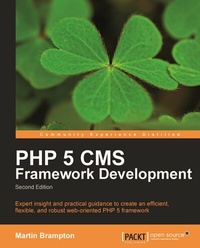
PHP 5 CMS Framework Development - 2nd Edition
For professional PHP developers, this is the perfect guide to web-oriented frameworks and content management systems. Covers all the critical design issues and programming techniques in an easy-to-follow style and structure.
Published on 13. January 2025
416 pages
978-1-84951-135-3 (ISBN)
Description

For professional PHP developers, this is the perfect guide to web-oriented frameworks and content management systems. Covers all the critical design issues and programming techniques in an easy-to-follow style and structure.
Key Features
Learn about the design choices involved in the creation of advanced web oriented PHP systems
Build an infrastructure for web applications that provides high functionality while avoiding pre-empting styling choices
Implement solid mechanisms for common features such as menus, presentation services, user management, and more
Written by a seasoned developer of CMS applications and other modern software
Book DescriptionIf you want an insight into the critical design issues and programming techniques required for a web oriented framework in PHP5, this book will be invaluable. Whether you want to build your own CMS style framework, want to understand how such frameworks are created, or simply want to review advanced PHP5 software development techniques, this book is for you.As a former development team leader on the renowned Mambo open-source content management system, author Martin Brampton offers unique insight and practical guidance into the problem of building an architecture for a web oriented framework or content management system, using the latest versions of popular web scripting language PHP.The scene-setting first chapter describes the evolution of PHP frameworks designed to support web sites by acting as content management systems. It reviews the critical and desirable features of such systems, followed by an overview of the technology and a review of the technical environment.Following chapters look at particular topics, with:'AEc A concise statement of the problem 'AEc Discussion of the important design issues and problems faced 'AEc Creation of the framework solution At every point, there is an emphasis on effectiveness, efficiency and security 'AEi all vital attributes for sound web systems. By and large these are achieved through thoughtful design and careful implementation. Early chapters look at the best ways to handle some fundamental issues such as the automatic loading of code modules and interfaces to database systems. Digging deeper into the problems that are driven by web requirements, following chapters go deeply into session handling, caches, and access control. New for this edition is a chapter discussing the transformation of URLs to turn ugly query strings into readable strings that are believed to be more 'AEusearch engine friendly'AEu and are certainly more user friendly. This topic is then extended into a review of ways to handle 'AEufriendly'AEu URLs without going through query strings, and how to build RESTful interfaces. The final chapter discusses the key issues that affect a wide range of specific content handlers and explores a practical example in detail.What you will learn
Effective coding techniques, illustrated through examples of key parts of sample solutions, along with detailed explanations.
Object architectures to fully exploit PHP 5 in advanced systems
A foundation for database processing to ease further development
Technical functions such as handling user sessions and the efficient creation and use of caches
How to support add-on applications to extend the main framework
Flexible and efficient ways to deal with supporting different world languages
Reviews and practical solutions for topics including XML handling, configuration management, editing, file system interfaces, mail, spam, timed operations and parameter objects
Transforming query string URLs to be more 'AEufriendly'AEu both for people and search engines
Alternative ways to deal with presentation services, including discussion of MVC (model-view-controller)
Who this book is forIf you are a professional PHP developer who wants to know more about web oriented frameworks and content management systems, this book is for you. Whether you already use an in-house developed framework or are developing one, or if you are simply interested in the issues involved in this demanding area, you will find discussion ranging from design issues to detailed coding solutions in this book.You are expected to have experience working with PHP 5 object-oriented programming. Examples in the book will run on any recent version of PHP 5, including 5.3.
Key Features
Learn about the design choices involved in the creation of advanced web oriented PHP systems
Build an infrastructure for web applications that provides high functionality while avoiding pre-empting styling choices
Implement solid mechanisms for common features such as menus, presentation services, user management, and more
Written by a seasoned developer of CMS applications and other modern software
Book DescriptionIf you want an insight into the critical design issues and programming techniques required for a web oriented framework in PHP5, this book will be invaluable. Whether you want to build your own CMS style framework, want to understand how such frameworks are created, or simply want to review advanced PHP5 software development techniques, this book is for you.As a former development team leader on the renowned Mambo open-source content management system, author Martin Brampton offers unique insight and practical guidance into the problem of building an architecture for a web oriented framework or content management system, using the latest versions of popular web scripting language PHP.The scene-setting first chapter describes the evolution of PHP frameworks designed to support web sites by acting as content management systems. It reviews the critical and desirable features of such systems, followed by an overview of the technology and a review of the technical environment.Following chapters look at particular topics, with:'AEc A concise statement of the problem 'AEc Discussion of the important design issues and problems faced 'AEc Creation of the framework solution At every point, there is an emphasis on effectiveness, efficiency and security 'AEi all vital attributes for sound web systems. By and large these are achieved through thoughtful design and careful implementation. Early chapters look at the best ways to handle some fundamental issues such as the automatic loading of code modules and interfaces to database systems. Digging deeper into the problems that are driven by web requirements, following chapters go deeply into session handling, caches, and access control. New for this edition is a chapter discussing the transformation of URLs to turn ugly query strings into readable strings that are believed to be more 'AEusearch engine friendly'AEu and are certainly more user friendly. This topic is then extended into a review of ways to handle 'AEufriendly'AEu URLs without going through query strings, and how to build RESTful interfaces. The final chapter discusses the key issues that affect a wide range of specific content handlers and explores a practical example in detail.What you will learn
Effective coding techniques, illustrated through examples of key parts of sample solutions, along with detailed explanations.
Object architectures to fully exploit PHP 5 in advanced systems
A foundation for database processing to ease further development
Technical functions such as handling user sessions and the efficient creation and use of caches
How to support add-on applications to extend the main framework
Flexible and efficient ways to deal with supporting different world languages
Reviews and practical solutions for topics including XML handling, configuration management, editing, file system interfaces, mail, spam, timed operations and parameter objects
Transforming query string URLs to be more 'AEufriendly'AEu both for people and search engines
Alternative ways to deal with presentation services, including discussion of MVC (model-view-controller)
Who this book is forIf you are a professional PHP developer who wants to know more about web oriented frameworks and content management systems, this book is for you. Whether you already use an in-house developed framework or are developing one, or if you are simply interested in the issues involved in this demanding area, you will find discussion ranging from design issues to detailed coding solutions in this book.You are expected to have experience working with PHP 5 object-oriented programming. Examples in the book will run on any recent version of PHP 5, including 5.3.
All prices
More details
Edition
Digital original
Language
English
Place of publication
Birmingham
United Kingdom
Edition type
Digital original
File size
0,93 MB
ISBN-13
978-1-84951-135-3 (9781849511353)
Copyright in bibliographic data and cover images is held by Nielsen Book Services Limited or by the publishers or by their respective licensors: all rights reserved.
Schweitzer Classification
Other editions
Additional editions
Martin Brampton
PHP 5 CMS Framework Development - 2nd Edition
Book
08/2010
Packt Publishing
€64.00
Shipment within 3-4 weeks
Person
Brampton Martin :
Now primarily a software developer and writer, Martin Brampton started out studying mathematics at Cambridge University. He then spent a number of years helping to create the so-called legacy, which remained in use far longer than he ever expected. He worked on a variety of major systems in areas like banking and insurance, spiced with occasional forays into technical areas such as cargo ship hull design and natural gas pipeline telemetry. After a decade of heading IT for an accountancy firm, a few years as a director of a leading analyst firm, and an MA degree in Modern European Philosophy, Martin finally returned to his interest in software, but this time transformed into web applications. He found PHP5, which fits well with his prejudice in favor of programming languages that are interpreted and strongly object oriented. Utilizing PHP, Martin took on development of useful extensions for the Mambo (and now also Joomla!) systems, then became leader of the team developing Mambo itself. More recently, he has written a complete new generation CMS named Aliro, many aspects of which are described in this book. He has also created a common API to enable add-on applications to be written with a single code base for Aliro, Joomla (1.0 and 1.5) and Mambo. All in all, Martin is now interested in many aspects of web development and hosting; he consequently has little spare time. But his focus remains on object oriented software with a web slant, much of which is open source. He runs Black Sheep Research, which provides software, speaking and writing services, and also manages web servers for himself and his clients.
Now primarily a software developer and writer, Martin Brampton started out studying mathematics at Cambridge University. He then spent a number of years helping to create the so-called legacy, which remained in use far longer than he ever expected. He worked on a variety of major systems in areas like banking and insurance, spiced with occasional forays into technical areas such as cargo ship hull design and natural gas pipeline telemetry. After a decade of heading IT for an accountancy firm, a few years as a director of a leading analyst firm, and an MA degree in Modern European Philosophy, Martin finally returned to his interest in software, but this time transformed into web applications. He found PHP5, which fits well with his prejudice in favor of programming languages that are interpreted and strongly object oriented. Utilizing PHP, Martin took on development of useful extensions for the Mambo (and now also Joomla!) systems, then became leader of the team developing Mambo itself. More recently, he has written a complete new generation CMS named Aliro, many aspects of which are described in this book. He has also created a common API to enable add-on applications to be written with a single code base for Aliro, Joomla (1.0 and 1.5) and Mambo. All in all, Martin is now interested in many aspects of web development and hosting; he consequently has little spare time. But his focus remains on object oriented software with a web slant, much of which is open source. He runs Black Sheep Research, which provides software, speaking and writing services, and also manages web servers for himself and his clients.
Content
Table of Contents

