

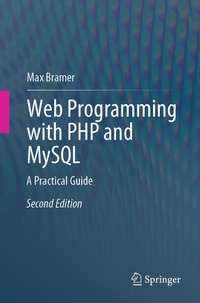
Web Programming with PHP and MySQL
Description

The second edition of this introductory textbook covers all the main features of the 'web programming' languages PHP and MySQL, together with detailed examples that will enable readers (whether students on a taught course or independent learners) to create their own applications or understand existing ones. A particular focus is the use of PHP to generate MySQL commands to access a relational database from a script as it is executed.
Each chapter includes aims, a summary and practical exercises (with solutions) to support learning. Chapters are designed to stand alone as far as possible, so that they can be studied independently of the rest of the text by those with some previous knowledge of the languages. There is a comprehensive glossary of technical terms, together with extensive appendices for quick reference of language features.
Amongst revisions made since the first edition, the mysql family of functions used for database access has been replaced by the improved mysqli functions throughout and further chapters have been added giving detailed accounts showing how to tackle some important practical applications. All the examples in this second edition have been tested using PHP version 8.3.22.
More details
Other editions
Additional editions
Person
Max Bramer is Emeritus Professor of Information Technology at the University of Portsmouth, England. He has designed and implemented many websites for over 20 years and has made extensive use of PHP and MySQL in his work.
His other Springer publications include successful textbooks on 'Principles of Data Mining' and 'Logic Programming with Prolog'.
Content
Introduction.- PHP Fundamentals.- The PHP Language: Types of Statement.- More About Arrays.- Some Important Functions.- Formatted Print Functions.- Using Files.- User-Defined Functions.- Passing Variables to a PHP Script I.- Passing Variables to a PHP Script II.- PHP in Action: Managing a Members' Area.- Using a MySQL Database I.- Using a MySQL Database II.- Creating and Updating MySQL Tables.- Using a PHP Script to Manage a MySQL Database.- PHP in Action: Converting Data between Text Files and Database Tables.- Using PHP to View and Edit Database Tables.- PHP in Action: Maintaining a Membership List.- Appendices.
