

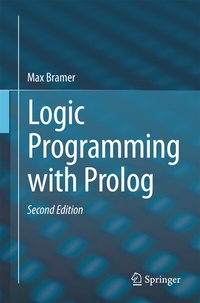
Logic Programming with Prolog
Description

Logic Programming is the name given to a distinctive style of programming, very different from that of conventional programming languages such as C++ and Java. By far the most widely used Logic Programming language is Prolog. Prolog is a good choice for developing complex applications, especially in the field of Artificial Intelligence.
Logic Programming with Prolog does not assume that the reader is an experienced programmer or has a background in Mathematics, Logic or Artificial Intelligence. It starts from scratch and aims to arrive at the point where quite powerful programs can be written in the language. It is intended both as a textbook for an introductory course and as a self-study book. On completion readers will know enough to use Prolog in their own research or practical projects.
Each chapter has self-assessment exercises so that readers may check their own progress. A glossary of the technical terms used completes the book.
This second edition has been revised to be fully compatible with SWI-Prolog, a popular multi-platform public domain implementation of the language. Additional chapters have been added covering the use of Prolog to analyse English sentences and to illustrate how Prolog can be used to implement applications of an 'Artificial Intelligence' kind.
Max Bramer is Emeritus Professor of Information Technology at the University of Portsmouth, England. He has taught Prolog to undergraduate computer science students and used Prolog in his own work for many years.
Reviews / Votes
From the book reviews:
"This book is a very practical introduction to the Prolog programming language. It would be good for students in a classroom setting or for a professional working at his or her desk. A job well done." (Anthony J. Duben, Computing Reviews, June, 2014)
More details
Other editions
Additional editions
Previous edition
Person
Max Bramer is Emeritus Professor of Information Technology at the University of Portsmouth, England. He has taught Prolog to undergraduate computer science students and used Prolog in his own work for many years. Some of Max Bramer's other Springer publications include:
- Principles of Data Mining, 2 nd Edition
- Research and Development in Intelligent Systems
- Artificial Intelligence in Theory and Practice
Content
Introduction.- Getting Started.- Clauses and Predicates.- Satisfying Goals.- Operators and Arithmetic.- Input and Output.- Loops.- Preventing Backtracking.- Changing the Prolog Database.- List Processing.- Strong Processing.- More Advanced Features.- Using Grammar Rules to Analyse English Sentences.- Prolog in Action.- Appendix 1 - Built-in Predicates.- Appendix 2 - Built-in Predicates.- Appendix 3 - Specimen Solutions to Practical Exercises.- Appendix 4 - Glossary.- Index.
