

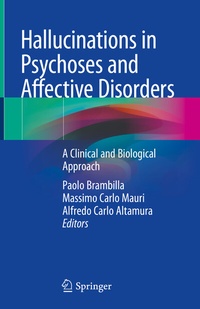
Hallucinations in Psychoses and Affective Disorders
Description

This book presents state of the art knowledge on the psychopathology, clinical symptomatology, biology, and treatment of hallucinations in patients with psychoses and affective disorders. The opening section describes and examines the origins of the hallucinatory symptoms associated with schizophrenia, bipolar disorders, and drug- or substance-induced psychoses. In addition, progress in understanding of hallucinations in children and adolescents and chronic hallucinatory disorder is reviewed, and the value of a Research Domain Criteria approach in elucidating the emergence of auditory hallucinations is explained. The biological basis of hallucinations is then closely scrutinized with reference to recent genetic research, neurochemical studies, and functional and structural neuroimaging data. Outcomes of a meta-analysis of diffusion tensor imaging studies regarding the association between white matter integrity and auditory verbal hallucinations are highlighted. The closing chaptersfocus on the roles of drug treatment and electric and magnetic brain stimulation techniques. The book will be of wide interest to psychiatrists and clinical psychologists.
Reviews / Votes
"This is a thorough, detailed, and well-written book that helps readers get an in-depth understanding of the nature of hallucinations in psychiatry. It is well organized, and presents the information in a digestible form, which would otherwise be difficult to find in a consolidated source such as this." (Jeff K Abbott, Doody's Book Reviews, March, 15, 2019)More details
Other editions
Additional editions
Persons
Paolo Brambilla, M.D., Specialist in Psychiatry, Ph.D. in Neuropharmacology and Neurophysiology, is currently Associate Professor of Psychiatry at the University of Milan, Adjunct Associate Professor of Psychiatry at UT Houston, USA, Chair of the EPA Neuroimaging Section and Co-Editor in Chief of the Journal of Affective Disorders. Since 2005 he has coordinated research studies at the Developmental Psychopathology Research Unit at the IRCCS Scientific Institute "E. Medea". Prof. Brambilla is a member of the Scientific Boards of the "Imago 7" Foundation, which manages the only MR scanner at ultra high field (7 Tesla) for human research in Italy. He is the recipient of several international scientific honors, of national and international grants, and is the author or co-author of more than 190 original papers published in international peer-reviewed journals.
Massimo Carlo Mauri, M.D., Specialist in Psychiatry, Ph.D. in Psychiatry and Behavioural Sciences, Psychiatrist, Department of Clinical Psychiatry, IRCCS Ospedale Maggiore Policlinico Milano. Chief of the Clinical Psychopharmacology Unit, he is member of several professional societies: Italian Society of Psychiatry, European College of Neuropsychopharmacology, International Membership American Psychiatric Association, and WPA Section on Pharmacopsychiatry. He published more than 300 papers in national and international journals on Psychopharmacology, Pharmacokinetics, Clinical and Biological Psychiatry and acts as a Reviewer for several international journals.A. Carlo Altamura is Professor and Chair, Department of Neuroscience and Mental Health, IRCCS Foundation Ca' Granda, Ospedale Maggiore Policlinico of Milan, University of Milan, Director of Residency of Psychiatry. He is President of the Italian Society of Neuropsychopharmacology, Past President of the Italian Chapter of the International Society of Bipolar Disorders, and President of the Italian Society of Depressive Disorders. Author of 250 publications cited in PubMed.
Content
SECTION I Psychopathology : Phenomenology of hallucinations. From phenomenology to neurophysiological understanding of hallucinations in children and adolescence. Hallucinations and research domain criteria. A synthesis of evidence on inhibitory control and auditory hallucinations based on the Research Domain Criteria (RDoC) framework. Hallucinatory symptomatology in Major Psychoses (Schizophrenia and Bipolar disorders). Substance abuse and hallucinatory symptomatology. Hallucinations in the Induced Psychosis. Chronic Hallucinatory Disorder.- SECTION II Biology : Hallucinations: genetics Basis. Imaging genetics of hallucinations. Structural Imaging of Hallucinations. Functional Imaging of hallucinations. Connectivity and hallucinations. The arcuate fasciculus in auditory-verbal hallucinations: a meta-analysis of diffusion-tensor-imaging studies.- SECTION III Treatment : Drug Treatment. Pharmacology of hallucinations: several mechanisms for one single symptom ? Innovative Approaches (DBS, tDCS, TMS).
