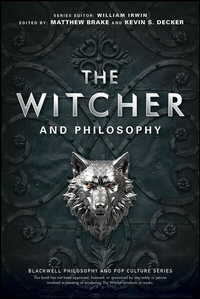
The Witcher and Philosophy
Description

Embark on a revealing philosophical journey through the universe of The Witcher
'If I'm to choose between one evil and another, I'd rather not choose at all,' growls the mutant 'witcher,' Geralt of Rivia. Andrzej Sapkowski's Witcher books lay bare the adventures of monster hunters like Geralt, who seek to avoid humanity's conflicts and live only for the next kill and the coin that comes with it. But Geralt's destiny is complicated by his relationship with a powerful sorceress, Yennefer of Vengerberg. When he connects with a displaced princess, Ciri, Geralt lands right in the middle of the political conflicts of the Continent, which is endangered by Nilfgaard, a domineering southern kingdom that threatens to conquer the world.
Part of the Blackwell Philosophy and Pop Culture series, The Witcher and Philosophy brings on twenty-seven philosophers to test their mettle against werewolves, the bruxa, strigas, vodyanoi, and kikimora; their work addresses the phenomenally popular books, three standalone Witcher video games, and the hit Netflix streaming show. These authors pass on their fascination with all manner of horror and sorcery: the mutations that make Geralt and others witchers, the commonalities between the Continent and post-apocalyptic settings, the intricacies of political power and scandal in the world of The Witcher, and reflections of our own world's changing views on race and gender that might offer hope-or portend a grim future.
Engaging and accessible, The Witcher and Philosophy considers key themes and questions such as:
- Who is human, and who is a monster?
- Can Geralt afford to stay neutral?
- What kind of politics do sorceresses engage in?
- How many universes converge on the Continent?
- If we stare long enough into the abyss, does it stare back into us?
- Silver or steel?
'Destiny is just the embodiment of the soul's desire to grow,' says Jaskier the bard, proving himself to be a natural philosopher. The tales of The Witcher remind us that our lives are a play written by both choice and destiny. And it is your destiny to read and be inspired by The Witcher and Philosophy.
MATTHEW BRAKE is Assistant Professor of Philosophy at Northern Virginia Community College in Manassas, Virginia. He is a contributor to the Wonder Woman and Philosophy and Doctor Strange and Philosophy volumes. He is also the series editor of the Theology, Religion, and Pop Culture series from Fortress Academic and the forthcoming Religion and Comics series from McFarland.
KEVIN S. DECKER is Professor of Philosophy at Eastern Washington University near Spokane, Washington. He is the editor of Dune and Philosophy and co-editor (with Jason T. Eberl) of Star Wars and Philosophy Strikes Back. He has edited or co-edited eleven other anthologies of popular culture and philosophy. He is the author of Who is Who? The Philosophy of Doctor Who.
More details
Other editions
Additional editions