

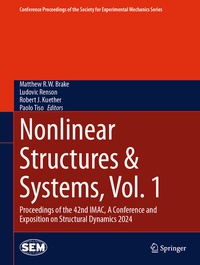
Nonlinear Structures & Systems, Vol. 1
Description

Nonlinear Structures & Systems, Volume 1: Proceedings of the 42nd IMAC, A Conference and Exposition on Structural Dynamics, 2024, the first volume of ten from the Conference brings together contributions to this important area of research and engineering. The collection presents early findings and case studies on fundamental and applied aspects of Nonlinear Dynamics, including papers on:
- Experimental Nonlinear Dynamics
- Jointed Structures: Identification, Mechanics, Dynamics
- Nonlinear Damping
- Nonlinear Modeling and Simulation
- Nonlinear Reduced-Order Modeling
- Nonlinearity and System Identification
More details
Other editions
Additional editions

Content
1. Experimental Bifurcation Forecasting using the Transient Response of an Airfoil in a Wind Tunnel.- 2. Challenges in Simulating the Forced Vibration Response of Assembled Space Structures.- 3. The Impact of Non-unique Residual Tractions on the Nonlinear Dynamics of Jointed Structures: Probabilistic Perspectives.- 4. Identifying Localised Nonlinearities: Nonlinear Restoring Force Surface in Piecewise Multi-degree-of-freedom Systems.- 5. Incorporating Implicit Condensation into Data-Driven Reduced-Order Models for Nonlinear Structures.- 6. Nonlinear Behaviour in Flexible, Large-Scale Space Structures: Dynamics and Control.- 7. A Harmonic Balance-Based Tracking Procedure for Amplitude Resonances.- 8. A Tutorial on Nonlinear Model Order Reduction.- 9. Reduced Order Modeling Research Challenge 2023: Nonlinear Dynamic Response Predictions for an Exhaust Cover Plate.- 10. More than Joints - Prof. Lothar Gaul's Contributions to IMAC.- 11. Effects of Non-unique Residual Traction on the Non-repeatability of the Dynamics of Jointed Structures.- 12. Explanation for Oscillating Backbone Curves based on Fractional Spectral Submanifolds.- 13. Evaluation of Interface Reduction Techniques for Systems with Frictional Contacts within the Scope of the Harmonic Balance Method.- 14. Analyzing Nonlinear Structures with Random Excitation using Integral Quadratic Constraints.- 15. Nonlinear Normal Modes of Highly Flexible Beam Structures Modelled Under the SE(2) Lie Group Framework.- 16. Extension and Experimental Verification of an Efficient Re-Analysis Method for Modified Nonlinear Structures.- 17. Modeling Nonlinear Beam Vibrations - A Comparison Between Classical and Data-Driven Approaches.- 18. Nonlinear System Identification with Multiple Data Sets for Structures with Bolted Joints.- 19. Nonlinear Vibration Analysis of a Two-Blade System with Shroud-To-Shroud Contact by using Response Dependent Nonlinear Normal Modes.- 20. Evaluating New Nonlinear System Identification Methods on Curved Beams.- 21. Numerical Investigation of a Reluctance Force Shunt Damping System.- 22. On the use of the Generating Series for the Impulse Response of Duffing's Equation.- 23. Effect of Loss Functions on the Learning Capabilities of Physics-Informed Neural Networks in Mechanical Systems.- 24. Dynamic Response of Damping Estimation of Layered Plate Systems Under Shock Loading.
