

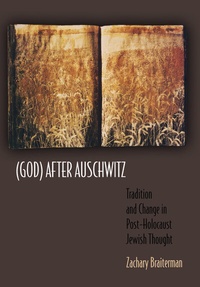
(God) After Auschwitz
Tradition and Change in Post-Holocaust Jewish Thought
1st Edition
Published on 23. November 1998
204 pages
978-1-4008-2276-8 (ISBN)
Description

The impact of technology-enhanced mass death in the twentieth century, argues Zachary Braiterman, has profoundly affected the future shape of religious thought. In his provocative book, the author shows how key Jewish theologians faced the memory of Auschwitz by rejecting traditional theodicy, abandoning any attempt to justify and vindicate the relationship between God and catastrophic suffering. The author terms this rejection "Antitheodicy," the refusal to accept that relationship. It finds voice in the writings of three particular theologians: Richard Rubenstein, Eliezer Berkovits, and Emil Fackenheim.
This book is the first to bring postmodern philosophical and literary approaches into conversation with post-Holocaust Jewish thought. Drawing on the work of Mieke Bal, Harold Bloom, Jacques Derrida, Umberto Eco, Michel Foucault, and others, Braiterman assesses how Jewish intellectuals reinterpret Bible and Midrash to re-create religious thought for the age after Auschwitz.
In this process, he provides a model for reconstructing Jewish life and philosophy in the wake of the Holocaust. His work contributes to the postmodern turn in contemporary Jewish studies and today's creative theology.
This book is the first to bring postmodern philosophical and literary approaches into conversation with post-Holocaust Jewish thought. Drawing on the work of Mieke Bal, Harold Bloom, Jacques Derrida, Umberto Eco, Michel Foucault, and others, Braiterman assesses how Jewish intellectuals reinterpret Bible and Midrash to re-create religious thought for the age after Auschwitz.
In this process, he provides a model for reconstructing Jewish life and philosophy in the wake of the Holocaust. His work contributes to the postmodern turn in contemporary Jewish studies and today's creative theology.
All prices
More details
Edition
Core Textbook
Language
English
Place of publication
Princeton, NJ
United States
Publishing group
De Gruyter
Target group
Professional and scholarly
Edition type
Digital original
Product notice
Reflowable
Illustrations
2 halftones
File size
0,62 MB
ISBN-13
978-1-4008-2276-8 (9781400822768)
Schweitzer Classification
Other editions
Additional editions
Book
12/1998
Princeton University Press
€117.80
Shipment within 10-20 days
Person
Zachary Braiterman is Assistant Professor of Religion at Syracuse University.
Content
Acknowledgments
Introduction: Modernity Surpassed: Jewish Religious Thought after Auschwitz 3
1 Theodicy and Its Others: Forms of Religious Response to the Problem of Evil 19
2 Anti/Theodicy: In Bible and Midrash 35
3 Theodicies: In Modern Jewish Thought 60
4 "Hitler's Accomplice"?! Revisioning Richard Rubenstein 87
5 Do I Belong to the Race of Words? Anti/Theodic Faith and Textual Revision in the Thought of Eliezer Berkovits 112
6 Why Is the World Today Not Water? Revelation, Fragmentation, and Solidarity in the Thought of Emil Fackenheim 134
Conclusion: Discourse, Sign, Diptych: Remarks on Jewish Thought after Auschwitz 161
Notes 179
Bibliography 193
Index 201
Introduction: Modernity Surpassed: Jewish Religious Thought after Auschwitz 3
1 Theodicy and Its Others: Forms of Religious Response to the Problem of Evil 19
2 Anti/Theodicy: In Bible and Midrash 35
3 Theodicies: In Modern Jewish Thought 60
4 "Hitler's Accomplice"?! Revisioning Richard Rubenstein 87
5 Do I Belong to the Race of Words? Anti/Theodic Faith and Textual Revision in the Thought of Eliezer Berkovits 112
6 Why Is the World Today Not Water? Revelation, Fragmentation, and Solidarity in the Thought of Emil Fackenheim 134
Conclusion: Discourse, Sign, Diptych: Remarks on Jewish Thought after Auschwitz 161
Notes 179
Bibliography 193
Index 201

