

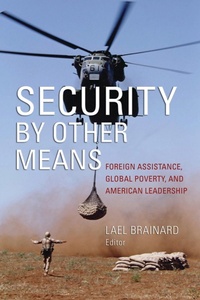
Security by Other Means
Foreign Assistance, Global Poverty, and American Leadership
1st Edition
Published on 29. August 2007
364 pages
978-0-8157-1368-5 (ISBN)
Description

A Brookings Institution Press and Center for Strategic and International Studies publication
In a world transformed by globalization and challenged by terrorism, foreign aid has assumed renewed importance as a foreign policy tool. While the results of more than forty years of development assistance show some successes, foreign aid is currently dispersed between many agencies and branches of government in a manner that formulation and implementation of a coherent, effective strategy.
The current political climate is receptive to a transition toward greater accountability and effectiveness in development aid. Because this transition is clearly an imperative but has not yet been comprehensively addressed, the Brookings Institution and the Center for Strategic and International Studies have conducted a joint study that both assesses the current structures of foreign assistance and makes recommendations for efficient coordination. Drawing on expertise from the full range of agencies whose policies affect foreign aid, Security by Other Means examines foreign assistance across four categories reflecting the interests that aid furthers: security, economic, humanitarian, and political.
As disparities in the world become more untenable, foreign aid plays a key role in not only the national interests of the U.S. but also the interconnected interests of the international community. This important new volume takes aim at critical questions in a concerted manner by assigning coherence and effectiveness to U.S. foreign aid.
Contributors include Owen Barder (Center for Global Development, formerly UK Department for International Development), Charlie Flickner (former Staff Director of the House Appropriations Subcommittee on Foreign Operations), Steve Hensch (George Washington University), Steve Morrison (Center for Strategic and International Studies), Steve Radelet (Center for Global Development)
In a world transformed by globalization and challenged by terrorism, foreign aid has assumed renewed importance as a foreign policy tool. While the results of more than forty years of development assistance show some successes, foreign aid is currently dispersed between many agencies and branches of government in a manner that formulation and implementation of a coherent, effective strategy.
The current political climate is receptive to a transition toward greater accountability and effectiveness in development aid. Because this transition is clearly an imperative but has not yet been comprehensively addressed, the Brookings Institution and the Center for Strategic and International Studies have conducted a joint study that both assesses the current structures of foreign assistance and makes recommendations for efficient coordination. Drawing on expertise from the full range of agencies whose policies affect foreign aid, Security by Other Means examines foreign assistance across four categories reflecting the interests that aid furthers: security, economic, humanitarian, and political.
As disparities in the world become more untenable, foreign aid plays a key role in not only the national interests of the U.S. but also the interconnected interests of the international community. This important new volume takes aim at critical questions in a concerted manner by assigning coherence and effectiveness to U.S. foreign aid.
Contributors include Owen Barder (Center for Global Development, formerly UK Department for International Development), Charlie Flickner (former Staff Director of the House Appropriations Subcommittee on Foreign Operations), Steve Hensch (George Washington University), Steve Morrison (Center for Strategic and International Studies), Steve Radelet (Center for Global Development)
More details
Edition
1. Auflage
Language
English
Place of publication
DC
United States
ISBN-13
978-0-8157-1368-5 (9780815713685)
Copyright in bibliographic data and cover images is held by Nielsen Book Services Limited or by the publishers or by their respective licensors: all rights reserved.
Schweitzer Classification
Other editions
Additional editions
Book
01/2007
Brookings Institution
€74.47
Article exhausted; check different version
Person
Lael Brainard is vice president and director of the Global Economy and Development Program at the Brookings Institution, where she holds the Bernard E. Schwartz Chair in International Economics. Brainard served as deputy national economic adviser in the Clinton administration.
Content
- Front Cover
- Title Page
- Copyright Page
- Table of Contents
- Foreword
- Chapter 1: A Unified Framework for U.S. Foreign Assistance
- Chapter 2: Organizing U.S. Foreign Assistance to Meet Twenty-First Century Challenges
- Chapter 3: What Role for U.S. Assistance in the Fight Against Global HIV/AIDS?
- Chapter 4: Strengthening U.S. Development Assistance
- Chapter 5: Humanitarian Assistance Expands in Scale and Scope
- Chapter 6: Development in the Shadow of Conflict
- Chapter 7: The Changing Complexion of Security and Strategic Assistance in the Twenty-First Century
- Chapter 8: Removing Impediments to an Effective Partnership with Congress
- Chapter 9: Foreign Aid Reform Commissions, Task Forces, and Initiatives: From Kennedy to the Present
- Chapter 10: Reforming Development Assistance: Lessons from the U.K. Experience
- Chapter 11: Conclusion and Recommendations
- Appendix A
- Appendix B
- Authors
- Index
- Back Cover
