

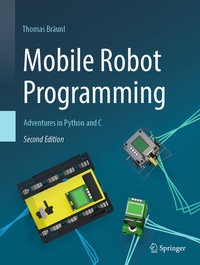
Mobile Robot Programming
Description

This book emphasizes software design as the most important topic in modern robotics and demonstrates practical code examples in Python and C. The book introduces the free simulation system EyeSim in combination with EyeBot robots, which can be built from inexpensive embedded processors, sensors and motors - or by adapting the control inputs of model cars.
EyeSim is a free software for MacOS, Windows and Linux, which uses a realistic physics simulation engine and is source-code compatible to the EyeBot mobile robots. So, each robot program can first be tested on the simulator before running it on a real robot. EyeSim includes modules for driving, walking, swimming and diving robots, as well as for robot manipulators. EyeSim also runs on the Meta/Oculus Quest, providing a fully immersive robotics experience in virtual reality.
Beginning with simple driving algorithms and sensor data processing for distance sensors, Lidar and camera, the book progresses to more complex localization and navigation tasks, as well as vision-based navigation and genetic algorithms. It concludes with artificial intelligence applications for mobile robots in traffic scenarios and full-size autonomous vehicles.
This book is suitable as a text for undergraduate and graduate courses in Robotics, Automation and Artificial Intelligence, as well as a self-study guide for practitioners and hobbyists. All robot application programs in this book are available as free downloads for MacOS, Windows, Linux, and Raspberry Pi OS.
Reviews / Votes
"This book serves as a very good resource for educators, as a teaching support material for introductory courses on mobile and intelligent robots . . this very interesting, complete, and didactic book describes important topics related to mobile robots. It provides tools for implementing programs for simulated and real mobile robots." (Fernando Osorio, Computing Reviews, October 29, 2024)
More details
Other editions
Additional editions
Person
Thomas Bräunl is a Professor in the School of Engineering at The University of Western Australia, Perth, where he directs the Robotics & Automation Lab as well as the Renewable Energy Vehicle Project (REV). He has developed numerous robotics systems, including the EyeBot robot family and the EyeSim simulation system. On the automotive side, he has done research on electric drive and charging systems, and is developing AI solutions for autonomous driving. Professor Bräunl worked on Driver-Assistance Systems with Mercedes-Benz Stuttgart and on Electric Vehicle Charging Systems with BMW Munich and BMW Mountain View. He holds a Diploma from the University of Kaiserslautern, an M.S. degree from the University of Southern California, Los Angeles, and a Ph.D. and Habilitation from the University of Stuttgart.
Content
Building Robots.- Robot Programming.- Driving Algorithms.- Lidar Sensors.- Robot Swarms.- Wall Following.- Alternative Drive Systems.- Submarines and Boats.- Mazes.- Navigation Algorithms.- Robot Vision.- Starman.- Autonomous Driving.- Automotive Robots.- Formula SAE.- Outlook.- Appendix.
