

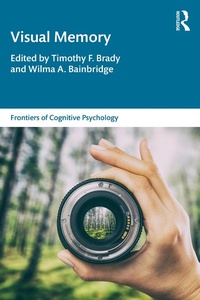
Visual Memory
1st Edition
Published on 29. March 2022
380 pages
978-1-000-55579-0 (ISBN)
Description

Featuring contributions from world-leading researchers, this book explores the relationship between visual perception and memory. It bridges the traditionally separate fields of vision science and recognition memory and deals with an interdisciplinary set of perspectives combining research in psychology, neuroscience, and artificial intelligence.
The book makes new connections between the wealth of research from each respective field, developing the idea that visuospatial memory is our best memory system. This volume traverses topics grounded in both empirical study and real-world applications, including working (short-term) memory, long-term memory, the neuroscience of memory, development of memory over the lifespan, autobiographical memories, false memories, and eyewitness testimony. It argues that an increased knowledge of how visuospatial memory works can lead to an improved understanding of the basic features of memory, as well as providing strategies for memory improvement. The book features cutting edge visual memory research, where converging methods in psychophysics, cognitive neuroscience, and computational modeling have been propelling the field forward.
Visual Memory is an essential read for all students and researchers of memory and visual perception. It will also be useful for researchers and students in related fields including human-computer interaction, data visualization, cognitive science, and cognitive enhancement.
The book makes new connections between the wealth of research from each respective field, developing the idea that visuospatial memory is our best memory system. This volume traverses topics grounded in both empirical study and real-world applications, including working (short-term) memory, long-term memory, the neuroscience of memory, development of memory over the lifespan, autobiographical memories, false memories, and eyewitness testimony. It argues that an increased knowledge of how visuospatial memory works can lead to an improved understanding of the basic features of memory, as well as providing strategies for memory improvement. The book features cutting edge visual memory research, where converging methods in psychophysics, cognitive neuroscience, and computational modeling have been propelling the field forward.
Visual Memory is an essential read for all students and researchers of memory and visual perception. It will also be useful for researchers and students in related fields including human-computer interaction, data visualization, cognitive science, and cognitive enhancement.
Reviews / Votes
"This outstanding book, edited by two prominent stars, features the leading researchers in visual cognition and memory. In an interdisciplinary and integrative manner, the must-read chapters address the most fundamental issues in visual memory, and they set the agenda for the next decade of inquiry and debate. I also applaud the coverage of both basic scientific questions and diverse applications to everyday memory."Marvin Chun, Yale University, USA
"Visual Memory is a timely and exciting book that explores a topic of fundamental importance to anyone interested in the workings of memory. The editors have assembled leading researchers from a variety of perspectives who have written superb chapters that are both engaging and informative. I highly recommend this landmark volume in the study of visual memory."
Daniel L. Schacter, Harvard University, USA
"The topic of visual memory has been exploding in recent years. This book is a vivid snapshot of the fireworks.
It lets us see the current shape of the field while also making us aware of the dynamism that is changing that shape as we watch."
Jeremy Wolfe, Harvard Medical School, USA
More details
Series
Edition
1. Auflage
Language
English
Place of publication
London
United Kingdom
Publishing group
Taylor & Francis Ltd
Target group
College/higher education
Illustrations
1 Tables, black and white; 49 Line drawings, black and white; 11 Halftones, black and white; 60 Illustrations, black and white
ISBN-13
978-1-000-55579-0 (9781000555790)
Copyright in bibliographic data and cover images is held by Nielsen Book Services Limited or by the publishers or by their respective licensors: all rights reserved.
Schweitzer Classification
Other editions
Additional editions
Timothy F. Brady | Wilma A. Bainbridge
Visual Memory
Book
03/2022
1st Edition
Routledge
€102.60
Shipment within 15-20 days
Timothy F. Brady | Wilma A. Bainbridge
Visual Memory
Book
03/2022
1st Edition
Routledge
€272.36
Shipment within 15-20 days
Persons
Timothy F. Brady is an Associate Professor of Psychology at the University of California San Diego, USA. His research focuses on the nature of visual memory. His lab studies visual perception, attention, working memory and long-term memory, using cognitive and cognitive neuroscience methods and computational models.
Wilma A. Bainbridge is an Assistant Professor of Psychology at the University of Chicago, USA. Her research focuses on the interactions of vision and memory in computation, behavior, and the brain, with recent work exploring the intrinsic memorability of items, and what drawings can show us about visual memory.
Wilma A. Bainbridge is an Assistant Professor of Psychology at the University of Chicago, USA. Her research focuses on the interactions of vision and memory in computation, behavior, and the brain, with recent work exploring the intrinsic memorability of items, and what drawings can show us about visual memory.
Content
Introduction
Timothy F. Brady and Wilma A. Bainbridge
Evidence For, and Challenges To, Sensory Recruitment Models of Visual Working Memory
Kirsten C.S. Adam, Rosanne L. Rademake, and John T. Serences
The Architecture of Interaction Between Visual Working Memory and Visual Attention
Andrew Hollingworth
The Functional Role of Visual Working Memory: A Storage Buffer for Non-Automated Cognitive Operations
Orestis Papaioannou and Steven J. Luck
Curating the Contents of Working Memory
Allison L. Bruning and Jarrod A. Lewis-Peacock
Pre-Existing Long-Term Memory Facilitates the Formation of Visual Short-Term Memory.
Weizhen Xie and Weiwei Zhang
Ensemble Representation: Efficient Organizer of Visual Memory
Sang Chul Chong and Yihwa Baek
Spatial Statistics in Perception, Learning, and Navigation
Kathryn N. Graves and Nicholas B. Turk-Browne
Limited Access to an Unlimited Store: Mechanistic Constraints and Limitations in the Voluntary Control of Visual Long-Term Memory
Keisuke Fukuda, Caitlin J. I. Tozios, and Joseph M. Saito
How to Induce the Forgetting of Pictures
Ashleigh M. Maxcey, Elizabeth Mancuso, Paul S. Scotti, Emily Spinelli, and Geoffrey F. Woodman
Memorability: Reconceptualizing Memory as a Visual Attribute
Wilma A. Bainbridge
Neural Representations of Visual Encoding and Retrieval
Anisha S. Babu and Brice A. Kuhl
The Link Between Conceptual and Perceptual Information in Memory
Marc N. Coutanche
Visual Category-Driven Differences in Memory
Adam Steel & Edward H. Silson
Medial Temporal Lobe Contributions to the Temporal Structure of Visual Memory
Willem Le Duc, Zhemeng Wu, Qun Ye, Rutsuko Ito, and Andy C. H. Lee
The Role of Visual Imagery in Constructing Autobiographical Memories and Future Events
Signy Sheldon
Visual Perspective in Event Memory
Peggy L. St. Jacques
The Development of Visual Memory
Alicia Forsberg, Eryn J. Adams, and Nelson Cowan
The Basic Science of Eyewitness Identification
John T. Wixted
Applying Confidence-Accuracy Characteristic Plots to Recognition Memory
Henry L. Roediger, III, Eylul Tekin, and Wenbo Lin
Visual False Memories
Jessica M. Karanian
Timothy F. Brady and Wilma A. Bainbridge
Evidence For, and Challenges To, Sensory Recruitment Models of Visual Working Memory
Kirsten C.S. Adam, Rosanne L. Rademake, and John T. Serences
The Architecture of Interaction Between Visual Working Memory and Visual Attention
Andrew Hollingworth
The Functional Role of Visual Working Memory: A Storage Buffer for Non-Automated Cognitive Operations
Orestis Papaioannou and Steven J. Luck
Curating the Contents of Working Memory
Allison L. Bruning and Jarrod A. Lewis-Peacock
Pre-Existing Long-Term Memory Facilitates the Formation of Visual Short-Term Memory.
Weizhen Xie and Weiwei Zhang
Ensemble Representation: Efficient Organizer of Visual Memory
Sang Chul Chong and Yihwa Baek
Spatial Statistics in Perception, Learning, and Navigation
Kathryn N. Graves and Nicholas B. Turk-Browne
Limited Access to an Unlimited Store: Mechanistic Constraints and Limitations in the Voluntary Control of Visual Long-Term Memory
Keisuke Fukuda, Caitlin J. I. Tozios, and Joseph M. Saito
How to Induce the Forgetting of Pictures
Ashleigh M. Maxcey, Elizabeth Mancuso, Paul S. Scotti, Emily Spinelli, and Geoffrey F. Woodman
Memorability: Reconceptualizing Memory as a Visual Attribute
Wilma A. Bainbridge
Neural Representations of Visual Encoding and Retrieval
Anisha S. Babu and Brice A. Kuhl
The Link Between Conceptual and Perceptual Information in Memory
Marc N. Coutanche
Visual Category-Driven Differences in Memory
Adam Steel & Edward H. Silson
Medial Temporal Lobe Contributions to the Temporal Structure of Visual Memory
Willem Le Duc, Zhemeng Wu, Qun Ye, Rutsuko Ito, and Andy C. H. Lee
The Role of Visual Imagery in Constructing Autobiographical Memories and Future Events
Signy Sheldon
Visual Perspective in Event Memory
Peggy L. St. Jacques
The Development of Visual Memory
Alicia Forsberg, Eryn J. Adams, and Nelson Cowan
The Basic Science of Eyewitness Identification
John T. Wixted
Applying Confidence-Accuracy Characteristic Plots to Recognition Memory
Henry L. Roediger, III, Eylul Tekin, and Wenbo Lin
Visual False Memories
Jessica M. Karanian
