

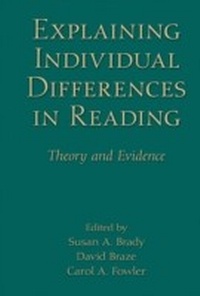
Explaining Individual Differences in Reading
Theory and Evidence
1st Edition
Published on 9. May 2011
292 pages
978-1-136-73283-6 (ISBN)
Description

Research into reading development and reading disabilities has been dominated by phonologically guided theories for several decades. In this volume, the authors of 11 chapters report on a wide array of current research topics, examining the scope, limits and implications of a phonological theory.
The chapters are organized in four sections. The first concerns the nature of the relations between script and speech that make reading possible, considering how different theories of phonology may illuminate the implication of these relations for reading development and skill. The second set of chapters focuses on phonological factors in reading acquisition that pertain to early language development, effects of dialect, the role of instruction, and orthographic learning. The third section identifies factors beyond the phonological that may influence success in learning to read by examining cognitive limitations that are sometimes co-morbid with reading disabilities, contrasting the profiles of specific language impairment and dyslexia, and considering the impact of particular languages and orthographies on language acquisition. Finally, in the fourth section, behavioral-genetic and neurological methods are used to further develop explanations of reading differences and early literacy development.
The volume is an essential resource for researchers interested in the cognitive foundations of reading and literacy, language and communication disorders, or psycholinguistics; and those working in reading disabilities, learning disabilities, special education, and the teaching of reading.
The chapters are organized in four sections. The first concerns the nature of the relations between script and speech that make reading possible, considering how different theories of phonology may illuminate the implication of these relations for reading development and skill. The second set of chapters focuses on phonological factors in reading acquisition that pertain to early language development, effects of dialect, the role of instruction, and orthographic learning. The third section identifies factors beyond the phonological that may influence success in learning to read by examining cognitive limitations that are sometimes co-morbid with reading disabilities, contrasting the profiles of specific language impairment and dyslexia, and considering the impact of particular languages and orthographies on language acquisition. Finally, in the fourth section, behavioral-genetic and neurological methods are used to further develop explanations of reading differences and early literacy development.
The volume is an essential resource for researchers interested in the cognitive foundations of reading and literacy, language and communication disorders, or psycholinguistics; and those working in reading disabilities, learning disabilities, special education, and the teaching of reading.
Reviews / Votes
"... With a stellar cast of active, respected researchers providing the analyses, [this book] summarises the current status of empirical research into sources of individual differences in reading development. ... Each chapter includes mouth-watering hints about the future of research in various domains, alongside excellent and up-to-date summaries of recent investigations. The list of contributors is a who's who of empirical reading research, and their contributions form a marvelous series of perspectives." - Kerry Hempenstall, RMIT University, Australia, in the Australian Journal of Learning Difficulties"The contributors to this book provide the most appropriate tribute to Don Shankweiler, one of the giants of our field-a description of the cumulative and continuing impact of his seminal ideas. In this volume, the reader gets what would be expected from this All Star list of contributors: a comprehensive treatment of our understanding of individual differences in the development of reading ability with particular emphasis on the phonological deficit hypothesis." - Keith Stanovich, Ph.D., University of Toronto, Canada, author of Progress in Understanding Reading and winner of the 2010 Grawemeyer Award in Education
"These chapters provide a brilliant overview of the last decade of research in reading. In addition, each chapter also provides a solid overview of the research base that has led to the current insights. It is an excellent book precisely in the spirit of one of the most creative, knowledgeable and persistent minds in reading research." - Carston Elbro, Ph.D., University of Copenhagen, Denmark
"This volume contains an excellent set of cutting-edge chapters on the interface between reading and language development. The contributors are truly an all-star cast. As well as covering the central role of phonological skills for reading development, work on broader oral language skills is also included. The coverage is broadened further by including recent work on genetic and neuroimaging studies. This is an excellent book, and a fitting tribute to the contribution made by Donald Shankweiler to the study of reading development and reading disorders." - Charles Hulme, Ph.D., University of York, United Kingdom
"Don't miss this brilliantly crafted and long awaited contribution to the field by leading scientists in honor of Donald Shankweiler, who, with colleagues at Haskins Laboratories, developed the phonological deficit hypothesis that spawned decades of landmark research in multiple disciplines and numerous languages. A must-read for graduate students and researchers!" - Benita A. Blachman, Ph.D., Trustee Professor of Education and Psychology, Syracuse University, USA
More details
Series
Language
English
Place of publication
London
United Kingdom
Publishing group
Taylor & Francis Ltd
Target group
College/higher education
Product notice
Reflowable
File size
3,64 MB
ISBN-13
978-1-136-73283-6 (9781136732836)
Copyright in bibliographic data and cover images is held by Nielsen Book Services Limited or by the publishers or by their respective licensors: all rights reserved.
Schweitzer Classification
Other editions
Additional editions
Susan A. Brady | David Braze | Carol A. Fowler
Explaining Individual Differences in Reading
Theory and Evidence
Book
09/2018
1st Edition
Psychology Press Ltd
€78.80
Shipment within 10-20 days
Susan A. Brady | David Braze | Carol A. Fowler
Explaining Individual Differences in Reading
Theory and Evidence
Book
04/2011
1st Edition
Psychology Press Ltd
€206.70
Shipment within 3-4 weeks
Persons
Susan Brady is a Professor of Psychology at the University of Rhode Island. Her basic research focuses primarily on phonological factors in reading ability. In addition, in applied research she investigates the ingredients, such as teacher knowledge, necessary for improving reading achievement in the primary grades.
David Braze, a linguist, concentrates his research on the cognitive bases underlying ability to comprehend speech and print. He employs online methods, including monitoring eye-movements during reading, to investigate bottlenecks in comprehension. Likewise, he explores how characteristics of text interact with individual differences in cognitive factors to impact reading comprehension.
Carol Fowler is a Professor of Psychology at University of Connecticut. Her research includes an emphasis on the relation between speech production and perception, and the implications of that relation for phonological theory. One aspect of that research explores the nature of the phonological structures accessed by skilled readers of a variety of writing systems.
The three editors are all Senior Scientists at Haskins Laboratories in New Haven, Connecticut.
David Braze, a linguist, concentrates his research on the cognitive bases underlying ability to comprehend speech and print. He employs online methods, including monitoring eye-movements during reading, to investigate bottlenecks in comprehension. Likewise, he explores how characteristics of text interact with individual differences in cognitive factors to impact reading comprehension.
Carol Fowler is a Professor of Psychology at University of Connecticut. Her research includes an emphasis on the relation between speech production and perception, and the implications of that relation for phonological theory. One aspect of that research explores the nature of the phonological structures accessed by skilled readers of a variety of writing systems.
The three editors are all Senior Scientists at Haskins Laboratories in New Haven, Connecticut.
Content
Foreword by William Tunmer. Preface. Part 1. Theoretical Foundations: Phonology and Reading. C.A. Fowler, How Theories of Phonology May Enhance Understanding of the Role of Phonology in Reading Development and Reading Disability. Part 2. Phonological Factors in Learning to Read. D. Braze, G.W. McRoberts, C. McDonough, Early Precursors of Reading-Relevant Phonological Skills. D.L. Share, On the Role of Phonology in Reading Acquisition: The Self-Teaching Hypothesis. S.A. Brady, Efficacy of Phonics Teaching for Reading Outcomes: Indications from Post NRP Research. N. Patton Terry, H. Scarborough, The Phonological Hypothesis as a Valuable Framework for Studying the Relation of Dialect Variation to Early Reading Skills. Part 3. Sources of Individual Differences Beyond Phonological Deficits . M.J. Snowling, Beyond Phonological Deficits: Sources of Individual Differences in Reading Disability. H.W. Catts, S. Adlof, Phonological and Other Language Deficits Associated with Dyslexia. C. Perfetti, Phonology is Critical in Reading -- But a Phonological Deficit is Not the Only Source of Low Reading Skill. Part 4. Unraveling the Biology of Reading and Reading Differences. B. Byrne, Evaluating the Role of Phonological Factors in Early Literacy Development: Insights from Experimental and Behavior-Genetic Studies. R. Olson, Genetic and Environmental Influences on Phonological Abilities and Reading Achievement. J.J. Diehl, S.J. Frost, W.E. Mencl, K.R. Pugh, Neuroimaging and the Phonological Deficit Hypothesis.
