

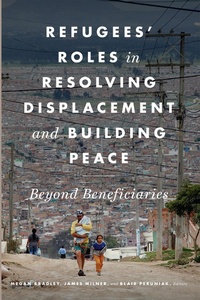
Refugees' Roles in Resolving Displacement and Building Peace
Description

How are refugee crises solved? This has become an urgent question as global displacement rates continue to climb, and refugee situations now persist for years if not decades. The resolution of displacement and the conflicts that force refugees from their homes is often explained as a top-down process led and controlled by governments and international organizations. This book takes a different approach. Through contributions from scholars working in politics, anthropology, law, sociology and philosophy, and a wide range of case studies, it explores the diverse ways in which refugees themselves interpret, create and pursue solutions to their plight. It investigates the empirical and normative significance of refugees' engagement as agents in these processes, and their implications for research, policy and practice. This book speaks both to academic debates and to the broader community of peacebuilding, humanitarian and human rights scholars concerned with the nature and dynamics of agency in contentious political contexts, and identifies insights that can inform policy and practice.
More details
Other editions
Additional editions
Persons
Megan Bradley is an associate professor in the Department of Political Science and at the Institute for the Study of International Development at McGill University.
James Milner is an associate professor in the Department of Political Science at Carleton University.
Blair Peruniak is a doctoral candidate in the Department of International Development at the University of Oxford.
Content
Foreword
François Crépeau
Acknowledgments
Introduction: Shaping the Struggles of Their Times
Megan Bradley, James Milner and Blair Peruniak
Part I: Refugees and Resolution Processes: Disciplinary Perspectives
1. Durable Solutions and the Political Action of Refugees
Karen Jacobsen
2. Refugees, Peacebuilding, and the Anthropology of the Good
Cindy Horst
3. Displacement Resolution and ?Massively Shared Agency?
Blair Peruniak
4. Transformative Justice and Legal Conscientization: Refugee Participation in Peace Processes, Repatriation, and Reconciliation
Anna Purkey
Part II: Pursing Peace and Social Reconstruction: Displaced Persons' Roles
5. Complex Victimhood and Social Reconstruction after War and Displacement
Erin Baines
6. Refugees, Peacebuilding, and Paternalism: Lessons from Mozambique
James Milner
7. Displaced Persons as Symbols of Grievance: Collective Identity, Individual Rights and Durable Solutions
Patrik Johansson
Part III: Seeking ?Solutions? to Displacement within and beyond Traditional Frameworks
8. Shunning Solidarity: Durable Solutions in a Fluid Era
Loren B. Landau
9. ?Grabbing? Solutions: Internal Displacement and Post-Disaster Land Occupations in Haiti
Angela Sherwood
10. From IDPs to Victims in Colombia: Reflections on Durable Solutions in the Postconflict Setting
Julieta Lemaitre and Kristin Bergtora Sandvik
11. Refugees' Roles in Resettlement from Uganda and Tanzania: Agency, Intersectionality, and Relationships
Christina Clark-Kazak and Marnie Jane Thomson
12. Liberian Refugee Protest and the Meaning of Agency
Amanda Coffie
13. From Roots to Rhizomes: Mapping Rhizomatic Strategies in the Sahrawi and Palestinian Protracted Refugee Situations
Elena Fiddian-Qasmiyeh
Conclusion: Where Do We Go from Here?
James Milner, Megan Bradley, and Blair Peruniak
List of References
List of Contributors
Index
