

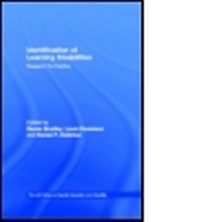
Identification of Learning Disabilities
Research To Practice
Published on 18. December 2002
880 pages
978-1-135-62763-8 (ISBN)
Description

Identification of Learning Disabilities: Research to Practice is the remarkable product of a learning disabilities summit conference convened by the Office of Special Education Programs (OSEP) in August 2001 and the activities following that summit. Both the conference and this book were seen as important preludes to congressional reauthorization of the historic Individuals With Disabilities Education Act (IDEA) scheduled for 2002 and subsequent decision making surrounding implementation. The OSEP conference brought together people with different perspectives on LD (parents, researchers, practitioners, and policymakers) and resulted in this book, which examines the research on nine key issues concerning the identification of children with learning disabilities. Coverage includes alternative responses to treatment, classification approaches, processing deficit models, and approaches to decision making.
Chapter Structure-- Each of the first nine chapters is organized around a lengthy, issue-oriented paper, which presents the most current research on that topic. These primary papers are then followed by four respondent papers that reflect a variety of viewpoints on the topic.
Summarizing Chapter -- A small group of researchers (listed in the final chapter) dedicated an enormous amount of time to summarizing the research and developing key consensus statements regarding the identification of children with learning disabilities. Their work is sure to have a tremendous impact on future discussions in this area.
Expertise-- The following well-known scholars have helped summarize the vast amount of research presented in this book as well as the consensus statements derived therefrom: Lynne Cook, Don Deshler, Doug Fuchs, Jack M. Fletcher, Frank Gresham, Dan Hallahan, Joseph Jenkins, Kenneth Kavale, Barbara Keogh, Margo Mastopieri, Cecil Mercer, Dan Reschley, Rune Simeonsson, Joe Torgesen, Sharon Vaughn, and Barbara Wise.
Chapter Structure-- Each of the first nine chapters is organized around a lengthy, issue-oriented paper, which presents the most current research on that topic. These primary papers are then followed by four respondent papers that reflect a variety of viewpoints on the topic.
Summarizing Chapter -- A small group of researchers (listed in the final chapter) dedicated an enormous amount of time to summarizing the research and developing key consensus statements regarding the identification of children with learning disabilities. Their work is sure to have a tremendous impact on future discussions in this area.
Expertise-- The following well-known scholars have helped summarize the vast amount of research presented in this book as well as the consensus statements derived therefrom: Lynne Cook, Don Deshler, Doug Fuchs, Jack M. Fletcher, Frank Gresham, Dan Hallahan, Joseph Jenkins, Kenneth Kavale, Barbara Keogh, Margo Mastopieri, Cecil Mercer, Dan Reschley, Rune Simeonsson, Joe Torgesen, Sharon Vaughn, and Barbara Wise.
Reviews / Votes
"This book is the product of a learnng disabilities summit conference convened by the Office of Special Education Programs (OSEP) in August 2001 and the activities following that summit. Both the conference and this book were seen as important preludes to congressional authorization of the historic Individuals with Disabilities Education Act (IDEA) scheduled for 2002 and subsequent decision-making surrounding implementation."-Zentralblatt fur Didaktik der Mathematik
More details
Series
Language
English
Place of publication
London
United Kingdom
Publishing group
Taylor & Francis Ltd
Target group
Professional and scholarly
Product notice
Reflowable
File size
6,22 MB
ISBN-13
978-1-135-62763-8 (9781135627638)
Copyright in bibliographic data and cover images is held by Nielsen Book Services Limited or by the publishers or by their respective licensors: all rights reserved.
Schweitzer Classification
Other editions
Additional editions
Renee Bradley | Louis Danielson | Daniel P. Hallahan
Identification of Learning Disabilities
Research To Practice
Book
07/2002
Routledge
€341.69
Shipment within 10-20 days
Renee Bradley | Louis Danielson | Daniel P. Hallahan
Identification of Learning Disabilities
Research To Practice
Book
07/2002
Routledge
€145.57
Shipment within 10-20 days
Persons
Renee Bradley (Edited by) , Louis Danielson (Edited by) , Daniel P. Hallahan (Edited by)
Content
Introduction, Chapter I: Learning Disabilities: Historical Perspectives, Chapter Ii: Early Identification And Intervention For Young Children With Reading/Learning Disabilities, Chapter Iii: Classification Of Learning Disabilities: An Evidencebased Evaluation, Chapter Iv: Learning Disabilities As Operationally Defined By Schools, Chapter V: Discrepancy Models In The Identification Of Learning Disability, Chapter Vi: Responsiveness To Intervention: An Alternative Approach To The Identification Of Learning Disabilities, Chapter Vii: Empirical And Theoretical Support For Direct Diagnosis Of Learning Disabilities By Assessment Of Intrinsic Processing Weaknesses, Chapter Viii: Clinical Judgments In Identifying And Teaching Children With Language-Based Reading Difficulties, Chapter Ix: Is "Learning Disabilities" Just A Fancy Term For Low Achievement? A Meta-Analysis Of Reading Differences Between Low Achievers With And Without The Label
