

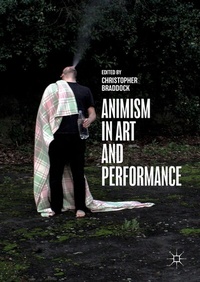
Animism in Art and Performance
Description

Reviews / Votes
"What beings are alive? What constitutes 'alive'? Timely questions, in particular to the notion of nonhuman lifeforms in a time of mass extinction; the ecological resonance of the term 'survive', which is often mistaken for 'alive', and the question of how indigenous cultures matter today, cultures where the concept 'inanimate object' don't hold sway. Where such questions start and stop, who gets to have them and why, are the subject of this wide ranging and learned book." (Timothy Morton, Rita Shea Guffey Chair in English, Rice University, USA, and author of Dark Ecology: For a Logic of Future Coexistence)"It's imperative that contemporary discussions of the 'liveliness' of the nonhuman world come to terms with indigenous epistemological frameworks. Putting the practices of contemporary art and theory based in European traditions to the test of rigorous dialogue with Maori ways of seeing and knowing, Animism in Art & Performanceadvances the conversation considerably, making terrific contributions to art history, cultural studies, and the range of theoretical tendencies grouped under the heading 'new materialism'." (Rebecca Zorach, Mary Jane Crowe Professor of Art and Art History, Northwestern University, USA, and author of The Passionate Triangle)
"Animism in Art & Performance demonstrates a unique instance of dual sovereignty emerging in academia. By engaging Maori, Pacifika and other academic frameworks (of interpretation, of embodiment, of performativity, and of materiality), this book offers the reader a model for critically engaged, culturally entangled, art writing. In arguments that demonstrate time and again the anti-humanism of the subject/object divide, and the anti-ecological practices that necessarily derive from that inherently exploitative relationship, several authors deploy Karen Barad's provocative question, 'Who gets to count as one who has the ability to die?' The answer, in this case, is a constellation of artworks that shimmer with life." (Hannah B Higgins, Professor of Art History, University of Illinois, USA, and author of The Grid Book)
"Chris Braddock's edited book brings together some of the most exciting writers working today in a way that is nuanced, dynamic and multi-cultural. Particularly exciting is the way that Maori and indigenous thought is woven through the chapters in a deliberate and unselfconscious manner, and in doing so sets a new direction for writing in the 21st century." (Dr. Ngarino Ellis (Ngapuhi, Ngati Porou), Museums and Cultural Heritage Programme, The University of Auckland, Aotearoa NZ)
"An intelligent and timely collection of texts on how recent art practices open up questions of animacy and the many ways in which we attribute properties of 'life' or 'non-life' to the phenomena surrounding us. The careful critical dialogue with the Polynesian ethnographic context is a particularly welcome contribution to recent efforts to rethink animism across cultural, historical and disciplinary boundaries." (Professor Ina Blom, Department of Philosophy, Classics, History of Art and Ideas, University of Oslo, Norway)
"Animism Lives! This book is a valuable collection of Maori scholarship, buzzing materialist thought and ontological be-keeping written through the arts, literature and culture. What is polychronically generative, lively and teeming is not only revivified, it never lapsed." (Douglas Kahn, Professor, Art & Design, University of New South Wales, Australia)
More details
Other editions
Additional editions
Person
Content
1.- Introduction: Animism and Animacies; Christopher Braddock.- 2. Te Tuna-Whiri: The Knot of Eels; Cassandra Barnett.- Activating Photographic Mana Rangatiratanga through Korero; Natalie Robertson.- 4. Dark Sun: Solar Frequencies, Solar Affects; Janine Randerson and Rachel Shearer.- 5. Language as a Life Form; Anna Gibbs.- 6. The Storm and the Still in the Art of Bridie Lunney; Simone Schmidt.- 7. Animate Atmospheres: Art at the Edge of Materiality; Edward Scheer.- 8. Intrainanimation; Rebecca Schneider.- 9. Animacies and Performativity; Amelia Jones with Chris Braddock.- 10. Animism, Animacy and Participation in the Performances of Darcell Apelu; Christopher Braddock.- 11. Exploring Posthuman Masquerade and Becoming; Martin Patrick.- 12. The Animist Readymade: Towards a Vital Materialism of Contemporary Art; Stephen Zepke.- 13. Sound Fossils and Arche-Fossils: Towards a Mineral Ontology of Contemporary Art; Amelia Barikin.
