

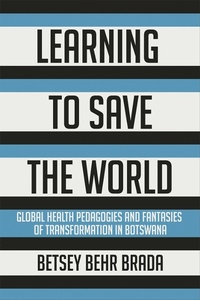
Learning to Save the World
Description

Learning to Save the World provides an innovative analysis of how individuals inhabit, refuse, and reconfigure the contours of global health.
In 2001, Botswana's government, faced with one of the highest HIV prevalence rates in the world, committed itself to sub-Saharan Africa's first free public HIV treatment program. US-based private foundations and medical schools offered support to demonstrate the feasibility of public HIV treatment in Africa. Given US interest and investment in global health, this support created opportunities for US physicians and medical trainees to interact with local practitioners, treat patients, and shape health policy in Botswana.
Although global health has emerged as a powerful call to planetary moral action, the nature of this exhortation remains unclear. Is global health a new movement for social justice, or is it neocolonial, creating new dependencies under the banner of humanitarianism? Betsey Behr Brada shows that global health is a frontier, an imaginative framework that organizes the space, time, and ethics of encounter.
Learning to Save the World reveals how individuals and collectivities engaged in global health-visiting experts as well as local clinicians and patients-come to regard themselves and others in terms of this framework.
More details
Other editions
Additional editions
Person
Betsey Behr Brada is Associate Professor of Anthropology at Reed College.
Content
Introduction: Learning to Save the World
1. Saving Medication vs. Saving Children
2. How to Do Things to Children with Words
3. The Metalanguage of HIV Intervention
4. The Global Health Frontier
5. Experiencing AIDS in Africa: The Anxious Fantasies of American Medicine
6. "We Are All Just Specimens": Pedagogy as Dispossession
Conclusion: Undoing Global Health
