

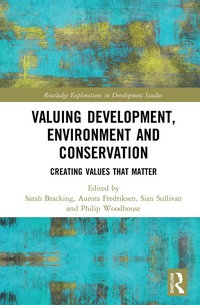
Valuing Development, Environment and Conservation
Creating Values that Matter
1st Edition
Published on 17. October 2018
252 pages
978-1-351-62511-1 (ISBN)
Description

Policy-makers are increasingly trying to assign economic values to areas such as ecologies, the atmosphere, even human lives. These new values, assigned to areas previously considered outside of economic systems, often act to qualify, alter or replace former non-pecuniary values. Valuing Development, Environment and Conservation looks to explore the complex interdependencies, contradictions and trade-offs that can take place between economic values and the social, environmental, political and ethical systems that inform non-monetary valuation processes.
Using rich empirical material, the book explores the processes of valuation, their components, calculative technologies, and outcomes in different social, ecological and conservation domains. The book gives reasons for why economic calculation tends to dominate in practice, but also presents new insights on how the disobedient materiality of things and the ingenuity of human and non-human agencies can combine and frustrate the dominant economic models within calculative processes.
This book highlights the tension between, on the one hand, a dominant model that emphasises technical and 'universalising' criteria, and on the other hand, valuation practice in specific local contexts which is more likely to negotiate criteria that are plural, incommensurable and political. This book is perfect for researchers and students within development studies, environment, geography, politics, sociology and anthropology who are looking for new insights into how processes of valuation take place in the 21st century, and with what consequential outcomes.
Using rich empirical material, the book explores the processes of valuation, their components, calculative technologies, and outcomes in different social, ecological and conservation domains. The book gives reasons for why economic calculation tends to dominate in practice, but also presents new insights on how the disobedient materiality of things and the ingenuity of human and non-human agencies can combine and frustrate the dominant economic models within calculative processes.
This book highlights the tension between, on the one hand, a dominant model that emphasises technical and 'universalising' criteria, and on the other hand, valuation practice in specific local contexts which is more likely to negotiate criteria that are plural, incommensurable and political. This book is perfect for researchers and students within development studies, environment, geography, politics, sociology and anthropology who are looking for new insights into how processes of valuation take place in the 21st century, and with what consequential outcomes.
More details
Series
Edition
1. Auflage
Language
English
Place of publication
London
United Kingdom
Publishing group
Taylor & Francis Ltd
Target group
College/higher education
Illustrations
4 Tables, black and white; 5 Line drawings, black and white; 5 Illustrations, black and white
File size
4,92 MB
ISBN-13
978-1-351-62511-1 (9781351625111)
Copyright in bibliographic data and cover images is held by Nielsen Book Services Limited or by the publishers or by their respective licensors: all rights reserved.
Schweitzer Classification
Other editions
Additional editions
Sarah Bracking | Aurora Fredriksen | Sian Sullivan
Valuing Development, Environment and Conservation
Creating Values that Matter
Book
09/2020
1st Edition
Routledge
€51.98
Shipment within 15-20 days
Sarah Bracking | Aurora Fredriksen | Sian Sullivan
Valuing Development, Environment and Conservation
Creating Values that Matter
Book
11/2018
1st Edition
Routledge
€215.41
Shipment within 10-20 days
Persons
Sarah Bracking is Professor of Climate and Society in the School of Global Affairs, King's College London, UK
Aurora Fredriksen is a Lecturer in Human Geography at the University of Manchester, UK
Sian Sullivan is Professor of Environment and Culture, Bath Spa University, UK
Philip Woodhouse is Professor of Environment and Development, University of Manchester, UK.
Aurora Fredriksen is a Lecturer in Human Geography at the University of Manchester, UK
Sian Sullivan is Professor of Environment and Culture, Bath Spa University, UK
Philip Woodhouse is Professor of Environment and Development, University of Manchester, UK.
Content
List of figures and tables
List of contributors
Acknowledgements
Introducing values that matter
Sarah Bracking, Aurora Fredriksen, Sian Sullivan and Philip Woodhouse
Value(s) and valuation in development, conservation and environment
Sarah Bracking, Aurora Fredriksen, Sian Sullivan and Philip Woodhouse
Part 1: Development
Assembling value for money in the UK Department for International Development
Aurora Fredriksen
The value of human life in health systems and social spaces: the HIV/AIDS context in Zimbabwe
Fortunate Machingura
Valuing infrastructure: competing financial and social valuations in the South Durban port expansion
Sarah Bracking and Aurora Fredriksen
Part 2: Conservation
Bonding nature(s)? Funds, financiers and values at the impact investing edge in environmental conservation
Sian Sullivan
Creating conservation values under DEFRA's biodiversity offsetting pilot and the pragmatics of a using a calculative device
Louise Emily Carver and Sian Sullivan
Part 3: Environment
A crash in value: explaining the decline of the Clean Development Mechanism
Robert Watt
Climate changing civil society: The role of value and knowledge in designing the Green Climate Fund
Jonas Amtoft Bruun
Water values and the negotiation of water use
Phil Woodhouse and Mike Muller
'Some are more equal than others': narratives of scarcity and the outcome of South Africa's water reform
Rebecca Peters and Phil Woodhouse
Conclusion: the limits of economic valuation
Sarah Bracking, Aurora Fredriksen, Sian Sullivan and Philip Woodhouse
Index
List of contributors
Acknowledgements
Introducing values that matter
Sarah Bracking, Aurora Fredriksen, Sian Sullivan and Philip Woodhouse
Value(s) and valuation in development, conservation and environment
Sarah Bracking, Aurora Fredriksen, Sian Sullivan and Philip Woodhouse
Part 1: Development
Assembling value for money in the UK Department for International Development
Aurora Fredriksen
The value of human life in health systems and social spaces: the HIV/AIDS context in Zimbabwe
Fortunate Machingura
Valuing infrastructure: competing financial and social valuations in the South Durban port expansion
Sarah Bracking and Aurora Fredriksen
Part 2: Conservation
Bonding nature(s)? Funds, financiers and values at the impact investing edge in environmental conservation
Sian Sullivan
Creating conservation values under DEFRA's biodiversity offsetting pilot and the pragmatics of a using a calculative device
Louise Emily Carver and Sian Sullivan
Part 3: Environment
A crash in value: explaining the decline of the Clean Development Mechanism
Robert Watt
Climate changing civil society: The role of value and knowledge in designing the Green Climate Fund
Jonas Amtoft Bruun
Water values and the negotiation of water use
Phil Woodhouse and Mike Muller
'Some are more equal than others': narratives of scarcity and the outcome of South Africa's water reform
Rebecca Peters and Phil Woodhouse
Conclusion: the limits of economic valuation
Sarah Bracking, Aurora Fredriksen, Sian Sullivan and Philip Woodhouse
Index
