

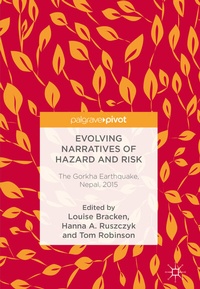
Evolving Narratives of Hazard and Risk
Description

This book presents a range of academic research and personal reflections on the Gorkha earthquake that struck Nepal in 2015. For the first time, perspectives from geography, disaster risk reduction, cultural heritage protection, archaeology, anthropology, social work, health and emergency response are discussed in a single volume. Contributions are included from practitioners and researchers from Nepal and Durham University in the UK, many of whom were in Nepal at the time of the earthquake.
Evolving Narratives of Hazard and Risk explores the event of the earthquake, its consequences and its impacts, to provide a holistic and multi-perspective understanding of this special hazard and its significant ramifications for social, political, economic and cultural aspects of life in Nepal. The book highlights how these multiple perspectives are needed to inform each other in order to develop and shape new ways of thinking and interacting with environmental hazards.
This collection of works will be of interest to students and academics of Environment Studies, Human Geography and Environmental Policy, and will be of particular relevance to those involved in risk research and managing risk and hazard events.
More details
Other editions
Additional editions
Persons
Louise Bracken
is Executive Director of the Institute of Hazard, Risk and Resilience and the Wilson Chair in Hazard and Risk Research at Durham University, UK.
Hanna Ruszczyk
is a Post Doctoral Research Associate in the Institute of Hazard, Risk and Resilience at Durham University, UK.
Tom Robinson
is an Addison Wheeler Fellow in the Department of Geography at Durham University, UK.
