

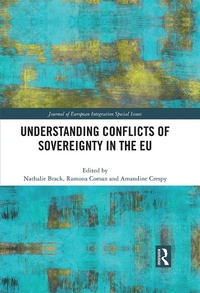
Understanding Conflicts of Sovereignty in the EU
1st Edition
Published on 9. May 2021
150 pages
978-1-000-38512-0 (ISBN)
Description

This book investigates the multifaceted conflicts of sovereignty in the recent crises in the European Union.
Although the notion of sovereignty has been central in the contentious debates triggered by the recent crises in the European Union, it remains strikingly under-researched in political science. This book bridges this gap by providing both theoretical reflections and empirical analyses of today's conflicts of sovereignty in the EU. More particularly, it investigates conflicts between four types of sovereignty. First, national sovereignty referring to the autonomy of the Westphalian Nation-State to rule on a territory delimited by borders; second, the supranational sovereignty acquired by the EU in a fragmentary fashion in a number of scattered internal and external policy fields; third, parliamentary sovereignty understood as the autonomy of parliaments (at the regional, national and European levels) to take part in the decision making process and control the executive in the name of the principles of election and representation; fourth, popular sovereignty whereby the body politic confers legitimacy to decision makers in a democratic system.
Through an analysis of the various crises (rule of law, Brexit, migration, Eurozone crisis), the chapters look at how sovereignty is framed and contested by different types of actors, and how the strengthening or the weakening of certain types of sovereignty contribute to shape preferences regarding policies and governance structures in the multi-level EU.
The chapters in this book were originally published as a special issue of the Journal of European Integration.
Although the notion of sovereignty has been central in the contentious debates triggered by the recent crises in the European Union, it remains strikingly under-researched in political science. This book bridges this gap by providing both theoretical reflections and empirical analyses of today's conflicts of sovereignty in the EU. More particularly, it investigates conflicts between four types of sovereignty. First, national sovereignty referring to the autonomy of the Westphalian Nation-State to rule on a territory delimited by borders; second, the supranational sovereignty acquired by the EU in a fragmentary fashion in a number of scattered internal and external policy fields; third, parliamentary sovereignty understood as the autonomy of parliaments (at the regional, national and European levels) to take part in the decision making process and control the executive in the name of the principles of election and representation; fourth, popular sovereignty whereby the body politic confers legitimacy to decision makers in a democratic system.
Through an analysis of the various crises (rule of law, Brexit, migration, Eurozone crisis), the chapters look at how sovereignty is framed and contested by different types of actors, and how the strengthening or the weakening of certain types of sovereignty contribute to shape preferences regarding policies and governance structures in the multi-level EU.
The chapters in this book were originally published as a special issue of the Journal of European Integration.
More details
Series
Edition
1. Auflage
Language
English
Place of publication
London
United Kingdom
Publishing group
Taylor & Francis Ltd
Target group
College/higher education
ISBN-13
978-1-000-38512-0 (9781000385120)
Copyright in bibliographic data and cover images is held by Nielsen Book Services Limited or by the publishers or by their respective licensors: all rights reserved.
Schweitzer Classification
Other editions
Additional editions
Nathalie Brack | Ramona Coman | Amandine Crespy
Understanding Conflicts of Sovereignty in the EU
Book
09/2023
1st Edition
Routledge
€51.98
Shipment within 15-20 days
Nathalie Brack | Ramona Coman | Amandine Crespy
Understanding Conflicts of Sovereignty in the EU
Book
05/2021
1st Edition
Routledge
€179.51
Shipment within 15-20 days
Persons
Nathalie Brack is currently Assistant Professor in Political Science at the Cevipol - IEE, Universite libre de Bruxelles and Visiting Professor at the College of Europe. Her research focusses on Euroscepticism, the European Parliament, radical parties as well as on political representation and congruence.
Ramona Coman is Associate Professor in Political Science and EU studies at Cevipol - IEE, Universite libre de Bruxelles and President of the Institute for European Studies. Her research focusses on EU integration in relation to the rule of law promotion, tools, actors and challenges. She coordinates the Jean Monnet Module "Rule of law and mutual trust in global and European governance".
Amandine Crespy is Associate Professor in Political Science and EU studies at Cevipol - IEE, Universite libre de Bruxelles and Visiting Professor at the College of Europe. Her work deals with political contention and legitimacy issues surrounding European integration, especially in relation with socio-economic governance in the European Union.
Ramona Coman is Associate Professor in Political Science and EU studies at Cevipol - IEE, Universite libre de Bruxelles and President of the Institute for European Studies. Her research focusses on EU integration in relation to the rule of law promotion, tools, actors and challenges. She coordinates the Jean Monnet Module "Rule of law and mutual trust in global and European governance".
Amandine Crespy is Associate Professor in Political Science and EU studies at Cevipol - IEE, Universite libre de Bruxelles and Visiting Professor at the College of Europe. Her work deals with political contention and legitimacy issues surrounding European integration, especially in relation with socio-economic governance in the European Union.
Content
1. Unpacking old and new conflicts of sovereignty in the European polity
Nathalie Brack, Ramona Coman and Amandine Crespy
2. 'I want my sovereignty back!' A comparative analysis of the populist discourses of Podemos, the 5 Star Movement, the FN and UKIP during the economic and migration crises
Arthur Borriello and Nathalie Brack
3. Contesting EU authority in the name of European identity: the new clothes of the sovereignty discourse in Central Europe
Ramona Coman and Cecile Leconte
4. In the name of 'the people'? Popular Sovereignty and the 2015 Greek referendum
Amandine Crespy and Stella Ladi
5. 'Parliamentary', 'popular' and 'pooled': conflicts of sovereignty in the United Kingdom's exit from the European Union
Chris Bickerton
6. The Court of Justice of the European Union, conflicts of sovereignty and the EMU crisis
Sabine Saurugger and Fabien Terpan
7. The new European Border and Coast Guard Agency: Pooling Sovereignty or Giving It Up?
Denis Duez and Martin Delheixe
8. Safeguarding, shifting, splitting or sharing? Conflicting conceptions of popular sovereignty in the EU-polity
Jan Pieter Beetz
Nathalie Brack, Ramona Coman and Amandine Crespy
2. 'I want my sovereignty back!' A comparative analysis of the populist discourses of Podemos, the 5 Star Movement, the FN and UKIP during the economic and migration crises
Arthur Borriello and Nathalie Brack
3. Contesting EU authority in the name of European identity: the new clothes of the sovereignty discourse in Central Europe
Ramona Coman and Cecile Leconte
4. In the name of 'the people'? Popular Sovereignty and the 2015 Greek referendum
Amandine Crespy and Stella Ladi
5. 'Parliamentary', 'popular' and 'pooled': conflicts of sovereignty in the United Kingdom's exit from the European Union
Chris Bickerton
6. The Court of Justice of the European Union, conflicts of sovereignty and the EMU crisis
Sabine Saurugger and Fabien Terpan
7. The new European Border and Coast Guard Agency: Pooling Sovereignty or Giving It Up?
Denis Duez and Martin Delheixe
8. Safeguarding, shifting, splitting or sharing? Conflicting conceptions of popular sovereignty in the EU-polity
Jan Pieter Beetz
